

Hello and welcome back to Moldova Matters! Today we’re covering part 2 of the Weekly Roundup. If you missed part 1 you can access it here.
Romania Re-enters Political Crisis
On May 5 Romania’s government collapsed when the Social Democrats (PSD) withdrew from the governing coalition of Prime Minister Ilie Bolojan and joined George Simion’s AUR party in a vote of no confidence. The collaboration between a center left party like PSD and far-right AUR has caused alarm in Brussels as the “cordon sanitaire” breaks down and cooperation with a far right party brings down a centrist government.
President Nicușor Dan called for calm stating:
“It is not a happy moment in any democracy. However, it is a democratic decision of the parliament. I call for calm. Romania is a stable state, the state institutions are functioning and Romania has a direction that it is following. There is consensus among the pro-Western parties on the major directions of Romania (...)
We will have a government within a reasonable time, I exclude the scenario of early elections and, I emphasize, at the end of the negotiations, we will have a pro-Western government. (…)
“With calm, we will get through this,”
Meanwhile, George Simion declared that AUR is willing to enter government.
Next there will likely be a protracted series of consultations and negotiations as Romania seeks a stable governing majority.
Romanian MEP Siegfried Mureșan, a major voice in support of Moldova in the European Parliament, spoke of how this turn of events could negatively impact Moldova. He noted that if there is a weak prime minister, then there will still be public support but that “bilateral projects will remain on paper and drag on.” On the possibility of the far right entering government, he went on to warn:
“A prime minister who acts like a puppet, calling himself pro-European but dependent on the anti-European PSD-AUR majority, will not enjoy the trust of Europe. This, unfortunately, will also affect the Republic of Moldova. If the prime minister in Bucharest does not have the trust of the EU, he will not be able to achieve results for Moldova. (…) If Romania has a prime minister who lacks trust, that will be bad news for Moldova as well,”
In April last year I took stock of what challenges Moldova could face if George Simion or AUR came to power in Romania. Here’s a link to that article:

International Affairs News
Here’s a roundup of the other top international affairs stories of the week:
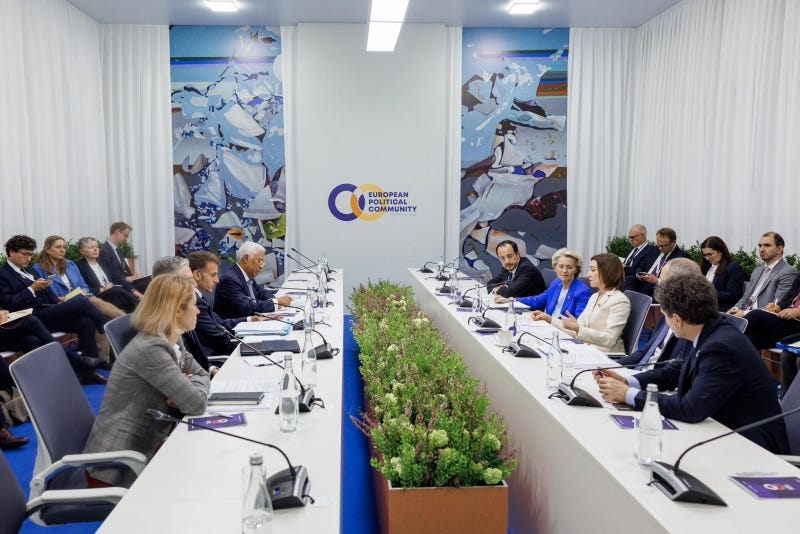
President Sandu attended the European Political Community (EPC) Summit in Yerevan. President Sandu traveled to the event with Romanian President Nicușor Dan and in addition to the summit and bilateral meetings met with leaders of EU countries on the topic of Moldova’s accession. This meeting included Nicușor Dan, French President Emmanuel Macron, Italian PM Giorgia Meloni, British PM Keir Starmer, EU Commission President Ursula von der Leyen and others. While no official readout was given, Romanian President Dan later stated that they anticipate an answer by the end of June on opening negotiating clusters with Moldova. The delay comes as EU leaders discuss Ukraine’s EU bid with Hungary’s new government.
More talk of Union with Romania - in the foreign press. In an interview with Le Monde, President Sandu reiterated her past comments on The Rest is Politics Podcast that joining with Romania would be a faster way to enter the EU. She went on to note that there is no public consensus for this, citing 40% support in Moldova1. Romanian President Nicușor Dan was asked about these comments while on a visit to Croatia and replied citing a 2018 vote in Romania’s parliament that indicated openness to union if Moldova wanted it. Also this week, a recent poll showed that 7 in 10 Romanians would support union with Moldova.
Moldovan Flag Day celebrated in Chicago. Moldova’s flag was raised in the heart of Chicago as the country’s new consulate celebrated the April 27 holiday with State Senators, county officials and members of the diaspora. The event celebrated Moldova’s connections to the local community and the growing and successful diaspora in the United States writ large.

Political Updates
Here’s a roundup of the top politics news of the week:
Parliament votes a new governing regulation in the first reading. The law restructures parliamentary procedure with a few notable changes. Firstly, it seeks to lock in the political configuration of parliament by cracking down on “political tourism.” MPs who leave their parliamentary faction would no longer be allowed to join a new faction or represent a party that was not elected to parliament in the last election. This does not prevent MPs from leaving their party, but makes it harder to consolidate new groupings as became common in the Plahotniuc era2. The draft regulation also defines Romanian as the working language of parliament and would stop the default translation of legislative projects into Russian - leaving translations as an option “when appropriate.” Opposition MPs claimed that this would prevent them from speaking Russian in parliament (it wouldn’t under the draft law) and walked out in protest. The draft regulation would also allocate schedule time to the opposition every 6th week in an “opposition day” where factions in opposition or independent MPs could add items to the agenda.
Parliament introduced legislation to impose oversight on the Commission for Emergency Situations (CSE) and update the definition of states of emergency. Under the draft legislation, Parliament’s Committee on National Security, Defense and Public Order will be able to examine “at any time the executive orders issued by the CSE during crisis situations.” They could then submit reports to parliament which would be able to modify or overturn these emergency government decisions. The draft legislation requires the government to submit a report to parliament at the conclusion of a state of emergency detailing actions taken under emergency powers and their impact. Finally, the law would make the declaration of a state of emergency more flexible by giving the government the option of declaring one with a duration 30 to 90 days. Currently, states of emergency are fixed at 60 days.
Alexandru Machidon3 was sworn in a Prosecutor General. He had been acting Prosecutor General since May 2025 and took office officially on April 30 after passing the vetting commission and getting support from the Superior Council of Prosecutors.
Moldova will lift import duties on a range of American products. 59 MPs voted for the law in the second reading which would exempt most industrial products while retaining protective duties for some agricultural products such as “beef, pork and poultry meat, milk and dairy products, as well as sugar and sugar products.” The stated goal of the legislation is to maintain Moldova’s new 10% tariff rate and “reciprocate” the US lowering tariffs from 25%. As usual with “Liberation Day” none of this is what it seems but I’ll leave that for a footnote4.
Anti-Corruption prosecutors have announced their decision to appeal the sentence against Vladimir Plahotniuc. They will again seek a 25 year sentence saying that “the punishment imposed does not reflect the seriousness of the acts.” Plahotniuc was previously sentenced to 19 years in prison and is himself appealing.
Moldova’s Association of Independent Press (API) reported 97 attacks against journalists in 2025. This is the highest number since 2017 and includes bullying, intimidation, hacking of accounts and other threats - both online and offline. Most serious were 12 physical attacks and death threats. Last week we wrote about the strength of Moldova’s independent press… but also the challenges it faces. If you missed it, you can find that article here:


PPDA and Shor?
Democracy at Home (PPDA)’s candidate for the Orhei Mayor’s election, Victor Perțu, was removed from the race by the Central Election Commission (CEC) for being part of a “camouflaged bloc.” The CEC noted that Victor Perțu was a member of the Shor Party and remained active in the Shor network after the party was declared unconstitutional. Their decision cited an overlap between the Shor network and PPDA and found that Shor candidates were seeking office under a new flag.
This decision provoked outrage among the opposition, including Chisinau Mayor Ion Ceban and Igor Dodon who called the decision political and evidence of a “captured state.” The CEC decision was overturned by the Orhei Court - though the CEC will appeal the decision.
ZdG has made a deep study of events held by Victor Perțu with PPDA leader Vasile Costiuc and found that numerous Shor Party elected officials, activists, defendants in cases of electoral corruption and defendants in cases related to illicit financing and paid protesting, are all present at these events. PPDA claims that the events are open and anyone can come. The story from ZdG is too long to detail here, but is worth reading for those interested.
We’ll be keeping an eye on links between the Shor network and PPDA in the context of this year’s local elections.
Economics & Infrastructure (& Iran)
Here’s a roundup of the top economics / infrastructure / Iran crisis news of the week:
Fuel prices remain volatile. While diesel prices have begun to fall gasoline prices remain high following the protracted uncertainty of the American-Israeli war against Iran. Compared to pre-war prices diesel is 44.58% more expensive while gasoline is 28.98% more expensive. On May 1 Chisinau increased public transport prices by 17% due to “the current situation of practically doubling the cost of fuel.”
The Ministry of Finance says food prices increases are “inevitable” due to the global oil crisis. The Ministry said that the government will not look for short term populist solutions but will take “very targeted” actions including support for agriculture via tax refunds and potential support for inter city transit.
The National Bank (NBM) has increased the base rate from 5% to 6.5%. This was done “out of the need to configure monetary policy in a way that would mitigate pressures on the inflationary process.” NBM now projects annual inflation in 2026 to hit 7%.
De minimis tax exemptions will end October 1. The Ministry of Finance announced this date when the €150 euro tax free package import regime will be eliminated. In 2025 Moldovans received approximately 10 million packages from Temu, Joom, Aliexpress and others.
Moldovan Railways are solvent again. Minister of Infrastructure Vladimir Bolea announced that all employees had been fully repaid wage arrears and that the company had eliminated its historical debts by the end of April.
Ending on a High Note
On May 7 the Moldovan pavilion at the 61st Venice Biennale officially opened. The Biennale is an international art and culture exhibition hosted every 2 years in Venice Italy since 18955. This marks the first time Moldova has participated in this event - sometimes called the Olympics of the art world. Moldova’s Minister of Culture Cristian Jardan called the country’s participation in the event a “significant moment for the country's cultural diplomacy.”
Moldova’s exhibit, titled “On the Thousand and Second Night” was created by artist Pavel Brăila and consists of numerous traditional carpets floating between the floor and ceiling supported by drones. It is described as “neither a refuge nor an escape from the ongoing war on life, but a way of making evident the power of imagining other possible exits.”
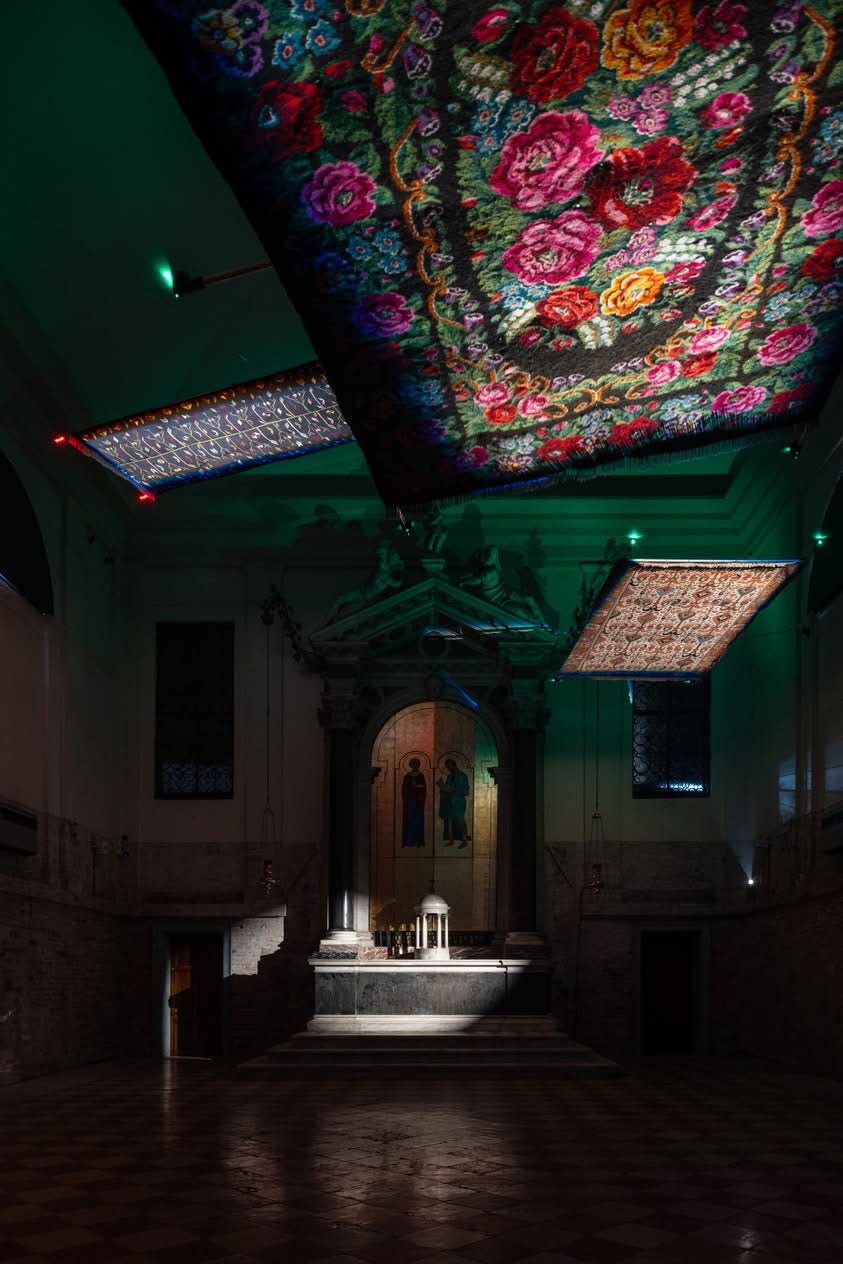
The exhibit is open to the public and can be visited until November 22, 2026. You can find more information on the official website here.
Probably high. Most polls come in at 30% but there has been a moderate uptick recently.
Plahotniuc, and later Shor, would “buy” MPs with bribes or coerce them via blackmail to leave their parties and join oligarchic political factions.
Alexander the Macedonian - strong name. If Machidon was your last name and you chose to name your kid Alexander then you must believe him destined for great things.
Initially Trump slapped Moldova with a 33% “Liberation Day” tariff that was based on some objectively terrible math. That was later reduced to 25% which still left Moldova as the country with the highest tariff rate in Europe. The reduction to 10% came when the Supreme Court ruled that all of this was unconstitutional. Trump then imposed the 10% global rate under a different power which is time limited for 150 days. Moldova passing legislation to “reciprocate” this 10% is basically just signaling to DC that they are trying to reach a good outcome for everyone. Meanwhile, a court has just knocked down the 10% tariffs as well…
Excepting a few wars and pandemics which upended the schedule.