

Hello and welcome back to Moldova Matters! Last week I was busy reporting out a new investigation into some of the familiar figures behind the new US NGO the “US Moldova Initiative” and their efforts to organize a privately funded Congressional Delegation to Moldova. If you haven’t read that story, you can find it here.
Today we’re going to start getting caught up on the other critical stories of the last week - but due to the volume of news we’ll split the Weekly Roundup into 2 parts. In Part 1 we’ll look at the biggest stories of the week and in Part 2 we’ll do a roundup of the many smaller - but equally important updates. You’ll have Part 2 in your inbox tomorrow.
Moldova Participates in Major Prisoner Exchange with Russia / Belarus
On April 28 the news broke that Moldova was a participant in a high level prisoner swap involving the intelligence agencies of 7 countries. Five prisoners “convicted” of espionage by Russia or Belarus were swapped for 5 persons held by EU countries and Moldova. While much of the news focused on the prominent Polish-Belarusian opposition journalist Andrzej Poczobut who was freed in the exchange, Moldova was notable for being responsible for 4 of the 10 prisoners exchanged - trading 2 and getting 2 back.
Two agents of Moldova’s Security and Intelligence Service (SIS) were returned home as part of the swap. In exchange, Moldova freed Belarusian spy Alexander Balan and Nina Popova.
Alexander Balan was the former deputy director of SIS during the Plahotniuc period. He was since arrested in Romania and charged with treason1 on accusations of passing intelligence to Belarus. Nina Popova is the wife of a Russian soldier serving in Russian army formations in Transnistria who was sentenced to 1 year in prison in October 2025 for attempting to bribe a border guard. After flying from Istanbul to Chisinau she was told that the was banned from entering the country, after which she attempted to slip the customs officer $300 in her passport and was arrested.
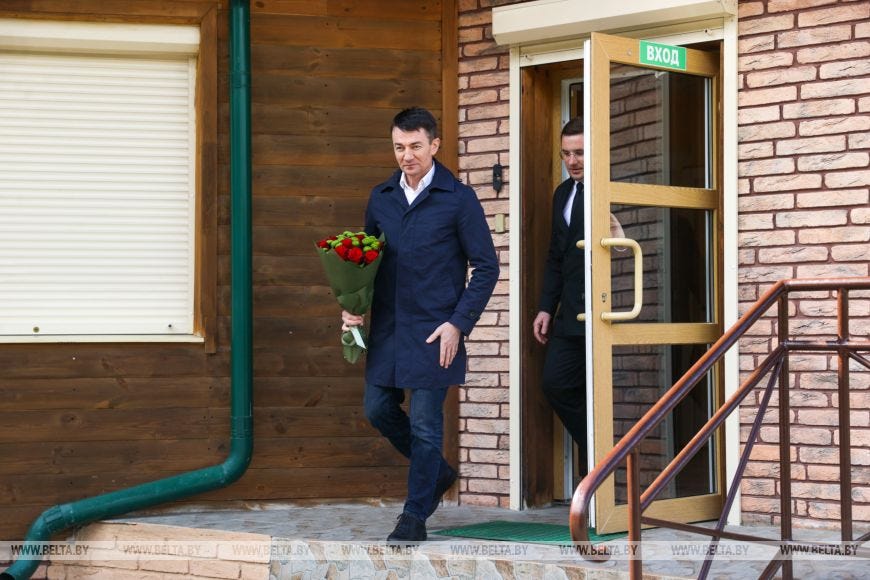
Upon his arrival, Belarus welcomed Alexander Balan with flowers from members of the State Security Committee of Belarus. State media celebrated the return of “Belarusian spies Alexander Balan and Vladislav Nadeiko.”
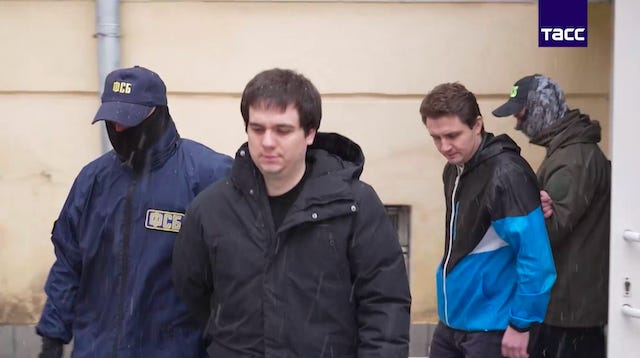
Russia’s state news agency TASS published video of Moldova’s SIS operatives being led by FSB agents to the exchange.
SIS Director Alexandru Musteață commented on the return of the men saying:
“Our officers, two young, dedicated and patriotic officers, went there on a secret mission, the details of which I cannot confirm or provide. Unfortunately, the mission failed, they were captured, which is why we have an internal investigation and an internal assessment of this fact. We started it the moment they (SIS officers, no.) were captured. We started the internal investigation from the beginning. We have completed 99% of the entire assessment. What remains are their statements. Now that they are home, they are safe, my colleagues will talk to them to create the picture - what happened that this operation failed and we will make a decision”
He noted that the 2 men were undergoing medical checks and will return to service in a non-clandestine role.
Commenting on the exchange President Sandu stated:
“It was a complicated operation, we had the support of the institutions of the United States, Romania, Poland. A lot of work was done, there were many risks and I repeat, I am glad that in the end we managed to make this exchange and that these two citizens of the Republic of Moldova, people of good faith, loyal to our state, are home safely and I hope that their health is also good. They are going to undergo some tests to make sure that everything is fine,”
On May 10, President Trump posted on Truth Social about the exchange writing
“We have just secured the release of three Polish citizens and two Moldovans from Belarusian and Russian detention. Thanks to my special presidential envoy, John Coale, we were able to exert serious pressure for this release to take place.
My friend, the President of Poland, Karol Nawrocki, met with me last September and asked me to help release Andrzej Poczobut from a Belarusian prison. Today, Poczobut is free thanks to our efforts.
The United States stands with its allies and friends. I thank President Aleksandr Lukashenko for his cooperation and friendship,”
Analysis of the Prisoner Exchange
According to reporting this operation was incredibly complex and involved coordination among multiple Western intelligence services. Alexander Balan was released by Romania while still pending trial into Moldovan custody so that he could plead guilty and be pardoned (for crimes in Moldova) prior to being repatriated to Belarus. American Special Envoy John Coale apparently helped coordinate the effort alongside the intelligence agencies of US allies and Moldova. This is the first time that Moldova participated at an organizational level in a coordinated effort of this kind, and it marks a clear signal that Moldova’s intelligence agencies are operating closely with partners in complex operations.
While it is unlikely that Russia would have ever dealt bilaterally with Moldova on an issue like this, it is notable that Moldova’s release of 2 of the 5 prisoners held in the West was a key enabler of the broader operation. Most importantly, the Moldovan authorities were able to bring the 2 SIS operatives home safely.
Sheriff’s German Companies
RISE Moldova reported on a network of German companies owned by the Sheriff corporation and its founder Viktor Gushan. The network of companies came to light after Der Spiegel reported millions of euros of tax evasion by 2 media companies - Kartina Digital GmbH and Kartina TV - both with connections to Sheriff Holding.
These companies, which provide Russian language TV streaming services, were part of a large network uncovered by RISE including companies trading in textiles, real estate, media, advertising, software development and more. Kartina Digital GmbH alone was found to have underpaid taxes by €39 million euros in the years 2010 - 2019. The company is also involved in an ongoing lawsuit in the United States with American company Actava, which is seeking $25 million in damages for fraud and breach of contract.
Gushan’s TV stations promised 200 Eastern European channels in a streaming package targeting Russian speakers in Germany, the US, Israel, Canada and other parts of Western Europe. Previous investigations have shown that some of these stations broadcast AfD political advertisements for Russian speakers in Germany.
The investigation by RISE is a reminder that while Viktor Gushan controls almost the whole economy of Transnistria, and is alleged to control much of the region’s “government,” he has not yet been sanctioned by Western government for the political oppression or human rights abuses endemic in the region.
Other Transnistria Updates
Here are the other important Transnistria related updates of the week:
Ukraine is strengthening their defensive lines on the Transnistrian border. Ukraine’s local commanders posted pictures of the new lines and noted that they…
“will allow the construction of a staggered defense system, capable of promptly reacting to any provocations or obvious manifestations of aggressive actions from the self-proclaimed unrecognized satellite of the Russian Federation”


Transnistrian “President” Vadim Krasnoselsky commented on the increasingly threatening rhetoric from Russia. His comments follow Russian media and diplomatic sources alleging that Moldova is considering a military resolution to the conflict and threatening responses. Krasnoselsky responded to this saying:
“I still believe in prudence and common sense. No matter how complicated our relations may be, I still believe Moldovan politicians. I believe that they are telling the truth and that they are opposed to a forceful solution to the Transnistrian issue. Of course, there are many nuances: Moldova’s armament, and the special units participating in NATO programs. But that aside, I believe the Madam President when she says she does not want to resolve the Transnistrian issue by military means. And for that, unequivocally, of course, we thank them,”
Parliament passes law imposing taxes on Transnistria. On April 30 parliament passed the law in the final reading which will phase in equal taxes for companies operating in the Transnistrian region. Taxes will first be applied this year to non-essential products such as alcohol, but will then be gradually phased in and cover all products by 2030. In the original draft, the law envisioned adding VAT taxes on natural gas purchases and balancing electricity by June 2026. The final bill pushed this back and allows the government to establish tax rates in these areas starting in August 2026 based on the progress of negotiations - essentially providing the government a tool of economic leverage. Taxes collected under this law will go into the “convergence fund” and begin funding Moldova’s broader strategy of convergence. Transnistria’s Supreme Soviet sent an official letter of protest to Speaker of Parliament Grosu objecting to the law as taxation without representation2 and highlighting how new taxes will further damage the already crippled regional economy.
Proekt Reports Abramovich is A7’s “Krisha”
Investigative journalists at the Russian outlet Proekt (“Project”) released an investigation into the vast and growing network of payment facilitation companies working to circumvent sanctions against Russia. They showed that all manner of transactions - from facilitating the purchase of Russian gas deliveries to Turkey, to allowing individuals to bypass Bank of America due diligence to buy a Cybertruck, now pass through this opaque network of operators. Proekt reports that the FSB “gets income from each operation” and that Ilan Shor’s A7 companies sit at the center of the web.
Moldova Matters has previously published reporting and analysis on Shor’s A7 companies and his A7A5 cryptocurrency. You can read about how this was used as infrastructure for election interference efforts here:

Proekt reported that Russian oligarch Roman Abramovich has close links to Shor’s A7 companies and according to their sources serves as the operation’s “krisha and sponsor.” In Russian slang, “krisha” or “roof” is the person or organization under which criminal activity is conducted and protected politically. In this formulation Abramovich is both Shor’s protection, patron and in some sense partner. According to Proekt’s source, Abramovich chose Shor for his ability to “build schemes.”
They further report that when Shor flew to Moscow from Israel in November 2023 he did so on a plane owned by Abramovich and that A7 has offices in multiple buildings owned by the Russian oligarch. Representatives for Abramovich deny these connections and any connections to Shor more generally.
In their reporting, Proekt puts A7 at the center of Russia’s sanctions evasion financial architecture, with their sources claiming that they now have a 15% share of all cross-border financial transactions. The report connected A7 to at least 25 companies under US and EU sanctions - including manufacturers of military drones and armaments.
This reporting is the first to publicly confirm rumors of a connection between Abramovich and Shor. It also highlights how his A7 network continues to grow and facilitate sanctions evasion efforts as well as to help finance Russia’s war efforts.
Europe Day and Victory Day
On May 9 Russia and many countries of the former Soviet Union celebrate “Victory Day” and the end of the second world war (for Russia). This year Moscow did not see any of the normal pomp and circumstance - namely tanks and ballistic missiles on parade in Red Square. Instead the holiday saw a more muted parade held under the shadow of potential Ukrainian drone attack.
In Moldova, this holiday has become a symbol of geopolitical tension, with pro-Russian politicians and activists dressing up in WW2 uniforms and proudly displaying Russian and Soviet military symbols. On the other side people celebrate Europe Day, the European Union’s holiday which marks the end of the war and the transition to peace in a united Europe.


Visiting Chisinau on May 8th, High Representative for Foreign Affairs and Vice-President of the European Commission Kaja Kallas spoke alongside President Sandu and outlined how this holiday is seen in countries formerly occupied by the Soviet Union saying:
“I come from a country where there were different communities and different approaches to May 9th. We discussed why we couldn’t celebrate May 9th as Victory Day. If, after May 9th, when the war ended, Stalin had said: you are free, you can live in freedom and independence, we would also have celebrated that day as Victory Day. But since that was the day the atrocities began for my country, we cannot celebrate May 9th as Victory Day. I’m glad we have different pasts, but we need to focus on a common future, and that’s what Europe Day means,”
On May 9th President of Cyprus Nikos Christodoulides visited Chisinau and hailed Moldova’s progress since June 2022. He stated that “The main objective of the Cyprus Presidency [of the Council of the European Union] remains the official opening of the negotiation chapters starting with cluster no. 1 in June itself.”
Speaking on May 9th to an academic conference of more than 1200 of Moldova’s history teachers, President Sandu spoke to the 2 observances of the same holiday saying:
“Yes, May 9 is Victory Day. We must respect and honor the memory of those who fought and died in World War II. But history didn’t end in 1945. Afterward, a regime began that brought deportations, organized famine, repression, fear, and attempts to suppress our national identity. Therefore, we must not confuse the memory of the war’s victims with the glorification of the Soviet regime. (…) At the same time, it is important to understand that there is no contradiction between Victory Day and Europe Day. The European project emerged as a response to the devastating consequences of war and totalitarianism,”

Balan is a dual Moldovan-Romanian citizen.
Remember - these taxes apply to Transnistrian companies registered in Moldova. Taken from their stated view - aka that they are an independent country - this is like a German opening a business in Chile and claiming they should be tax exempt because the owner of the company is not a citizen. Never mind that the company is registered in Chile and operates in Chile. As I have written before, the entire Transnistrian system requires serious contradictions that are no longer tenable - economically or politically.