

In 1993, as nations emerged from the collapse of the Soviet Empire and a wave of democratization movements swept across Africa, the UN General Assembly declared May 3 to be World Press Freedom Day. On this day the free press is celebrated and many organizations raise awareness of threats to a free press around the world.
Each year Reporters Without Borders (RSF) publishes a global press freedom index that assesses nations on a 0 to 100 point scale - taking into account legal protections for journalists as well as other factors including intimidation and censorship. Countries are ranked and broadly grouped into 5 categories - “Good,” “Satisfactory,” “Problematic,” “Difficult” and “Very Serious.” The 2026 index is quite a warning - global press freedom is at a 25 year low. For the first time in the history of the index 50% of countries globally fall into the categories of “Difficult” or “Very Serious.”
In this time of retreat for freedom of speech and the press around the world, Moldova stands out as a rare good news story. The country climbed 4 places to rank at 31 globally. That puts Moldova as the only EU candidate country ranked as “Satisfactory” and the only country in the region with that rank - surpassing Ukraine (ranked 55), Romania (49), Bulgaria (71) and others.
The ranking puts Moldova in the middle of Europe and far ahead of the United States (64) which RSF notes is “experiencing a significant and prolonged decline in press freedom.”
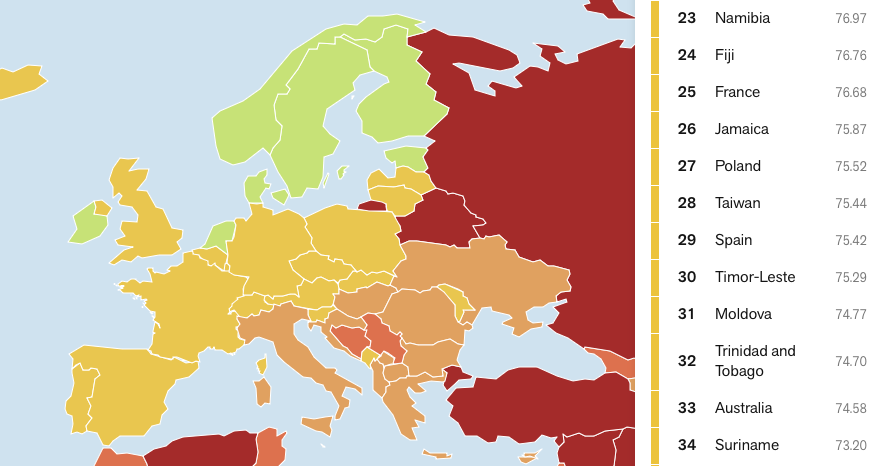
Good Signals - But Still a Challenging Situation
In Moldova there is a sense of pride that the nation has managed to climb the ranking in a year that saw some of the most profound attacks on both the country’s information space and democracy as a whole. The fact that Moldova ranks higher than numerous EU member states and all EU candidates is rightly a point of pride and a real accomplishment in this context.
At the same time, Moldova’s independent press faces huge challenges. Marking the occasion ZdG writes:
“the free press operates in an increasingly complicated environment, marked by increasingly frequent misinformation, pressures, and limited resources”
These challenges - especially in the context of information warfare, were also highlighted by President Sandu’s statement on the day where she wrote:
“A democracy can endure only if there are courageous, fair, and dedicated journalists. On the occasion of International Press Freedom Day, I thank all media professionals in our country who, through their efforts, have contributed to strengthening resilience and defending democracy, in the face of unprecedented attacks on the Republic of Moldova’s right to decide its own future.
It is encouraging that the seriousness of our press is reflected in the evolution of the Press Freedom Index of the organization “Reporters Without Borders” (RSF), where our country has risen this year by four positions, reaching 31st place. We have thus achieved the best score among countries seeking accession to the European Union and are the only country in the region classified as “satisfactory.” However, there is still much work to be done, especially in countering increasingly sophisticated tools used to spread falsehoods and disinformation aimed at manipulating public opinion.
Freedom of expression cannot be equated with the freedom to spread lies, and protecting the truth remains a responsibility of society as a whole. To defend our values, it is essential to build strong cooperation between the press, institutions, and citizens—based on trust, mutual respect, and an unequivocal commitment to democracy and the common good.”
It is critical that Moldova’s free and independent press be strong enough to hold the government to account and to provide citizens with factual information in the context of Russia’s ongoing attacks on the country’s information space. Among the biggest challenges to this is what ZdG called “limited resources” - a turn of phrase that greatly understates the challenges that media organizations face.
In Moldova, the most sustainable independent media organizations rely on grants for around 70% of their operating budgets. Many smaller investigative or regional media outlets rely on grants for more than 97% of their budgets. The destruction of USAID and serious damage to the National Endowment for Democracy (NED) by DOGE in the United States removed core institutional funders in this space. In 2025 the European Union as well as member states rushed to fill these funding gaps in the context of Moldova’s elections.
This very needed support only highlighted how fragile the finance of Moldova’s independent press is. With global crises popping up almost weekly, there is no certainty that 2026 will see the same level of support. Long term, media organizations know that funding of this kind will fall greatly when Moldova joins the European Union and no longer has access to funding from development partners in the same way. This year’s RSF Press Freedom Index was a great sign of Moldova’s progress, but serious challenges remain.
How You Can Help
In 2025 I co-founded a US NGO (501c3) called the Moldova Resilience Fund (MRF) as a way to support independent media and civil society organizations that support Moldova’s democratic resilience.
Note: MRF is completely independent of Moldova Matters and no donations support the work of this newsletter or my work in any way.
Since launching in November, MRF has raised $39,800 from 43 donors and distributed $11,500 in flexible grants to local organizations. You can read a report on our activities in the MRF Q1 update on our website here.
While MRF is a new organization with an all volunteer executive board, we have been busy meeting with media organizations and NGOs in Moldova to figure out how a small player like us can have the biggest impact. Members of our team have also been meeting in the United States with diaspora groups and individuals who care about Moldova’s democratic future to discuss ways that they can get involved. Based on these discussions, we’ll be announcing more of our 2026 programming soon - if you want to stay in the loop sign up for our mailing list here.
Right now, the Moldova Resilience Fund is the only tax-deductible 501c3 organization in the United States that raises money specifically to support local organization in Moldova that provide fact based coverage of important events, conduct investigations and otherwise support the country’s civil society in these challenging times. If you find this cause important - consider making a donation to the Moldova Resilience Fund here:
For US citizens or residents donating to a 501c3 like MRF is often the most convienent way to support a cause you believe in. But giving directly to local organizations that you want to support is also a really good option. On the MRF website we’ve compiled a list of some of the independent media organizations that we feel have the highest impact because of their fearless coverage and detailed investigations. MRF subscribes to these organizations on Patreon and shares the list to encourage those who want to make a monthly small dollar donation to do so directly - you can view our list as well as links for how you can support them here.
Other Ways to Help MRF
The Moldova Resilience Fund is a startup - and we’re always looking for dedicated people with out-of-the-box ideas for how we can be more effective. MRF will expand our board this year and we’re specifically looking for people with US non-profit experience willing to provide strategic advice - and for people with a background in providing on-the-ground support for independent media organizations in places like Moldova.
If you have ideas, want to get involved or otherwise want to reach out - drop me an email here:
david@moldovaresilience.org
Final Thoughts on World Press Freedom Day
As I reflected on the RSF index and what World Press Freedom Day means in 2026, my mind was drawn to the cascade of bad news we are getting from a world that keeps slipping deeper into crisis. These are truly unprecedented times - wars are spreading at the same time as social media pumps disinformation into our national and international discourse. This disinformation fuels the profits of social media companies at the same time as legitimate advertisers pull their placements with independent media in favor of facebook, YouTube and Tiktok. This is a vicious cycle that starves the free press of resources at the same time as it fuels disinformation.
Against this backdrop, we are also contending with a new age of AI that promises to fundamentally disrupt how we interact with information - with both positive and negative effects.
The role of independent journalists doing public interest reporting and investigations has never been more important. I’m not the sort of person who romanticizes this work - and I know that far too many journalists are not reporting without fear or favor and are themselves driving agendas. But I also know that the hard work that goes into uncovering the truth in a complicated world has a profound positive impact on our democracies. In Moldova, there is a vibrant free press that has made a huge impact in a time of hybrid war and democratic backsliding globally.
So for me, today is a day to honor those who do the work - but also to support them.
Sincerely,
David Smith
As a working journalist, I can only salute the work you are doing to support the journalists of your adopted country. So, cheers!