

Hello everyone and welcome back to Moldova Matters. I hope those who celebrate had a good Easter and everyone else enjoyed a day (or in Moldova, week) off. While I was gone I shared a few stories including 2 related to the recent April 7 anniversary - one from Daniel Vodă and one from Cristina Panaguta. For those who enjoyed those pieces, but want to know more about the events of April 2009, check out this podcast I recorded on the topic:

Lots of news happened while I was on a short vacation so today’s update is a bit long - but I really encourage you to grab a coffee and dig in because there was lots of important news.
The State of Emergency in the Energy Sector to Continue
After initially indicating that he would ask parliament to lift the State of Emergency, Prime Minister Munteanu convened the National Crisis Management Center on April 2 and announced that the State of Emergency will continue. Following the repair of the Isaccea-Vulcănești high voltage line, the energy system remains unstable as engineers check the repair and make adjustments. At the same time, April-May is a critical time in Moldova’s energy sector as the Thermoelectric plants will soon cease central heating and return to summer mode - causing a loss of around 50% of domestic energy production.
Moreover, the authorities particularly highlighted the crisis caused by the War in Iran. With the country 100% reliant on fuel imports, the decision to maintain the State of Emergency will also let the government adapt quickly to this new and larger crisis. The temporary cease fire between the United States and Iran caused diesel prices to fall slightly, but uncertainty remains after talks in Pakistan failed to find a solution over this weekend.
Moldova’s Ministry of Defense announced that all Moldovan soldiers deployed as part of the United Nations Interim Force in Lebanon (UNIFIL) are safe. Moldova has 32 peacekeepers deployed in south Lebanon with UNIFIL where they are serving alongside the Italian Army.
With these crises as a backdrop, Moldova announced a major milestone in the shift to renewables this week. The country has now exceeded 1 GW of installed renewable capacity, of which 73% is solar and 25% wind. The Ministry of Energy made the announcement stating:
“In the last five years, installed capacities have increased 13.23 times. Compared to 2020, when the total installed was only 77.37 MW, there is an increase of 946.05 MW, with 2025 playing a decisive role in this evolution,”
The Government Presents their Concept for LPA Reform
Alexei Buzu, Secretary General of the Government, unveiled the high level concept for the promised Local Public Administration (LPA) reform. He announced 4 objectives for the reforms, namely:
Strong mayors through administrative-territorial consolidation
Strong mayors through increased financial autonomy
Strong mayors through real institutional capacity
Strong mayors through transparency, accessible services and involved citizens
Essentially, they hope that efforts to create larger local government units will strengthen capacity and services at the local level. In order to accomplish these goals, the government laid out 3 high level changes:
Voluntary amalgamation. The government has set a goal that no local authority (towns and villages) should have fewer than 3000 residents by 2027. Currently, 87% of town halls have fewer than 3000 residents. Buzu noted that 310 local councils are already starting the voluntary amalgamation process. At the same time, parliament is voting on legislation to simplify this process further. The reform plan provides for financial incentives for LPAs that chose to merge. Forced mergers for those that don’t is not spelled out but is heavily implied.
Reducing the number of districts from 32 to 10. Moldova’s 32 raions (districts) would be replaced with 10 larger districts which Buzu said would be engines of regional development - managing roads and common infrastructure.
Elevating Taraclia to a municipality with sub-LPAs. Essentially, the town government of Taraclia would be merged with the current Raion (district) government of Taraclia. Other towns and villages in the region would retain their local government. This would make the region something of a hybrid district-municipality. This special case is likely related to local demographics (see footnote1).
Secretary General Buzu explained the 3000 resident threshold saying:
“In the Republic of Moldova, out of 10 families that do not have sewage, 8 are in municipalities with a population of less than 3,000 inhabitants. Out of 10 families that do not have a water supply connection, 7 are in municipalities with a population of less than 3,000 inhabitants. This is the reality ,”
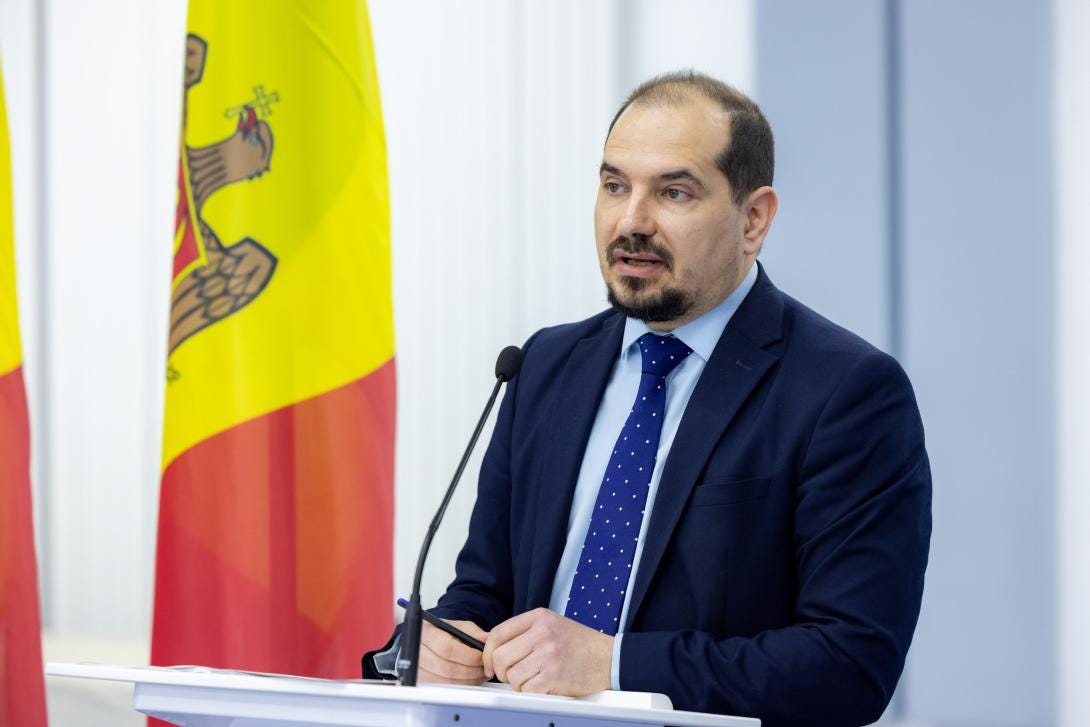
rnment. Photo source Moldovan GovernmentHe went on to note how important it is for LPAs to have more capacity and expertise in order to attract funding through EU accession mechanisms and to implement local projects.
Business leader Vasile Tofan2 has emerged as a major critic to the proposal which he called “much too timid” and “too small for the size of the problem.” He stated:
“Local taxes in a town hall of 3-4 thousand people barely cover about 60% of the cost of the fiscal apparatus that collects them. In other words, almost 2 out of 3 lei in taxes are expenses on tax collectors - an absurd model ,”
Tofan went on to note that Romania averages 6000 residents per LPA and that these are going bankrupt. The country is exploring a move to a minimum of 18,000 residents. He explained:
“In other words, we are deliberately undertaking a very politically costly reform, unpopular anyway, in order to amalgamate at a level that was bankrupt from the start. What is the point of these costs then?”
Recent polling from IMAS has shown that 42% of citizens disapprove of the merging of city halls compared to 22% who consider is somewhat necessary, 18% who consider it important and only 7% who consider it extremely important. 65% oppose the merging of districts while 24% were in favor. The Socialist Party has called on the government to hold a referendum on the final plan.
Recall, Moldova Matters published an op-ed from Vasile Tofan on the subject in March:

News and Politics
Here’s a roundup of the top politics stories of the week:
On April 2 parliament formally denounced Moldova’s membership in the Commonwealth of Independent States (CIS). The degree was immediately promulgated by President Sandu. Parliament cited Russia’s failure to uphold the CIS agreement by invading Georgia and Ukraine while maintaining illegal troop deployments in Moldova. This is the biggest step so far in Moldova’s attempts to remove itself from the 1991 agreement and its many sub agreements.
Mayor Ceban announced that his MAN party was withdrawing from the Alternative Bloc. At the same time the party will remain in the Alternative Faction in parliament. Explaining the reason he stated “We dissociate ourselves from any actions and statements that contradict the interests of the people and the course of European integration.3”
Moldova fell in the EIU Democracy Index, published by the Economist, from a “flawed democracy” to “hybrid regime.” The index measures various factors across 167 countries and did not publicly explain the change for Moldova or detail the methodology. The news caused lots of opinions and assessments in Moldova, with opposition parties celebrating and repeating lines about PAS capturing the state. Analysts suggested that the change was likely the methodology’s failure to account for hybrid attacks and the government’s response. IPRE Director Iulian Groza explained:
“In other words, a country that actively defends itself against hybrid aggression paradoxically pays a methodological price in the index for its own defensive measures,”
Scandal at MediaCor - Yuri Dud’s interview with Denis Kapustin. Russian YouTuber Yuri Dud interviewed the leader of the Russian Volunteer Corps at the media center located on the State University campus. Kapustin is banned from the Schengen area and has been widely described as a neo-Nazi. His volunteer corps fights for Ukraine with a manifesto focused on overthrowing Putin and creating a Russian ethnostate. The Ministry of Education promised an investigation into how the interview took place at MediaCor, while the center’s management put out a statement saying that they do “not intervene in the selection of guests or in the editorial content of the materials produced” in the center.
No Easter benefits this year. Minister of Labor and Social Protection Natalia Plugaru answered a reporters question on the topic saying that the focus was instead on winter heating compensation. Last year (an election year) more than 230,000 people benefited from one time holiday payments of between 1500 and 5000 lei. Meanwhile, Alexandr Stoianoglo proposed a bill in parliament to give an Easter Amnesty and drop all charges and fines related to electoral bribery and vote selling. While he couched the bill in religious terms, it was hard to avoid the fact that these voters were largely bribed by the Shor network to vote for him.
PPDA connections with Shor? Vasile Costiuc’s Democracy at Home (PPDA) party announced that their candidate for Orhei Mayor this year will be Victor Perțu. This means that Unionist party PPDA is running a former senior member of the Shor party and campaigner for the Pobeda Bloc in one of the most significant mayor’s races in the country. Costiuc initially dodged questions about the nomination before giving this answer filled with confusing and unsubstantiated allegations:
“if the man is not officially banned from holding office, if he is not convicted, if he has not stolen and is not under criminal investigation, I do not see the logic in talking about a man who, what did he do? Carp and Maia Sandu participated in the theft of the billion”
Minister of Finance Andrian Gavriliță announced that the President and Prime Minister are getting a raise. Currently President Sandu is the lowest paid head of state in Europe with a salary of just 22,000 lei / month. The Prime Minister currently earns 17,000 lei. In the last PAS term, salaries for ministers and other high level officials were raised but these top positions were skipped due to political sensitivities. The Socialists and other opposition parties regularly call for ministers to earn no more than a minimum pension. Responding to this expected criticism, the Minister of Finance stated that a “worthy country cannot pretend that politicians do not need salaries. I propose to citizens to beware of politicians who tell them that they will work even without salaries.”
International Affairs
Here’s a roundup of the top foreign policy stories of the week:
Europe has woken up to a future without Viktor Orban. Responding to the landslide victory of pro-EU reformer Peter Magyar, President Sandu posted congratulations writing:
“Moldova looks forward to accelerating our partnership with Hungary — building on the friendship that unites our people — and to working together for a stronger, more united, resilient Europe.”
US Senator Jack Reed (D-RI) visited Chisinau on a working trip. The ranking member of the US Senate Armed Services Committee met with President Sandu and discussed the regional security situation, EU integration and joint US-Moldovan projects.
A group of opposition MPs traveled to Georgia to meet with parliamentary factions and the Georgian Dream government. The group included Igor Dodon, 2 other socialist MPs, an MP from Alternative and Vasile Costiuc of PPDA. PAS and Our Party declined to join the delegation. Following meetings, Igor Dodon suggested that Georgia’s political situation4 “is a good example, which Moldova should follow.”
Transnistria and Security News
Here’s a roundup of the top security stories of the week:
Mihail Podoleak, advisor to President Zelenskyy, confirmed that mines were placed on some parts of the border with Transnistria. He explained that this was a precaution against Russia being tempted to use the region to conduct strikes against Ukrainian infrastructure and logistics.
On April 3 another Russian drone entered Moldovan airspace before returning to Ukraine.
The “authorities” in Tiraspol premiered a new “documentary” titled “The Transnistrian People: Forged Over the Centuries.” The propaganda film, largely made with AI, sought to position the “Transnistrian people” at the center of various major historical events in Europe.
Former Transnistrian official Ruslan Mova was denied entry into Moldova. Mova is the former head of the region’s Ministry of Internal Affairs and was one of 9 regional officials stripped of their Moldovan citizenship by President Sandu in February. The motivation for Mova was his direction of, and participation in, the imprisonment of political prisoners and repression against the population. He left Chisinau on a Ukrainian passport and was stopped on March 30 trying to renter the country. With Moldova controlling 100% of the active “border crossings” into Transnistria, this means that officials who lose their citizenship due to human rights abuses risk either being trapped in the region, or trapped outside of it.
Ion Chirița and Nikita Sirenko were convicted and sentenced in relation to their participation in training camps in Serbia and Bosnia and Herzegovina. The men were part of Shor’s efforts to prepare for mass riots and violent demonstrations around the 2024 presidential elections. In particular, they were trained in piloting and using military style drones and making explosives and incendiary devices. The men admitted their action but claimed they were patsies for others. Ion Chirița was sentenced to 3 years in prison, suspended, and Nikita Sirenko was sentenced to 3.5 years with 3 years suspended. Sirenko, a Finnish citizen, will be expelled from Moldova at the end of his sentence.
The US Department of Justice alongside European partners including Ukraine and Romania dismantled a worldwide network of infected home routers. The hack, directed by Russia’s GRU, used DNS poisoning to monitor traffic and create phony websites in order to capture login details and monitor messaging and emails. If you want to read more about this tactic, and how it was used to attack Moldova’s elections, see my recent report:

Economics and Infrastructure
Here’s a roundup of the top economic stories of the week:
Moody’s has upgraded Moldova’s credit rating from B3 to B2. This is the highest credit rating for the country in 25 years. The company cited ongoing reforms, progress on EU accession and a “demonstrated an increased capacity to respond to shocks” - noting particularly the pivot away from Russian energy, efforts which they say have “contributed to an overall reduction in Moldova’s political event risk from previously very high levels.” New reports show that Moldova’s external debt was €10.11 billion euros as of December 31, 2025. This is up 2.4% since 2024 but down 2.7% as a percent of GDP. The vast majority of these loans are long term and at favorable interest rates from the IMF (27%), World Bank (26%), European Commission (15%), EBRD (7.8%) and others.
The Ministry of Finance will delay VAT taxes on small imports until Fall. The imposition of VAT on parcels under €150 euros was planned to come into effect in July but has now been moved with a planned testing period in September and full implementation in October.
Parliament is working to replace the Prima Casa (First House) program. High demand has led to the year’s funds for the program already being depleted on April 1st. Prima Casa is a subsidized preferential mortgage program with lower rates and a minimum down payment. The program will continue through banks, but government funds for additional subsidies for first home buyers are depleted. Critics of the program and its expansion under the last parliament say that it created demand for housing exceeding the supply resulting in a run up in pricing. That happened, and now the real estate market has essentially stalled with Q1 sales down 80% year on year. Chair of the Parliamentary Committee on the Economy, Budget and Finance, Radu Marian stated that the program “must be replaced with a mechanism that will stimulate the construction of new affordable apartments, rather than create pressure on the market through increased demand.” This new mechanism to encourage the construction of affordable housing will be announced soon.
Parliament has introduced a draft law to eliminate tariffs on American goods. The law would have exceptions for local products including beef, pork, poultry and dairy. Speaker Grosu presented it as a “reciprocal gesture5” for the US dropping tariffs on Moldova from 25% to 10%, and spoke about the substantial support provided to Moldova from the United States including in energy infrastructure.
Crime, Corruption and Justice Reform
On March 31st anti-corruption police (CNA) and Anti-Corruption Prosecutors announced the detention of 4 police employees and 1 prosecutor for:
“complicity in passive corruption, manifested by the illicit demand of 400 thousand dollars for the settlement of a criminal case .”
Allegedly the accused demanded this bribe to sway the outcome of an undisclosed money laundering case. Newsmaker reported that other officers of the police unit, the National Investigation Inspectorate (INI), felt that their fellow officers were being detained on flimsy evidence. Many officers attempted to join the preliminary court hearings but were not let in. There were rumors that members of the INI resigned en-masse, but the Ministry of Internal Affairs responded saying that “There were dissatisfactions. We worked with the management team, both of the INI and the IGP. Today, this team is intact.”
Details on the alleged bribery are scant so we’ll return to this story as it develops.
Taraclia district is located in the South of Moldova and borders Gagauzia. The district is ethnically majority Bulgarian and this shift is likely focused on maintaining a level of self governance and autonomy in this minority community.
Recall, it was reported that Tofan was considered for the position of Prime Minister after the elections but turned it down. He was also reportedly instrumental in putting forward Munteanu as a candidate.
… but they remain together in parliament? did Ceban just realize that his bloc was not credibly pro-EU? It boggles the mind.
Aka state capture, constricting human rights and a pivot to Moscow
Nope. The US Supreme Court ruled those tariffs unconstitutional (remember “Liberation Day?” and President Trump imposed a temporary blanket 10% tariff under different authority. It seems like no one went to class the day the word “reciprocal” was introduced.
To what extent is the CIS a substantive international association as opposed to just being an annual photo opportunity for the Kremlin?