

Editor’s Note: this piece was published by Cristina Panaguta on her new substack newsletter. Cristina is an undergraduate student at Colby College and a columnist at the Colby Echo. When I read her piece I thought it was a beautiful reflection on a complicated historical moment, and that it would be a great compliment to Daniel Vodă’s recent piece on the anniversary which focused on putting the events in to historical context. I reached out to Cristina for permission to republish her essay and she kindly agreed.
Some of my thoughts and memories about Moldova’s April 2009 protests which occurred in the immediate aftermath of the parliamentary elections.
I remember my lunch on April 5, 2009, because I never finished eating those crispy fried potatoes with pickled tomatoes. It was still Great Lent, ahead of Orthodox Easter on April 19th, during which my family observed a strict 49-day diet that excluded meat, dairy, and fish.
“Who did you vote for?” my mother asked.
To this day, after voting in four Moldovan and two Romanian elections, I have never had my family ask me that question. It has never quite been a topic of conversation in our family, not because it is a secret, but because there is a degree of trust in each other’s judgment. Election day has always been a huge event for my family. My mom has been a poll watcher for over a decade, likely since the 2011 local elections. I recall getting back from summer camp during the coldest rainstorm of June, waiting to see her because it was my first time away from home. She was running the mobile ballot box and stopped by for five minutes to hug me when she happened to be in the neighborhood. Equally, during the electoral season, we always gathered in front of the TV to watch the debates and interviews. As I grew up, I became increasingly impatient to vote. When I was 16, my Facebook post urging people to vote in the 2019 parliamentary elections went viral, with a few media outlets sharing it. I exercised my right to vote for the first time just hours before boarding my one-way flight to Canada, during the 2020 presidential election. But to this day, I can’t forget that bitter feeling, paralyzing my mouth, and the pit in my stomach, growing slowly as I lay there trying to sleep, while the TV was playing in the background, showing the election results.
“Why does it matter?” asked my grandmother.
My grandmother was born in the middle of World War II, when Moldova was already bleeding red. She would rarely talk about the Soviet Union, even when I asked her to. She spoke about the kolkhoz and the early-morning harvesting of tobacco leaves, the boarding school where she worked as a custodian and overnight guardian, and her unhappy marriage that left her grey-haired at 30.
My grandmother did not look up as my mother started scolding her. Whenever difficult conversations arose, she would stare into the distance, and after a while grow prickly, taking umbrage at every little thing. My mother, on the other hand, leaves the room when a conversation gets heated, to avoid saying something she might later regret. I found her on the stairs leading to our terrace, which opens onto the main street of our village. You could see anyone passing by, but also the grand forest unraveling across the long, stretching hills. I sat next to her for a while without saying anything. I was not angry at my grandmother, but I could understand my parents’ frustration.
The aftermath of those elections saw the most violent protests in Moldova’s history since gaining its independence. Like most of the countries in the Soviet Union, Moldova gained its independence without bloodshed. Between 1991 and 2009, it was only the casualties during the war in Transnistria in 1992 that represented a dark page in the country’s history.
The next day, there was fire on the TV. I remember seeing young faces and the police with their tall riot shields and nightsticks. To this day, I can’t quite stand the view of a cylindrical baton despite its purpose. I remember the fire. On the stairs of the Parliament Building and inside the Presidential Palace.
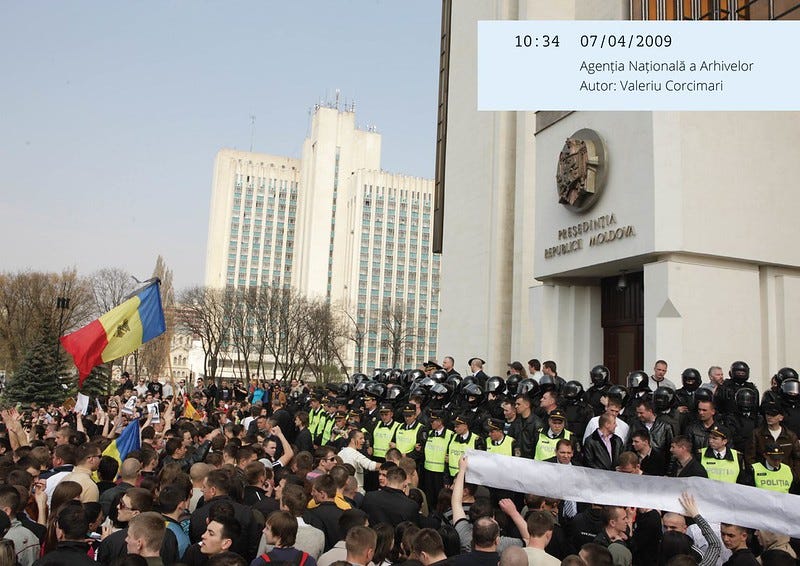
It all happened very quickly or, perhaps, incredibly slowly. Or maybe, all at once? After the Soviet Union collapsed, the Baltic states moved swiftly to rebuild their political and economic systems through lustration and shock therapy, overhauling everything at once rather than pursuing gradual reform. Moldova, like many other former Soviet republics, opted for a more gradual approach. That was mainly because the political system was largely inherited by the Old Guard, who clung to power. The Communist Party of the Republic of Moldova (PCRM), led by Vladimir Voronin, was one such example.
I thought about this as I was writing the date in my notebook at the beginning of my Post-Communist Transformations class. Coincidence or not, on April 7th, we covered the Color Revolutions and transitional justice. One of the assigned readings states that, in Moldova, “the ten years that politicians spent debating lustration, starting in 2000, allowed the communist elite to retain and convert its economic and political clout” (Vacroux 2018, 357). And memories started playing out before my eyes, moving through time, bringing me back to our black, box-shaped TV bought in 1996. I was 6 in April of 2009. But there is something about seeing a revolution for the first time that makes the memory untouchable. There is something about your parents’ fury and the red segment growing on the screen longer and longer as the Communist Party gains more and more votes.
PCRM had been in power since 2001. Moldova followed the pattern of a post-communist comeback, in which the old regime returned in the second or third election after independence, despite the initial victory of non-communist candidates. This has been the case in many former communist countries, such as Hungary, where the Hungarian Democratic Forum (MDF), led by József Antall, won the 1990 election. Still, four years later, the Hungarian Socialist Party (MSZP), the successor to the former ruling communist party, won an absolute majority, securing 209 of 386 seats. In 2001, PCRM secured 71 out of 101 seats in the Parliament. At that time, Moldova was a parliamentary republic in which the legislature elected the head of state. PCRM, holding the parliamentary majority, thus unilaterally elected Voronin as the president.
Communists maintained power in the 2005 elections as well, winning 45.98% of the vote and 56 seats. However, they fell short of the 61-seat supermajority required to elect the president on their own. Voronin was re-elected with the support of the Christian Democratic People’s Party (PPCD), which had been one of his more vocal opponents, the Democratic Party of Moldova (PDM), and the Social-Liberal Party (PSL). And on the night of April 5th to 6th of 2009, we went to bed knowing that the Central Electoral Commission (CEC) had counted enough votes to declare PCRM’s victory.
But the next morning, after CEC processed 96.51% of the tally sheets from polling stations, PCRM emerged with 49.94% of the vote and 60 seats, and young protesters began gathering in the Great National Assembly Square (Piața Marii Adunări Naționale), claiming the election was rigged and demanding a rerun.
The independent Moldovan newspaper Ziarul de Gardă reports that the message communicated online to bring people together was: “Young people declare April 7th a day of national mourning in the Republic of Moldova.” The political opposition also amplified this message, calling for a boycott of the election.
The protests started peacefully, with participants holding signs reading “Better dead than communist”, “Wake up, drugged homeland”, “No to election fraud”, “Down with the communist clan”. Thus, in the afternoon of April 7th, the central Chișinău saw at least 30,000 protesters rallying against the election results. As the day turned to evening, the protest grew increasingly violent.
The protesters first started throwing stones into the Parliamentary and Presidential buildings, which later escalated into full-scale fire as they stormed the buildings. Moldova’s PROTV’s coverage wrote about Voronin’s portraits being set on fire while the protesters chanted “Fight, Resist, I am anti-communist!”

While the protests turned violent with the destruction of state property, a young student, Dragoș Musteață, hoisted the European Union and Romanian flags on the Parliamentary and Presidential buildings. Later, he’d recall his act as one through which he wanted to signal that the buildings “belonged” to a European future rather than the communist regime, theoretically removing the incentive for protesters to vandalize them. The protests saw the Romanian (and EU) flags with a frequency perhaps last seen in the late 89s to early 90s, when the pan-Romanian movement gained incredible momentum.
In the evening, the Moldovan police fired rubber bullets at demonstrators in the Square to disperse them, also deploying tear gas and water cannons. Many protesters were also severely beaten by police. This escalated into intense altercations between police and protesters, with at least 193 demonstrators, mainly students, being detained. Seventeen years later, Marian Macovei, who was 32 at the time and ended up physically paralyzed in the following years as a result of the police brutality, would recall the basement of the Buiucani Police Station, where he was taken, as the “corridors of death.” Many of those detained suffered violent mistreatment while in police custody.
At the same time, the PCRM was busy pointing fingers at the political opposition, accusing the leaders of the Liberal Democratic Party, the Liberal Party, and the Our Moldova Alliance of organizing a “coup “ that formed a human shield of students, high school students, and pupils, whom they instigated to come to the square. But the blame did not stop at the Prut, as the Moldovan communists also accused Bucharest of attempted coup d’état, given the omnipresence of Romanian symbols during the protests. While the unionist movement that sought to merge Moldova and Romania together never quite disappeared, it most certainly weakened in the late 90s. The sudden resurgence of unionist sentiment added another pressure point for the communist regime. The communists moved swiftly: the Romanian Ambassador to Moldova, Filip Teodorescu, and counselor Ioan Gaborean were expelled, visas were reinstated for Romanian citizens, and Romanian journalists were denied entry into Moldova.
On the other hand, Voronin immediately called Moscow, which in turn called on the European Union and Romania to intervene and prevent what he described as threats to Moldova’s sovereignty. For Lavrov, who even 17 years ago was still Russia’s Foreign Affairs Minister, Romanian flags and Romanian slogans were being used as a “cover” to undermine Moldova’s sovereignty.
What happened to the political opposition that called Moldovans to take to the streets while comfortably shielded in their own residences? Vlad Filat, leader of the Liberal Democratic Party of Moldova (PLDM), served as the Prime Minister from 2009 to 2013, and was sentenced to 9 years in prison in 2016 for passive corruption. Nevertheless, Filat was released at the end of 2019 through a compensatory appeal, which was implemented to address human rights violations within the prison system. At the end of 2025, Filat was placed on an international wanted list following a French court’s money laundering conviction.
Another opposition figure was Mihai Ghimpu, leader of the Liberal Party (PL), who served as acting President of Moldova and President of the Parliament for a year after the protests. I grew up knowing Ghimpu as the most vocal supporter of reunification with Romania, but also as the uncle of Chișinău’s mayor at the time, Dorin Chirtoacă. Chirtoacă took over the PL’s leadership at the end of 2018; however, the PL never returned to Parliament after the 2019 elections.
Serafim Urecheanu is a name I have not heard in a long time, but in 2009, he led Our Moldova Alliance, which, a few years later, merged with Filat’s PLDM. At last, he pretty much vanished from Moldova’s political landscape. Marian Lupu is a name one won’t hear often these days, but back in 2005, he was elected as the President of the Parliament as a PCRM member. After calling the April protests “an attempted coup d’état” organized by the political opposition, Lupu became part of it, serving as Moldova’s interim president from 2010 to 2012. Today, Lupu is remembered mostly for his ties to Moldova’s oligarch, Vlad Plahotniuc, who chaired PDM for three years before fleeing Moldova in 2019.
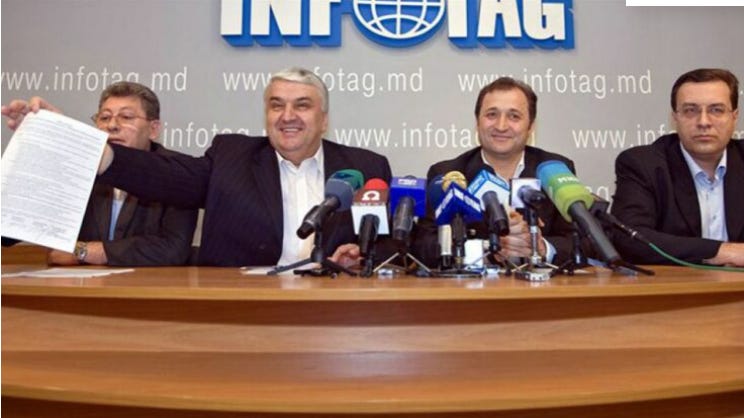
These figures greatly benefited from the protests, gaining general support. For that time, they felt like a breath of fresh air, and that’s why young Moldovans took it to the Assembly Square. They successfully marketed themselves as the carriers of the “European dream” by positioning themselves against the outdated, intransigent, and, ultimately, morally corrupt communists. Perhaps their perceived legitimacy rested solely on this contrast because, after the protests were cracked down on and the CEC confirmed PCRM’s victory once again, Moldova entered a deep political crisis of polarization, leaving the country without a president for almost 3 years. Because the head of state required a 61-seat supermajority that the PCRM lacked, the Parliament was so divided that it failed to cooperate on electing a president.
Certainly, the stakes were incredibly high in the past two elections, in 2024 and 2025. However, looking back, I can’t quite think of an election that has marked Moldova more than April 2009. This is the closest Moldova came to a revolution. Some call the protests the Twitter Revolution because the protesters mobilized online, but also because it was a youth movement, and Twitter at the time stood for youthful innovation and breakthroughs, which the Moldovan opposition wanted to be associated with.
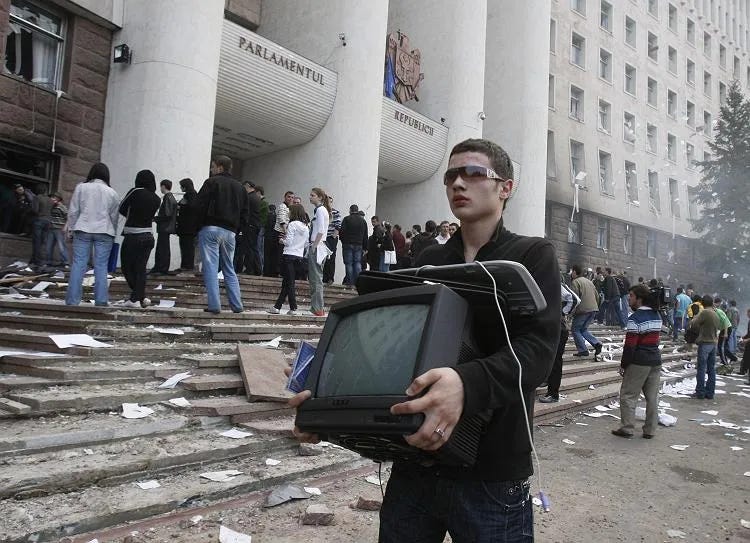
Yet the Twitter Revolution, if you will, is not regarded in Western scholarship as part of the chain of revolutions in former communist states, starting with Serbia’s Bulldozer Revolution in 2000 and continuing with the Orange Revolution and later the Revolution of Dignity in Ukraine, the Rose Revolution in Georgia, and the Tulip Revolution in Kyrgyzstan. If one insists on a narrow theoretical framework in which the label of “revolution” is granted only where there is some degree of continuity, Moldova’s April protests are not even considered part of the club of attempted revolutions that Azerbaijan (2005), Belarus (2006), and Russia (2011-12) share. I do find this omission significant because the protests’ organization, intentions, and consequences closely resemble those of a revolution. A revolution is typically led by a counter-elite, with high mass participation, occurring bottom-up, aiming at the fundamental transformation of the political class and the socio-economic system, and resulting in a new political class, new institutions, and new property relations (Lane 2009).
But I do not think the events of April 2009 represent a turning point in Moldova’s consciousness merely because they loosely fit the scholarly definition of revolution.
April 2009 was of paramount importance because it showed, and continues to show, that Moldova has not done its work on the transitional justice chapter. It is important to return to the fact that people mobilized following the alleged victory of the communists, a party that stands for so much suffering inflicted on Moldova. A party that brought not only a painful geopolitical rupture embodied by the USSR’s annexation of Moldova from Romania, but also a fracture in Moldova’s identity that remains difficult to reckon with. The Moldovan educational system is exceptional in the weight it places on the study of history, with particular attention to the Soviet Union and the damage it caused to Moldova through the Stalinist deportations, during which so many Romanian-Bessarabian families were callously persecuted and murdered, the demographic engineering, collectivization, and rapid industrialization, all of which have left deep legacies on the Moldova we live in today. And yes, victims of the communist regime are mourned and remembered. But transitional justice is two-dimensional: for it to be effective, perpetrators must also be punished and denounced. Today, this remains a difficult thing to do, mostly because a lot of time has passed.
Yet politicians proudly continue their careers wielding Soviet symbols, like the red star of the PSRM and the hammer and sickle of the PCRM. Moreover, they actively court Russia’s president, who, besides all the war crimes he is committing in Ukraine, wholeheartedly believes the dissolution of the USSR “was the greatest geopolitical catastrophe of the century.”
I think April 2009 marks the apogee of a contradiction in Moldovan national identity, which sought to resolve itself through the removal of the Communist Party. What complicates its aftermath is not the failure to achieve that aim, but the absence of meaningful and sustained reckoning with the violence and brutality of the protests. This left intact the same dynamic of the early post-communist years: victims are remembered, but few are held accountable. That unaddressed gap, I believe, is one of the many fault lines that run through Moldova’s identity. The first step to shrink this gap would be to fully declassify the files related to the April 2009 protests and continue the investigations into the gross human rights violations that occurred.
While the most immediate consequence of failing to deliver justice is the complete alienation of firsthand victims, the longer-term risk of leaving such trauma unaddressed is its diffusion into the broader public consciousness, which will fossilize over time into a collective victim mentality. A victim mentality at the national level manifests as learned helplessness, in which suffering becomes so central to a country’s self-understanding that it displaces agency. It is the difference between a nation that says “this was done to us” and one that also asks “what do we do about it.” Moldova has an abundance of the former and a deficit of the latter. Decades of deportations, forced collectivization, linguistic suppression, and political pressure by the Soviet Union and, later, Russia, have given Moldovans every reason to see themselves as a people acted upon rather than acting.
April has always been a particularly strange month for me. Running on cereals and bread during the last weeks of Great Lent, pruning the grapevines in our vineyard, planting potatoes and onions and garlic and everything else I can’t think of but that surely grows in my parents’ garden, and covering the tree trunks with slacked lime… And hoping, so desperately hoping, that the temperature will not drop overnight so the blossoming trees and the plants don’t freeze… And the air, saturated with pollen, grows stifling, the church bells ring and ring, and the swallows begin building their nests under the eaves of our house…
One of my favorite poems is T.S. Eliot’s “The Waste Land,” which opens with the line “April is the cruelest month.” Eliot’s wasteland is built on the ruins of World War I, where the cruelties of war emerge from the “forgetful snow” as it melts with the arrival of spring. The poem paints a blurry picture of loss, distortion, and disorientation: the tragedy has already occurred, yet the visceral, restless imagery conveys a sense of looming threat, as if the worst is still somehow ahead. I wonder whether we do something similar with April 2009 every time we return to it… whether memory, revisited enough times, becomes its own distortion. So much has happened in between, events that have reshaped how Moldovans see themselves and the world around them. But that feeling of something unresolved keeps haunting us, and maybe it grows a little stronger in April.
You can follow and subscribe to Cristina’s Substack newsletter here.
