

Editor’s Note: The Moldovan government is currently in the early stages of planning a major reform of the country’s local public administration system. This is an extremely important and controversial topic as it brings together questions of local identity and the ever shrinking size of Moldova’s villages. This week, during public consultations, Vasile Tofan, Senior Partner at Horizon Capital, delivered a presentation to the government titled The Baltic Formula: A Case for Bold Reform Based on Best Practices (Romanian). In it, he made a case for major reform and backed it up with hard numbers. I found the presentation extremely compelling and asked Tofan if he’d like to write an op-ed - which he kindly agreed to. Here is his case for bold reform.
The Baltic Formula
In 1800, Napoleon Bonaparte sat down to redraw the map of France. He replaced a chaotic patchwork of feudal provinces with a clean grid of departments and prefectures, designed so that any citizen could reach the administrative centre within a day’s ride on horseback. Two hundred and twenty-six years later, long after the horses retired and the Emperor met his Waterloo, the French state still breathes through that same Napoleonic design.
The lesson for Chișinău is as clear as it is uncomfortable: administrative reforms are not policy tweaks. They are state architecture. Get them right, and they last for centuries. Get them wrong, and you live with the consequences just as long.
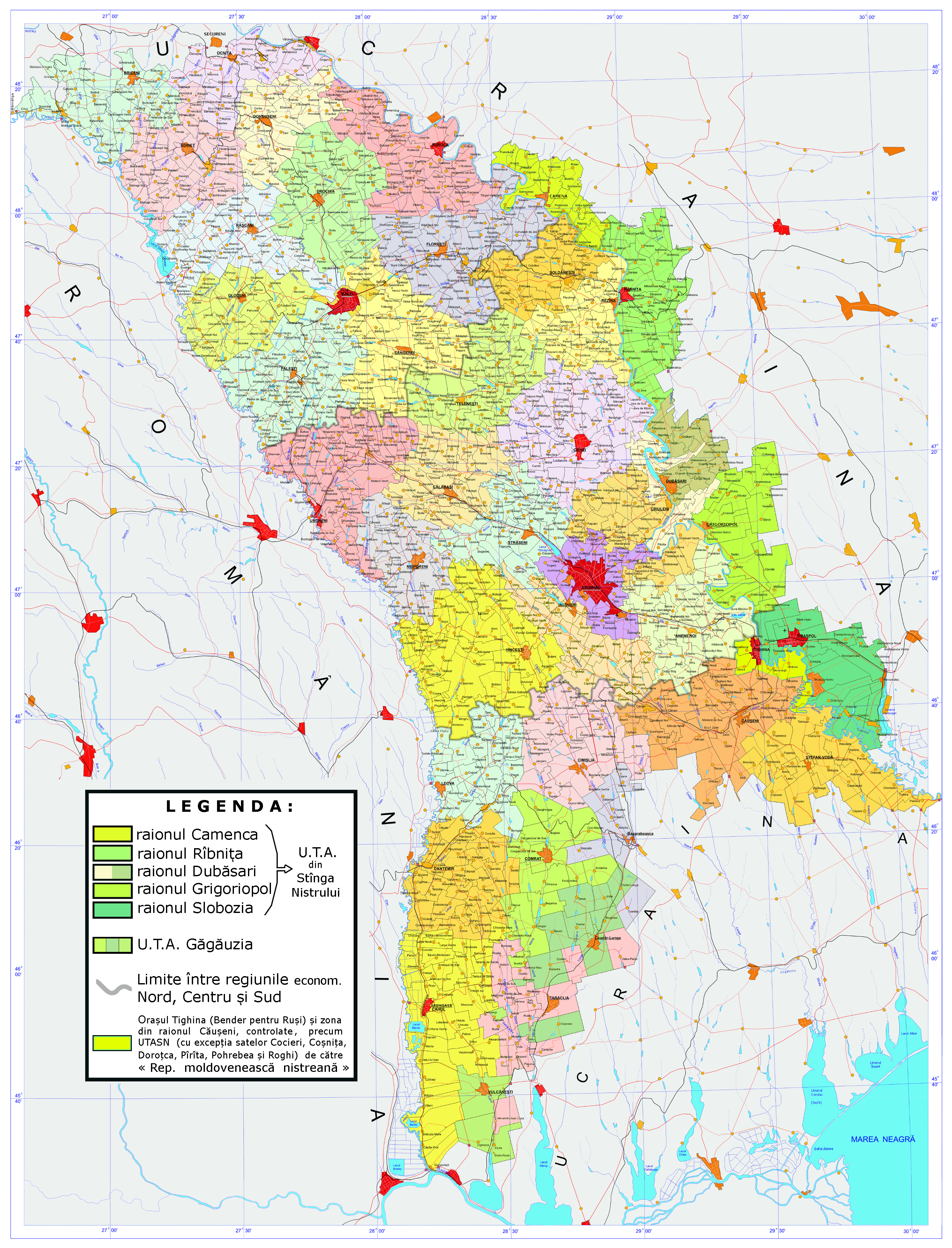
The current PAS government deserves real credit for touching this third rail of Moldovan politics. For decades, successive governments have stared at Moldova’s map, a bloated, Soviet-era patchwork of 898 tiny primării (city / town halls) and 32 redundant rayons (counties), and blinked. To propose consolidation in a country where “local identity” is often a polite euphemism for “local patronage” takes genuine political courage.
But courage is wasted if it is spent on half-measures. The reform currently under discussion, reducing the number of primării to around 300 and rayons to roughly 10, is a step forward, but a hesitant one. It risks falling into what might be called the Latvian trap: paying the political price of reform without actually solving the problem.
The Cost of Hesitation
Latvia has already run this experiment. In 2009, it reduced its 548 municipalities to 119. At the time, this was seen as bold. In reality, it was a compromise designed to soften local resistance. Within a decade, it became clear that many municipalities were still too small to function effectively. In 2021, Latvia had to go through the entire process again, reducing the number to 43. The lesson is simple: reform done halfway is reform done twice.
Moldova cannot afford that luxury. It is already sleepwalking into a demographic wall. Many rayons have lost over 40% of their population since independence. In places like Nisporeni, the state has quietly become the employer of last resort. Around 35% of the workforce are bugetari (state employees), outnumbering those in agriculture by a factor of three and industry by a factor of four.
This is not a development model. It is an expensive, fragmented waiting room for emigration.
The Baltic Formula
Moldova often speaks of the Baltic states as a North Star. But when it comes to the plumbing of the state, it prefers its own broken pipes. The Baltic formula is disarmingly simple: scale creates capacity.
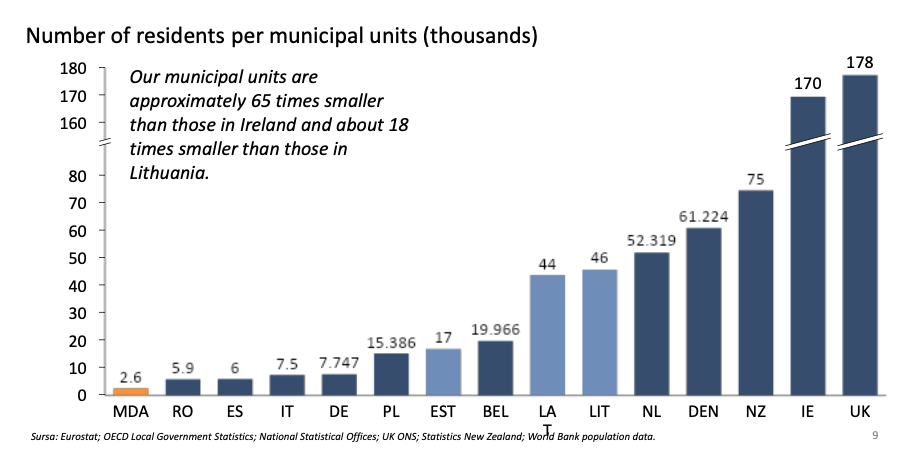
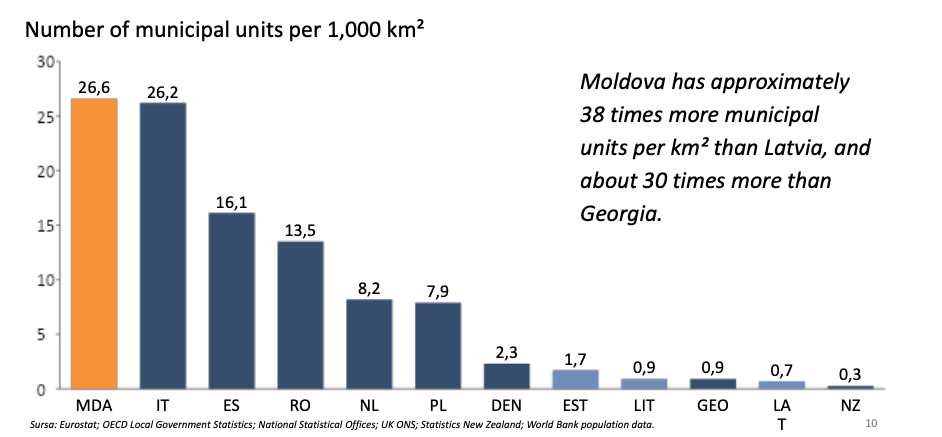
Lithuania operates with just 60 municipalities for 2.8 million people. Latvia now has 43 for 1.9 million. Estonia runs with 79 for 1.3 million. In each case, the Soviet-style district layer, the equivalent of Moldova’s rayons, has been eliminated.
Georgia followed the same logic in 2006, under Saakashvili, consolidating rapidly, in his characteristic bold, top-down fashion, and abolishing the intermediate tier altogether. Ireland, with nearly 6 million people, functions with just 31 local authorities and no elected regional layer. Denmark retains regions, but with limited roles. Real power sits at the municipal level.
In Moldova, by contrast, a typical village primărie is a ghost ship and 60% of them don’t meet even the extremely low legal requirement of 1,500 residents. With a staff of five or six, a mayor, a secretary, a couple of accountants, there is no one left to design a wastewater system, apply for EU funding, or coordinate even a basic regional transport route.
Compare that to a Lithuanian municipality of 40,000 to 50,000 people, with over 100 to 150 professional staff, including departments dedicated to urban planning, infrastructure, investment attraction, and utilities.
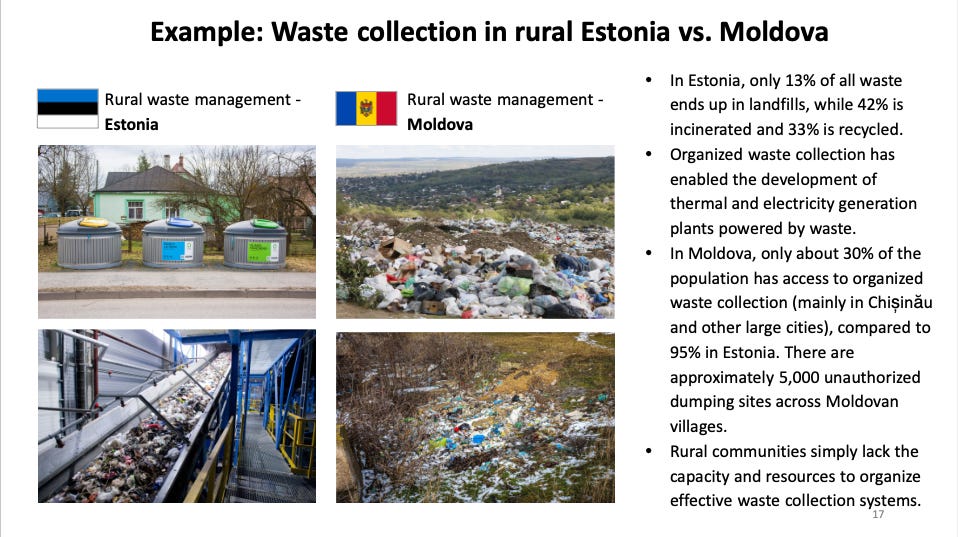
The results are not cosmetic; they are foundational. In Lithuania, over 90% of households are connected to public water systems. In rural Moldova, that number is closer to 35%, with many families still relying on nitrate-heavy wells. The disparity in basic sanitation is equally stark: while Estonia has moved toward a high-tech, centralized waste management system that mirrors its digital prowess, Moldova remains scarred by nearly 5,000 unauthorized, open-air dumps that poison the local water table.
You just cannot build a 21st-century economy on 19th-century infrastructure managed by a 20th-century bureaucracy.
Leadership Over Logistics
One of the recurring objections to reform is that it is politically difficult, especially when it involves merging villages. That is true. But it is also beside the point.
The current “voluntary amalgamation” approach is, in essence, a polite request for people to vote themselves out of existence. It rarely works. Villages have weak coordination, strong local identities, and often long-standing tensions, administrative, political, sometimes even ethnic. Disputes over which village becomes the center are almost guaranteed. You cannot blame people for resisting this.
The solution is not to force villages into artificial unions. It is to change the unit of reform. Instead of merging villages with villages, Moldova should consolidate around existing rayon centers (county seats), natural economic, logistical, and cultural hubs. This creates scale while respecting how people actually live, move, and identify.
At the same time, local representation in villages can and should be preserved. The model already exists. Ukraine uses the starosta system. France has the maire délégué. Poland - soltys. Moldova can introduce a similar role, pretors, to handle local issues, while shifting real administrative capacity to the municipal level. This is not about erasing the village. It is about giving it a functioning administration behind it.
The Missing Ingredient: Fiscal Power
Structure alone is not enough. Without money, decentralization is an illusion. Moldova’s current system leaves local governments dependent and underpowered. To change that, fiscal decentralization must be part of the reform.
Allow municipalities to retain 50% of corporate income tax and 2 percentage points of VAT generated locally. This would immediately change incentives. Municipalities would compete, not for transfers from the central budget, but for businesses, residents, and investment. They would have a reason to issue permits faster, build better infrastructure, and attract employers. In short, they would behave like economic actors, not administrative outposts.
The Bottom Line
Today, Moldova is spending a disproportionate share of its limited resources simply to maintain its fragmented administrative structure. Even in larger communes, some 60% of local tax revenue goes not into development, but into paying the salaries of those who collect the taxes. It is a model of recursive futility.
If Moldova is serious about EU accession, this has to change. The country will need local administrations capable of absorbing large volumes of EU funding, managing complex projects, and acting as credible partners for investors. That requires scale.
PAS has done the difficult part by opening the discussion. Now comes the harder part: following through. If Moldova is willing to pay the political cost of reform, it should at least ensure the reform is worth it. So the question is not whether to reform, but how decisively. Doing it halfway risks repeating the Latvian experience - paying once now, and again later.
Administrative systems, once built, tend to endure. Moldova has the opportunity to design one that works for decades to come. It would be a pity to waste it.


It's positive to see a multitude of opinions on the reform, especially from someone like Vasile Tofan. Unfortunately, I think there is a legal perspective which has not been considered in this proposal: a constitutional requirement that "districts" (what we call raions today) must exist (Art. 110) and must have a "district" council that is elected (Art. 113).
The idea of a single level of local government in Moldova is probably an admirable one to pursue over the long-term, but reforms are needed now in order to deliver services more efficiently to residents. A constitutional battle is unlikely to be one that can be carried out swiftly over the course of 2026. It would be great to instead see steady progress in 2026 and 2027 towards:
a) strengthening level 1 localities (reducing the number of local governments while still retaining local community identities), and
b) a reduction of level 2 districts to provide a better support service network to level 1 localities in the interim (while also getting rid of the raion Soviet legacy name).
Informative and well-argued!