

Hi and welcome back to Moldova Matters. The holiday season is in full swing in Chisinau - which anyone who lives here know makes for a chaotic schedule. Everyone is rushing to get all their work done before the extended winter holidays and everyone is also holding their holiday parties and get togethers as well. Moldova Matters is going to have a slightly altered publishing schedule through the new year. We’ll have lots of content coming out, but the Weekly Roundups will sometime be delayed and combined.
Is Transnistria Preparing for War?
Last week Ukrainian news outlet Ukrinform reported that Transnistria was preparing for war. They wrote:
“In particular, mobilization measures have been intensified in the territory of the so-called PMR [Transnistria] - reservists are being called up to military formations of quasi-formations, and weapons are being deconserved in warehouses.
Also, UAV production and drone operator training centers have been launched in Transnistria.”
They went on to write that the goal was to divert Ukrainian resources and destabilize Moldova. Ukrinform cited an unnamed source in the Main Intelligence Directorate of the Ministry of Defense of Ukraine.
Initially, Moldovan government sources were slow to comment on the story leaving local outlets to print it with a “no comment” from relevant agencies. This was reversed the following day (December 11th) with Defense Minister Anatolie Nosatîi stating:
“The very existence of this uncontrolled territory, the illegal presence of the Russian Federation, its forces on our territory is a possibility for manipulation on this topic and discussions. The fact that state institutions are not present there, do not monitor, do not follow all activities gives an opportunity to come up with such statements.
“What is related to mobilization activities or how it was said that weapons are already being received and so on is an exaggeration, it is not so. The fact that activities are being carried out in the region is correct and they have constantly carried out all kinds of activities,”
Deputy Prime Minister for Reintegration Valeriu Chiveri further clarified saying:
“Relevant agencies are responsible for security issues. Our colleagues working in this area have not recorded any actions different from those that occurred previously”
A government source, speaking to Moldova Matters stated that they see nothing unusual in the region and that the situation is calm.
Recall: in late February 2024 a series of reports (with poor sourcing) alleged that Transnistria would soon request annexation from Russia. This never happened, but triggered a media firestorm in the Western press - as it was intended to. Its unclear what the origin of this most recent story is, but it is worth remember that the Kremlin has successfully planted stories in the past with the sole purpose of inspiring panic in newsrooms that are not well informed about Moldovan affairs. Here’s a link to that 2024 article:

Other Transnistria and Security News:
Here’s a roundup of the other top stories about the region:
Moldova will try and decouple EU integration and reunification. This was stated by Deputy Prime Minister for Reintegration Valeriu Chiveri last week while speaking at a conference addressing human rights in the region. He stated:
“We will do everything possible to ensure the reintegration process is dynamic and produces results. At the same time, we understand that it requires a longer period than we allot for the start of accession negotiations and, possibly, for EU integration. We will, frankly, try to separate these two processes,”
Transnistria introduced a new state of emergency. From December 15th gas supplies will be restricted with priority given to household use. This will result in a reduction in supply to heavy industry. “Officials” in the region blamed this on a “a decrease in the rate of settlement transactions within the European Union.” This tracks with past stories that Russia’s complex workaround payment structure for this EU gas has caused problems with some banks and other financial institutions delaying payments as they check for sanctions compliance.
A holiday trick from Sheriff? On November 17th the Transnistrian authorities announced that the Sheriff holding company would provide a holiday support payment of 200 Transnistrian rubles1 for all the region’s pensioners. In total this would cost the company 30 million rubbles or around $1.86 million USD. On December 2nd the funds started going out, but a few days later pensioners began reporting that they were taken back. Floods of bank statements showing a neat 200 ruble credit, followed a few days after by a 200 ruble debit were posted online. No official announcements have come from either the regional “authorities” or the company as to what is going on.
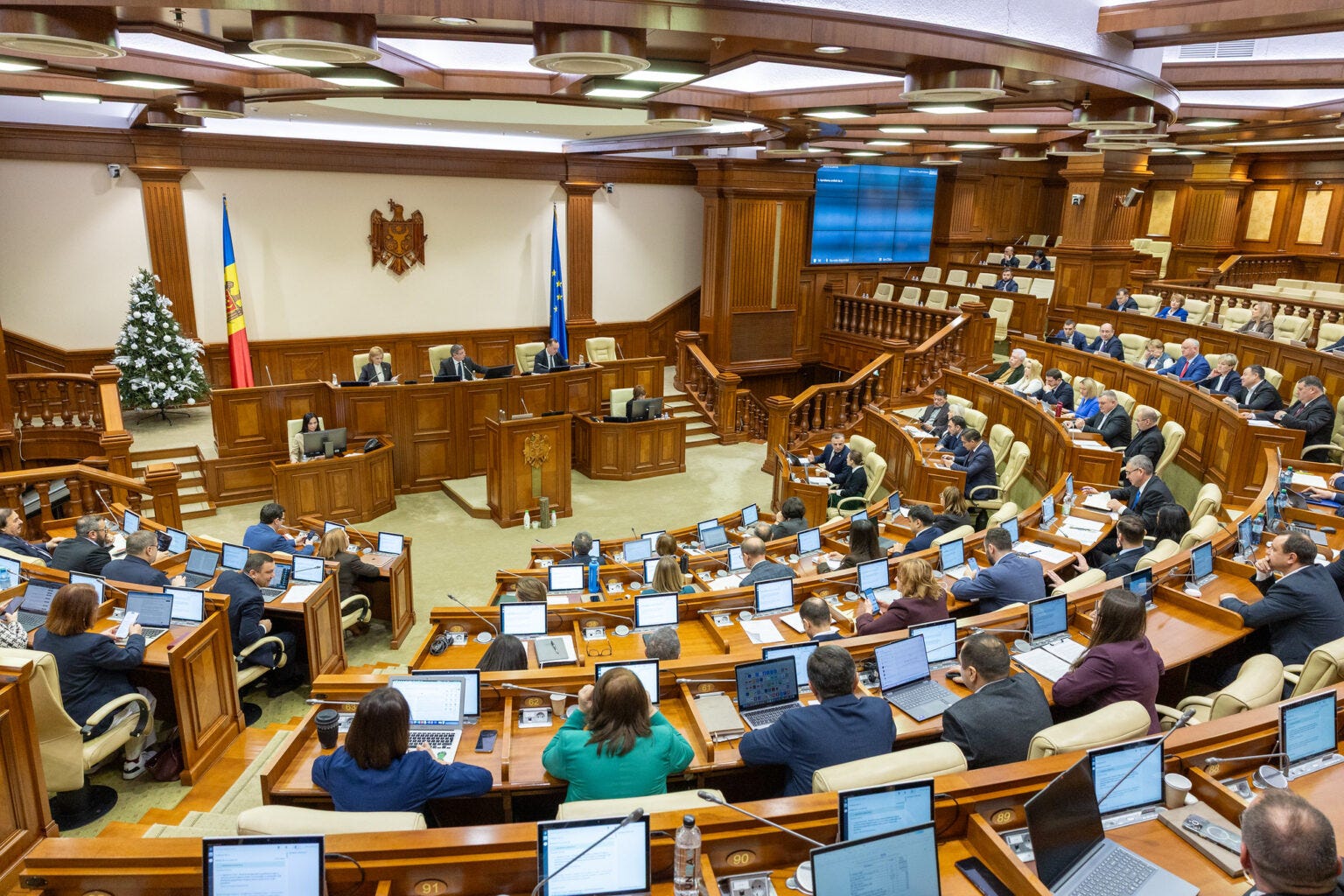
Parliament Passes the Budget
On December 12th Parliament passed the 2026 budget in the first reading. The budget envisions revenues of 79.67 billion lei (+5%) and expenses of 100.57 billion lei (+7%), resulting in a budget deficit of 20.9 billion lei. The government stated that the emphasis of this budget was on capital investments, which were increased by 35.6% to 3 billion lei.
The budget included the following notable changes in taxation:
The zero percent tax on re-invested profits for small and medium sized companies was extended through 20262.
The VAT registration threshold for companies was raised from 1.2 to 1.5 million lei3.
VAT refunds for farmers will be simplified and sped up
Individuals will be eligible for a new mortgage interest tax deduction. Borrowers who have not benefited from government subsidy programs (such as Prima Casa) will be able to deduct mortgage interest of up to 16,100 lei / year from their income tax.
The education expense tax credit will be expanded to a 20,000 lei / year limit and will apply to the whole family. Previously, parents could deduct education related expenses for their children, but not it will apply to adult learning as well.
It’s worth noting that areas that did involve tax breaks (e.g. the raising of the VAT threshold) have in no way kept up with inflation. In this case, as in other taxes that used fixed thresholds, taxes have effectively increased over the past 6 years - even with these changes.
Taxing Temu?
One contentious issue hanging over the budget is Temu - China’s massive online marketplace. The app has exploded in popularity in Moldova and across Europe in recent years. This has largely been due to how cheap it is - most items offer free delivery from China to Moldova. Other similar platforms like Shein operate on similar (aka highly subsidized) business models. These parcels are not taxed in Moldova (or most countries) that operate with a “de-minimis” threshold under which shipments are tax exempt. In Moldova this threshold is €150 euros.
Members of parliament have signaled that taxes will be coming in 2026, and which we don’t have any news in this budget we now have some indications from the Ministry of Finance how this will work. Minister Andrian Gavriliță spoke to Newsmaker and indicated that the tax structure would be as follows:
20% VAT
5-10% customs duties (depending on the product)
an unspecified “package fee” for all parcels from foreign market places
Explaining the thinking, the Minister stated:
“The goal isn’t to eliminate cheap goods. No, we must ensure that consumers have access to affordable goods. Many order clothing. This allows both children and adults to dress better and afford more. This must be preserved. But at the same time, we must reduce the unfair competition that exists, so access to low-cost goods must include a fair tax that businesses pay when importing,”
According to Minister Gavriliță, right now more than 50,000 packages enter the country daily. He noted that experts predict 2-3 billion extra lei in yearly taxes from this potential change.
Critically, Minister Gavriliță claims that individuals will not have to register their purchases and pay taxes themselves. He suggested that the government would work with the platforms so that the companies withhold the taxes and pay it themselves.
The plan is to introduce these taxes in 2026.
The Temu and Shein problem is not unique to Moldova. With China subsidizing shipping and manufacturing, cheap goods are flooding the European market. Romania has also recently announced a flat tax of 25 RON (97 MDL / €4.89 euro) per incoming package below their €150 euro de-minimis threshold. They note that around 78 million parcels of non-EU products are projected to enter the country in 2025 tax free. Their tax comes into play on January 1st, but might be replaced soon because…
The EU itself also announced an agreement on December 12th to impose a €3 euro tax on incoming parcels under €150 euros starting in July. This tax would apply to each type of product in a package (aka, if you buy 4 pairs of headphones you pay €3, but if you buy a pair of headphones and a toothbrush you pay €6). The EU announced this as a stopgap measure that will come into effect in July. They are working on plans to scrap the de-minimis threshold completely, but acknowledged that the customs infrastructure is not prepared to understand the valuations of all of these parcels and impose taxes on the end users yet.
Moldova’s approach of asking the platforms themselves to implement the country’s complex tax code is the “boldest” approach - and the one with the highest taxes. We’ll see how well it holds up against the reality of negotiating with these huge companies.
Other Political Updates
Here’s a roundup of the other top political stories of the week.
Mayor Ceban wants to drug test all the teenagers in Chisinau. The Mayor, who has been urgently declaring an illicit drug emergency for weeks (without evidence), has proposed mandatory drug tests for all students in Chisinau schools over 13. He claimed that he himself just took a drug test and urged all elected officials to do so as well. Ceban claims that mass, mandatory school testing is the norm in the United States (it is not). He also suggested that exemptions would be granted if parents wanted to opt out. Minister of Education Dan Perciun responded saying:
“Implementing such a measure would mean forcing 107 thousand children to go through an intrusive and unnecessary procedure. (…) The practice of universal mandatory drug screening for all students does NOT exist in democratic states with high-performing educational systems. Where testing is done, it is always targeted, voluntary, strictly regulated and never applied en masse,”
President Sandu appointed former Prime Minister Dorin Recean as a special envoy for development and resilience. The position has a mandate to “contribute to promoting inter-institutional and multi-sectoral efforts aimed at strengthening the state’s capacity to prevent and combat hybrid threats to national security.” It is unpaid and, like Nicu Popescu’s special envoy role, is somewhat unclear in scope.
The state will take over Lukoil’s airport assets within 20 days. This was announced by Prime Minister Alexandru Munteanu who noted that a 2005 agreement had allowed the company to operate the airport’s fuel terminal, and that a recent review by the Council for the Review of Investments Significant to National Security resulted in a refusal to extend the agreement.
The US Embassy keeps warning Moldova about “mass migration.”
This week the Embassy’s facebook page made a post stating that the Chargé d’Affaires met with Moldova’s Minister of Internal Affairs and stressed that migration leads to “serious crime and lawlessness.”
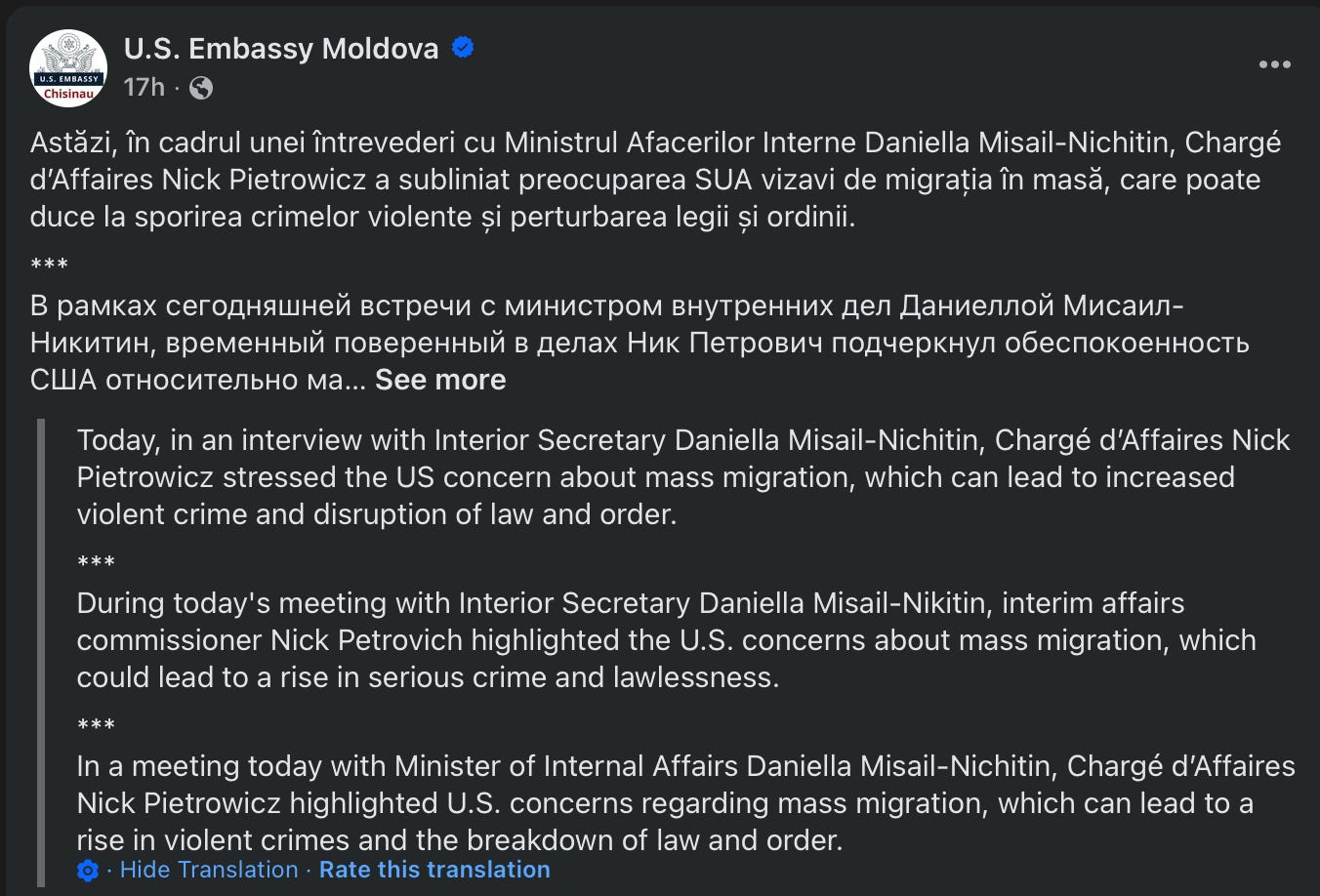
This is not the first time that the Chargé has “warned” Moldova of this “threat.” Unspoken is that fact that Moldova has very few immigrants and through the Moldovan diaspora is a source of migrants rather than a magnet for them.
This was the only official statement or readout of the meeting, causing a lot of discussion on social media. Some simply wondered what the US government is trying to say, and hard right accounts using it to boost various conspiracy theories and attack the Moldovan government. Minister of Internal Affairs Daniela Misail-Nikitin was forced to clarity, noting that the statement “does not directly relate to the situation in Moldova.” She stated that the Chargé “made this statement during the presentation of the new United States National Security Strategy, which considers mass migration as a risk factor in the context of U.S. national security priorities.”
For those who missed it I wrote about this strategy last week:

Ilan Shor and Hybrid War
Here’s a roundup of the top stories in Russia’s hybrid war of the week:
A new Shor resignation. Balti municipal councilor Anastasia Svetlicinii resigned with a statement claiming that PAS was preventing their social projects and particularly the construction of a “NordLand” amusement park.
OrheiLand amusement park will close (maybe?). After fleeing to Moscow months ago and resigning on December 2nd, Orhei ex-Mayor Tatiana Cociu announced on December 6th that the amusement park would be closed until “there will be no Sandu and PAS.” The acting Mayor Anastasia Țurcanu contested this saying that the park is on public land and managed by the city. She noted that its closed now due to the cold season but did not confirm that it would be closed permanently.
Voter bribery cases reach 25,000 in Gagauzia alone. TVR Moldova reports that 4950 people paid fines (ranging from 37,000 to 57,500 lei) while the rest self denounced and agreed to cooperate (resulting in no fines). These fines relate to “humanitarian aid” delivered to pensioners and public sector employees in April 2024 by what Bashkan Gutsul called a “sponsor.”
Economics & Infrastructure
Over the last week the Moldovan government and power companies have been urging people to conserve energy - especially at peak hours. The reason isn't risk of power cuts but focused on price. Russia’s attacks against the Ukrainian power grid have forced Ukraine to rely more and more on imported electricity from the EU. Moldova and Ukraine are each allocated a certain amount of electricity that they are allowed to buy from Romania. Very often, Moldova needs more than its allocation and Ukraine needs less - meaning that Moldova uses some of Ukraine’s capacity. With Ukraine’s power grid stretched to the limit both countries are exceeding their import limits.
This is basically a billing question. When Moldova imports power above the agreed limits it is forced to request emergency supply and pay emergency prices - around €400 euros / MW. So far, Moldova hasn’t had to request too much emergency supply - but the message from the government is clear: conserve power so prices don’t rise.
~210 MDL or €10
Recall, Moldova Matters ran an article on this topic from former Minister of Economy Dumitru Alaiba on December 3rd

This is the annual sales threshold at which companies are required to become VAT payers. Companies operating under the threshold are subject to lower (and far less complex) tax rates.