

Welcome back to Moldova Matters! With the holidays behind us we’re starting back with a regular publishing schedule. Today we’re going to do a roundup of all the stories that came out while we were on our holiday publishing schedule - including the 2025 in review (part 1 & part 2) as well as the Moldova Matter’s exclusive: Moldova’s Approach to Reintegration (with Transnistria).
Luckily, Moldova’s news cycle is pretty slow during the holidays - though there are a few exceptions (including a serial killer?!).
No slow news for the rest of the world in 2026. Like pretty much everyone else on earth the Moldovan press has been fixated on whether or no Trump will shatter NATO by annexing Greenland, what happened with Maduro? and now, what’s going on in Iran - with President Maia Sandu expressing solidarity with the protestors this week. Unexpectedly, Ilan Shor even pops up in the Venezuela story a bit as we’ll see below.
Holiday Messages
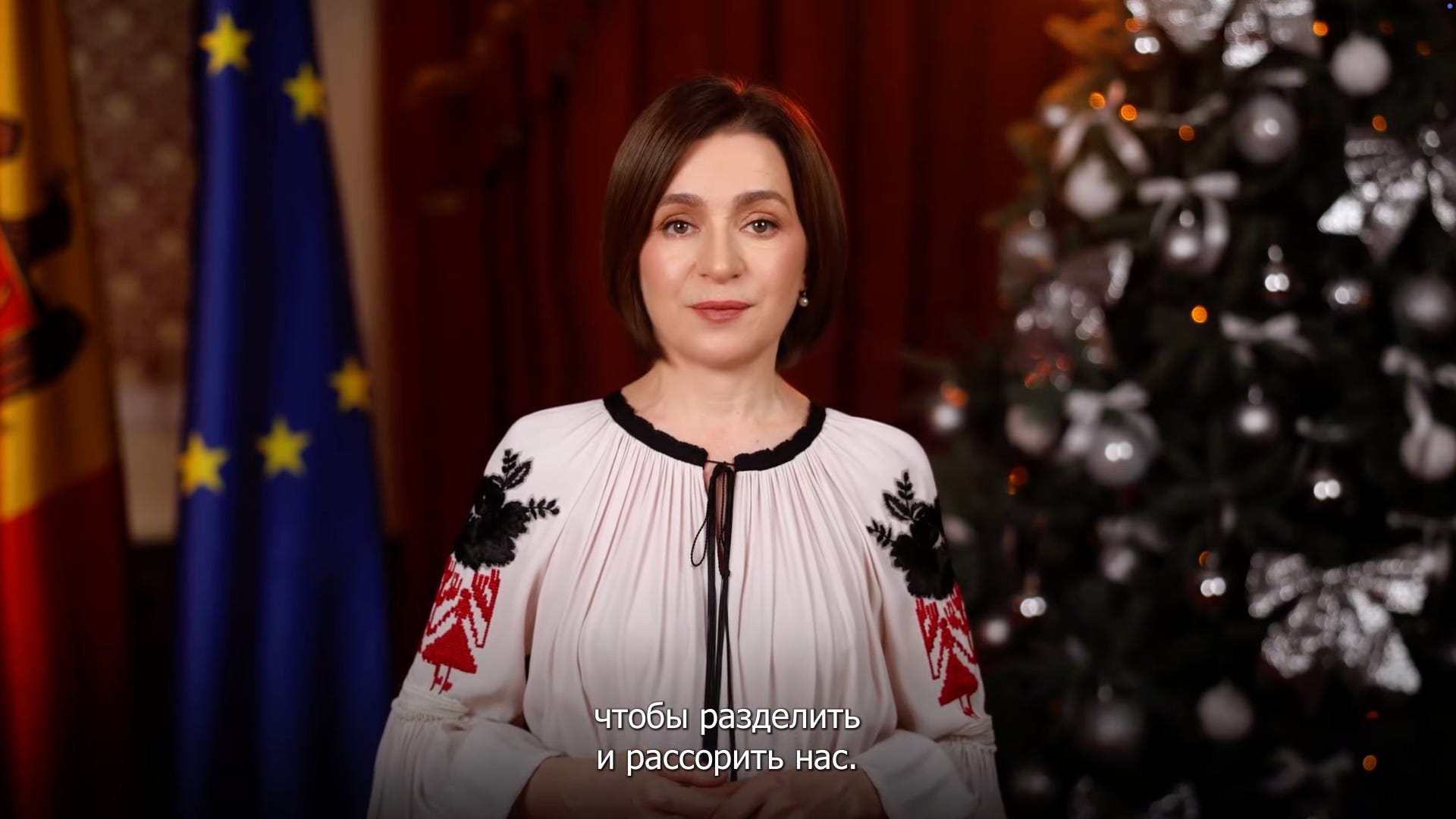
The fact that Moldova celebrates most holidays by the old and new calendar gives a lot of opportunities for holiday cheer. Politicians posted various Christmas messages for December 25th to kick off the holiday season, but the main event is the President’s New Year’s Eve address. This year, President Sandu sought to highlight each citizens contribution in 2025 saying:
“The year 2025 was a courageous year, because Moldovans demonstrated courage and love of freedom. It was a dignified year, because state institutions acted with dignity and patriotism. A year of solidarity through countless examples of care that, I am convinced, almost each of you demonstrated. A year of trust – we trusted each other and our country and strengthened our belief that Moldova deserves and can be a good country for its families, for children and the elderly, for strong traditions, but also for groundbreaking innovations.” (…)
The challenges of 2025 have brought our society to its knees, at times. We have had battles imposed by others to divide and argue. The holidays are a time when we can put everything aside and turn our hearts and minds to the things that matter most – the well-being of our families and the peace in our homes.”
The holidays finally wrap up with Old New Years on January 14th. Whew… that was a lot.
The Rest is Politics Leading
As I wrote about last week, Hosts Rory Stewart and Alastair Campbell of The Rest is Politics Leading interviewed Maia Sandu in Chisinau. Their hour long English language interview went live yesterday - you can find it on youtube or wherever you get your podcasts.
The interview is wide ranging, starting from her childhood in the Soviet Union and progressing through her entry into politics and growth as a politician. In it, President Sandu is very candid and strikes a conversational tone throughout.
One answer of hers has already made quite a bit of news in Moldova (and even internationally). In a wider discussion about Moldova’s independence from the Soviet Union and that moment of change, the hosts asked about Union with Romania. Maia Sandu gave an interesting answer saying:
“If we have a referendum, I would vote for the unification with Romania. Look at what’s happening around Moldova today, what’s happening in the world, it is getting more and more difficult for a small country like Moldova to survive as a democracy, as a sovereign country, and of course to resist Russia. But as the President of Moldova I do understand, looking at the polls, that there is not a majority of people today who would support the unification of Moldova with Romania. But there is a majority who support the EU integration. This is what we are pursuing, it is a more realistic objective and it helps us to survive as a democracy.”
This answer, separating personal opinion from her political project or political ambition, is not particularly surprising. Running for President back in 2016 Maia Sandu answered the same question the same way on Romanian language TV. It’s also been the basic assumption of her position both by political allies and enemies.
That said, she has rarely spoke of the topic in the intervening years as Union is very politically divisive in Moldova. The opposition are already putting out messages attacking her on this and it is likely to be a reoccurring attack line. It’s unclear if she wanted to send a signal with this statement, or if she is simply feeling more comfortable now that she does not face reelection.
If you haven’t listened already, I highly recommend the interview!
Russia Strikes the Maiaki-Udobnoe Bridge
On December 18th Russian drones struck the bridge at Maiaki-Udobnoe damaging the structure and cars that were passing. You can see video of the attack here:
This bridge lies just outside the Moldovan border on the road to Odesa. In the past I have written about how the geography of southern Moldova and south western Ukraine create complex interdependencies - here’s a good example.


In the lefthand image you can see Moldova’s 2 main souther border crossings with Ukraine in green. Crossing (#1) Palanca leads to a winding road through marshland in the Nistru river delta before crossing at the (#3) Maiaki-Udobnoe bridge into Ukraine proper. Crossing (#2) Tudora leads into the Budjak region and towns like Bilhorod-Dnistrovskyi. Crossings from Budjak to Odesa all cars must backtrack via Moldova and the (#3) Maiaki-Udobnoe bridge or the via the (#4) Zatoka bridge. That later bridge was destroyed in the first weeks of the war to isolate Budjak from Odesa1.
With the bridge damaged, cars and buses were turned around at Palanca and Tudora and the General Inspectorate for Emergency Situations, supported by the UNHCR, set up temporary warm tents for people who were stranded. The new route to Odesa, pictured on the right above, meant that a 4-5 hour trip by bus had become a 10-15 hour trip due to this strike.
Within a few days travel resumed for light vehicles while heavy trucks had to remain diverted for a time. This story is important because it underlines how interlinked Moldova and Ukraine are in the river delta regions. Russia’s strike - timed right before the holidays and without a military purpose - also underlines their desire to inflict maximum pain and inconvenience on the civilian population.
Shor and Hybrid War Updates
Here’s a roundup of the top Shor / hybrid war updates of the last few weeks:
Venezuela oil tanker linked to Shor. As part of the war and partial blockade by the United States against Venezuela, the US Coast Guard attempted to interdict an oil tanker on December 20th. The tanker was flying a Guyanan flag and managed to evade the coast guard and lead them on a multi week chase from the Caribbean to the North Atlantic. On the 4th day of the chase the tanker painted a Russian flag on their hull and (according to some media) rendezvoused with a Russian submarine for escort. This didn’t help much as the tanker was later boarded and captured on January 7th. RFE/RL Moldovan service reported that this tanker has close ties to Ilan Shor. The system of shell company ownership is very complicated, but the owners of the tanker as well as the fuel distributors and other companies associated with it, mostly lead back to women from Moldova who are also holders of Shor’s other companies (TV stations, etc). So like a bad penny, Mr. Shor keeps showing up as a shadowy figure behind global news stories.
Shor’s A7 network is growing in Kyrgyzstan. Local investigative outlet Kloop reported that despite sanctions, the A7A5 cryptocurrency is growing in scale and in capability. Their investigation shows the Shor network entrenching itself in the Kyrgyz business, banking and political system as they build out more and more tools for sanctions evasion. They even quote A7’s Director of Government Relations and International Relations, Oleg Ogienko, as saying that “Sanctions are something we were preparing for [...] there were some negative consequences, which we successfully mitigated.” Critically, A7A5 has created a new product - a “digital bill of exchange” which functions like a digital bearer bond. Like a paper bearer bond, this product would entitle the owner to a set amount of the A7A5 cryptocurrency when they redeem it. Until they do redeem it though, it could trade like cash - leaving no record of transactions on the crypto ledger at all. So between the issuance of the “bond” until its redemption it could not be traced.
Shor’s people keep getting sentenced… and fleeing. Prosecutors and courts and now providing a steady drumbeat of convictions and sentences for local leaders in the Shor network. This is leading to preemptive departures by top Shor elected officials, with Veaceslav Zhukov, chairman of the Pobeda (Victory) Bloc of the Balti Municipal Council, joining this growing exodus. Unfortunately, high profile figures are still dodging their convictions because…
Former President of the People’s Assembly of Gagauzia, Dmitrii Constantinov, vanished before sentencing. On December 26th he was sentenced to 12 years in prison after being convicted in a case of abuse of power and embezzlement of 46 million lei. Constantinov, who stepped down as President of the Assembly in November, had served in the role since 2022 and was a prominent Shor network politician. He attended the creation of the Pobeda Bloc in Moscow and in spite of recent statements attempting to distance himself from Shor, had close links with the oligarch. Dmitrii Constantinov did not attend his sentencing as his lawyers claimed he was in the hospital. On December 30th Police reported that he had escaped to Transnistria on December 25th. On that day, supported by unnamed others, he changed vehicles 3 times on the short drive in order to throw off surveillance and prevent tracking. He joins a growing number of Shor officials who sit in Transnistria rather than jail.
Victoria Furtună and Vasile Costiuc each appealed to Marco Rubio on December 24th following the US announcing sanctions against EU officials and activists. The politicians, linked to Shor and George Simion respectively, both claimed that they were being censored in Moldova due to their “sovereignist convictions,” and in Furtună’s case her “open support for @POTUS Donald Trump.” Costiuc claimed that he plans more meetings and work in order to “strengthen cooperation and jointly counter the abuses of the ‘Soros’ network” who he calls parasites2.
Moldovan citizen Denis Cuculescu was sentenced in absentia to 15 years in prison for treason and fraud. The trial showed the Cuculescu was recruited to work for the FSB by fellow Moldovan citizen Nidjat Askerov (subject of a parallel trial). Askerov’s handler with the FSB was Iurii Gudilin. If you remember that name then you will recall that Gudilin was sanctioned by the US in October 2022 as a major player in efforts to undermine Moldova’s democracy. He was also a lead campaign consultant for Igor Dodon in 2020. In the trial, Denis Cuculescu was shown to have been brought in as a crypto and money laundering specialist, and to have moved more than €300 euros from Russia to Moldova. From February to March 2022 he also recruited other operatives in order to “incite the population against refugees from Ukraine” by vandalizing buildings and cars while painting Ukrainian symbols on them. In one case, he tried to hire someone to set an Instagram influencer’s car on fire. In the trial various witnesses spoke to Mr. Cuculescu’s connections in Chisinau - here are a few stand out quotes:
While in Odesa with Cuculescu withdrawing money, a witness claimed that Cuculescu said “the money belongs to the Russians.” He then noted that he was working with “a very influential person, Nidjat Askerov, who would have direct connections with Ion Ceban and Igor Dodon , free access to the Chisinau City Hall and influence at the diplomatic level.”
They later went to a birthday party at a disco and spent €4000-€5000 euros of this “Russian” money. Denis Cuculescu berated Nidjat Askerov saying he was “stupid” and that “the money represented salaries for people from the Chisinau City Hall and that Askerov easily spent foreign money.”
Another witness explained that after Igor Dodon lost the 2020 election, his Russian advisors Iurii Gudilin and Olga Grag, promoted Nidjat Askerov for his work in that race and delegated him to work for Ion Ceban in the future.
Denis Cuculescu has been put on the wanted list and is being sought by police. He is understood to have fled to Russia.
Other Crime and Corruption Updates
Here’s a roundup of the other top stories in crime and corruption:
Former Prime Minister Vlad Filat was sentenced to prison in France. Filat and his ex-wife Sandra were both sentenced to prison time (2 years for him and 18 months suspended for her) and fined €100,000 and €150,000 euros respectively. The case stems from 2012-2014 when Filat and his ex-wife bought multiple French properties through shell companies and an intermediary. He was convicted of using funds from a Canadian company that in 2011 was awarded the contract to manage Moldova’s National Lottery. The court ruled that the corrupt origin of the funds had been deliberately concealed. The Moldovan State joined the case seeking moral damages and was awarded €10,000 euros - to be jointly paid by the Filats. Vlad Filat maintains his innocence and is appealing the case.
Quick Explainer: Filat has been found guilty in the first instance, and France has put him on the Interpol international wanted list and notified Moldova. The Moldovan constitution prohibits the extradition of citizens, so for now he’s safe in Moldova but is effectively banned from international travel. In France, the conviction is not consider to be final until appeals are exhausted. In theory, Moldova can request that France forward the case material and try him in Moldovan courts (with potential for Moldovan prison time) on the merits. This is highly unlikely until the case is final in France (which could take years). That said, in order to join the EU Moldova must change its extradition rules. Filat is fine for now at home, but faces some real jeopardy in the future.
Maia Sandu Speaks Out About Justice System Issues
On December 30th President Sandu called a press conference to urgently appeal to parliament and the government to reform aspects of the vetting mechanism. Like in France, Moldova’s system has a trial “in the first instance” followed by an almost automatic appeal on the merits for major cases. Because the appeals court ultimately decides these cases, the vetting process has focused on this court as well as other high courts such as the Supreme Court of Justice (SCJ). In her press conference, the President noted numerous high profile corruption cases with trials nearing a decade in duration. She called on an urgent extension of the vetting process to the lower courts so that judges to not feel that they are perpetually exempt from scrutiny - and therefore comfortable taking indefinite payments for prolonging the trial.
Additionally, the President called attention to the new role Transnistria is playing in justice saying:
“Another issue I want to address – an issue widely followed and discussed in society these days, is the fact that people awaiting their sentence leave the territory controlled by the constitutional authorities before it is pronounced. The Transnistrian region is increasingly used to evade serving their sentence. And the procedures for searching for the convicted person are ineffective, because they involve terms that jeopardize the possibility of locating the person and thus, the chance for him to be brought before the courts to be served justice is lost.”
A Serial Killer in Anenii Noi?
On December 24th the Moldovan police put out a press release indicating that they may have caught a serial killer. Details began to emerge over the following weeks but the picture remains far from complete.
The story begins in September of 2025 in the town of Beriozchi, Anenii Noi, when a 61 year old man named “Gheorghe” went missing. The man’s wife notified the police who quickly suspected local farmer Stepan Gaina and went to talk with him. Gaina has an extensive violent criminal record dating from the early 90s and is known as something of the town thug. Over time he purchased a number of adjoining properties and ran a farm along with his son and girlfriend.
Police questioned Stepan Gaina who said that he had not seen Gheorghe for 6 months. Police later found video from a shop camera showing Gheorghe walking down the street the day before with Stepan Gaina and entering his house. That was the last anyone saw of him.
When confronted by Gheorghe’s wife who threatened to open a missing persons case, Gaina ominously replied:
“there is no body - there is no case, especially with the way our police work.”
Apparently, he was wrong. Chief of the national police Viorel Cernăuțeanu gave an interview in late December where he explained that they strongly suspected Stepan Gaina from the start but felt that the existing circumstantial evidence would not hold up in court. So the police decided to send an undercover cop to pose as a farm hand and observe Stepan Gaina. This undercover investigation led to a large scale raid and search of the property on December 22nd and was later followed by this statement from the Chief Viorel Cernăuțeanu:
“At the same time, we equipped his household with special equipment so that we could see absolutely everything that was happening and to exclude the risks to the infiltrated person [the undercover cop],”
“As part of the measures, new suspicions arose regarding the commission of the crime of murder in relation to other people, and this terrifying fact was confirmed that, in order to destroy the traces and all evidence, people were being used as food for pigs.”
Emphasis mine.
The police are not currently saying how many murders they suspect were carried out on this farm but have indicated that there were at least 3. They have removed 30+ tons of material from the farm for searches - including land to sift through for evidence. They noted that the property is large and the search will take some time. The 33 year old son of Stepan Gaina was arrested while trying to flee the country - police say that they suspect him in a crime committed with his father dating back to 2012-2013.
We’ll check back in with this story as the police release more updates.
Economics / Infrastructure
Here’s a roundup of the top economics / infrastructure stories of the past weeks:
The Straseni-Gutinas high voltage line will be constructed by American companies. This was confirmed by Moldova’s Ambassador to the United States Vladislav Kulminski who said that the project “isn’t charity at all; it’s a partnership.” He noted that the $130 million dollar project is among the largest approved under the Trump administration and that it signaled strong support for Moldova as well as a future based on win-win style projects. Recall, the Straseni-Gutinas high voltage line is the 3rd of 3 planned interconnections between Moldova and Romania. It was previously funded by USAID with construction planned to start in late 2025 and finish by 2029. When the money was reallocated in mid-September, American officials had stated only that American companies should get a fair shake at the opportunity to implement the project. Moldovan officials would say that using American companies was not a condition of the grant. Ambassador Kulminski has more or less spelled out the unspoken assumption that underpinned those statements.
Experts project economic growth in 2026. The IMF projects 2.3% GDP growth in 2026 to rise to 3.7% by 2028, while the Ministry of Economy projects rates of 2.4% and 3.6% respectively. While the IMF notes that the forecast is subject to "significant uncertainty," other experts who spoke with Newsmaker expressed confidence that the economy would return to moderate growth in 2026.
At the time this was thought to foreshadow an amphibious landing in the sparsely populated Budjak region. If this had happened, the Russian army would have needed to cross through Moldova in order to link up with the other forces approaching Odesa from Crimea. This is just one of the many geographical realities that mean an attack on Odesa requires the Russians to invade at least parts of Moldova as well.
It’s hard to even remember a time when we had to call these dog whistles right?