
This article was first published in the Autumn - Winter 2026 edition of the “East-West Review,” the Journal of the Great Britain-Russia Society. Editor Charlie Mackenzie Portlock asked me to submit an article looking at Moldova 35 years after the collapse of the Soviet Union. Today I’m republished the article with permission for Moldova Matters readers. I also encourage you to check out the other interesting articles in the East-West Review.
On August 27 Moldova celebrated 35 years of independence with the tagline for this year’s celebration being “Independence Unites Us.” One could say that those three and a half decades since the collapse of the Soviet Union have been a story of Moldova searching for this unity against a Russian Federation that was never keen to see the former colonies wander too far.
For most of those years Moldova has been considered a backwater in Europe. News outlets took to calling it the “poorest country in Europe” and would confine their coverage to a few biannual photo essays showing statues of Lenin and gray buildings under an overcast sky.
The story of the country’s politics as told by Western observers was always one of false starts and missed opportunities. As the Baltic states sprinted towards NATO and the European Union (and Romania and Bulgaria lurched behind them), Moldova seemed destined for a two steps forward, one back, three sideways and a somersault - all to land roughly where they started.
…and this is exactly how the Kremlin liked things.
Agency comes in many forms, but for a country it is often as simple as being able to tell its own story. In Moldova’s case, the issue was that few were listening. To this day, Moldova has no resident foreign correspondents from any major Western outlet. In September, the New York Times published yet another “Moldova is gray and full of sadness” article that infuriated people locally because it was both false and deeply insulting. I wrote an op-ed calling it out at the time.
Now Moldova is starting to tell its story more forcefully, and a big part of that story is one of determined resistance to constant Russian pressure and interference. In September, the country’s top investigative newspaper Ziarul de Gardă debuted a documentary called “In Moscow’s ‘Friendship’: 35 Years of Russian Influence in the Republic of Moldova.” The title relies on a bilingual pun: in Russian, the word for friendship is дружба (druzhba), while in Romanian, the same word (drujbă) means “chainsaw.”
In 1992 separatists in the Transnistria region, mostly led by criminal gangsters, attempted to break away from Moldova. This short but bloody war was frozen by the intervention of the Russian 14th Army, which backed the separatists against the fledgling Moldovan defense forces. This conflict remains frozen to this day with Russian soldiers stationed on Moldovan sovereign territory long after their own self-declared mandate expired. In justification, they claim the need to guard a Soviet-era ammunition depot at Cobasna that is supposedly so dangerous that it could explode with the force of the Hiroshima bomb if left unattended. This narrative is a lie, constructed over time by many hands and now used by Russia for leverage in talks with Western leaders. I recently published a two part investigation debunking this narrative in Moldova Matters based on historical interviews and a new explosive ordnance study by the Moldovan Army. The real reason the Russians remain there is simple - control.
Over these 35 years Russia has used its monopoly on Moldova’s energy supply as a weapon, raising prices or threatening to turn off the tap anytime that the Moldovan government strays from Moscow’s line. For decades Moscow provided “free” natural gas to Transnistria. This subsidized its clients, while purporting to show how the “grass is greener” when you are friends with Russia. Meanwhile, the Kremlin chalked the debt for this free gas up to the Moldovan government, using the fake debts as leverage in European courts and diplomatic negotiations.
Other tools of economic coercion have also wreaked havoc on the Moldovan economy. In 2006, Russia imposed a crippling embargo on Moldovan wine. This first embargo was designed to pressure Moldova into changing its constitution in such a way as to give Transnistrian oligarchs and their FSB masters control of the country. At that time, 80-90% of all Moldovan wine exports went to Russia. Later embargoes hit wine, fruits, vegetables and more in 2013, 2014, 2022 and 2023.
Then, there was the so-called “Russian laundromat.” This scheme, which moved between $20 and $80 billion out of Russia between 2010 and 2014, relied heavily on Moldovan banks and courts. In the process, it deeply entrenched corrupt networks in Moldova’s judiciary and political elite.
Moldova has always factored importantly into Vladimir Putin’s plans and through 2019 he mostly kept the country where he wanted it - poor, corrupt and hopelessly divided. But there is a point at which people can be pushed to when they say “no further.”
In 2021 Maia Sandu’s Party of Action and Solidarity (PAS) won a parliamentary majority with a campaign slogan of “good times are coming.” The message was simple: if we clean up corruption we will have more money for schools, for roads, for healthcare, for citizens.
All through this time Moldova was building resilience against Russian threats and attacks. Following the embargoes Moldovan wine makers tore up their vines and pivoted from the sickly-sweet wine loved by Russian consumers to more sophisticated varieties, rediscovering native Moldovan grapes like the Fetească and Rară Neagră blends along the way. Even now, Moldova produces less wine than it did before 2006, but it is far more valuable and the country wins award after award at international exhibitions.
When Russia invaded Ukraine in February 2022 no one in Moldova believed they would stop at the border. One military officer who served on the general staff at the time told me that they expected to be engaged within seven days.
Even while Russia was coming, Moldovans opened their country and their homes to massive numbers of Ukrainian refugees. Millions of Ukrainians crossed the border of a country with only 2.5 million residents, most headed west but many stayed - for days, for weeks, some until today. Moldova saw the largest per-capita refugee flow with the least international support. As major organizations and volunteers clustered at border points in Poland, they ignored Moldova either out of ignorance or fear that the country would soon itself be invaded. That didn’t matter as Moldovans rose to the occasion and earned the moniker “small country with a big heart.” To this day Moldova has seen negligible backlash or ill-will towards refugees in spite of massive Kremlin propaganda campaigns and provocations by pro-Kremlin politicians.
That response highlighted a simple truth - Moldovans are much more united than outsiders understand. Politically, overwhelming majorities see themselves as part of Europe and reject a future in some reconstituted Russian empire. Ironically, the first people that Moldova really told its story to were the hundreds of thousands of refugees who found an open door and a welcoming seat at the table.
Since February 2022, Russia has not ceased to try to break the Moldovan government and its people’s dreams for Europe. In 2023 they tried to organize a violent coup with paid rioters and mercenaries. In 2024 they spent hundreds of millions of euros, including directly bribing around 140,000 voters (almost 10% of the turnout), to vote against a referendum on European integration. In 2025 they spent hundreds of millions more euros to try and sway parliamentary elections towards the myriad parties they controlled directly from Moscow.
They failed. Each time they failed, and each time Moldova gained more confidence in its own agency. Slowly, the rest of Europe has started to take notice. Moldovan teams of journalists and civil society activists have advised and supported colleagues in Armenia, Hungary and elsewhere to push back against Russian information warfare and election interference.
That confidence came at a cost. Today, Moldova has fully shifted away from Russian energy sources - a high price to pay for independence as consumer energy bills have risen by more than six times. Moldovans have seen cumulative inflation of more than 75% since the invasion.
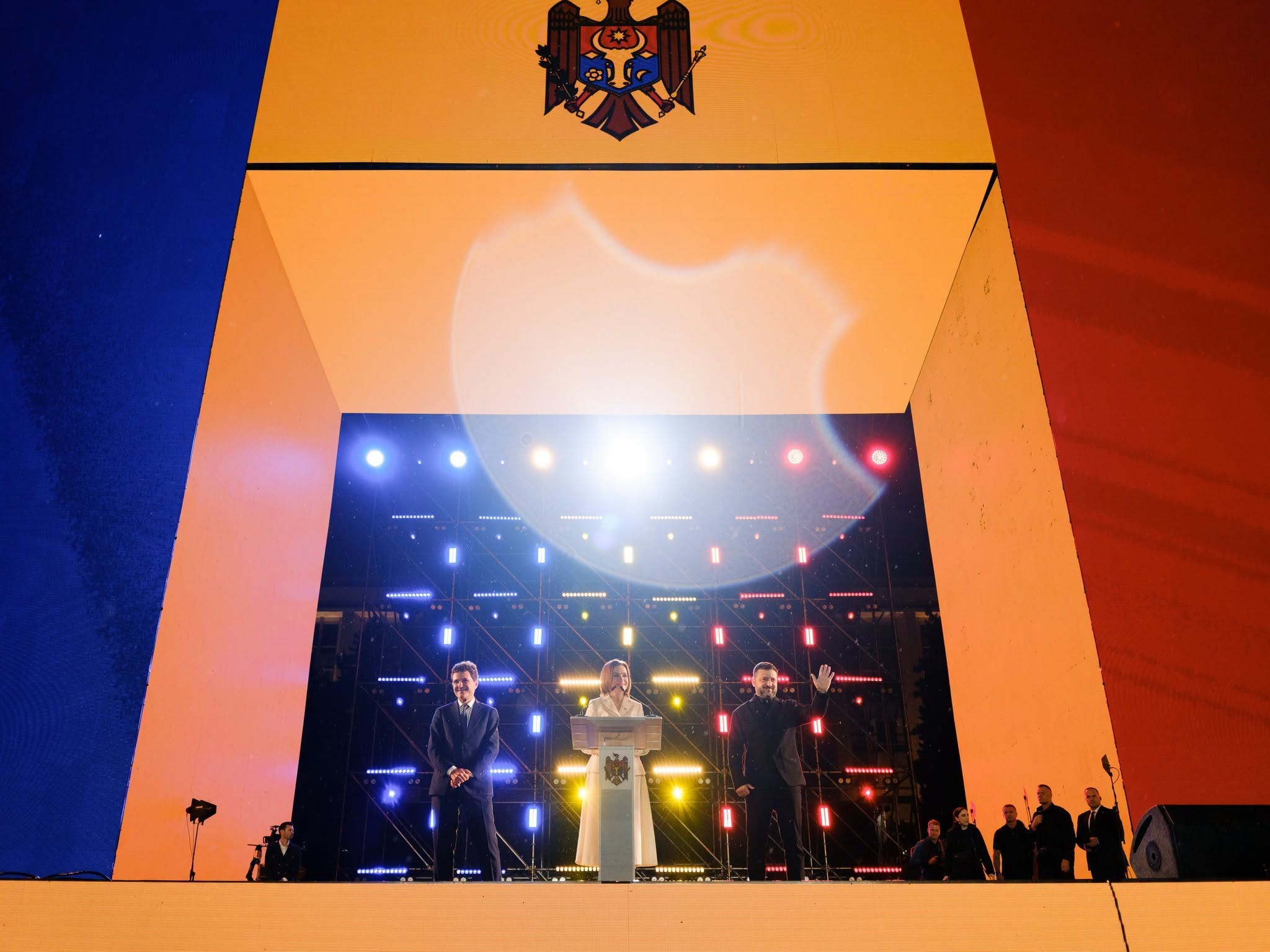
To mark the 35th anniversary of Moldova’s independence, Ukrainian President Volodymyr Zelenskyy and Romanian President Nicușor Dan both traveled to Chișinău to celebrate alongside Moldova. Speaking alongside them, President Sandu said:
“Independence means having light and warmth in your home, no matter what is decided in Moscow. Selling your products where you and your work are respected. Choosing your own friends and path. Being treated as a partner, having a say. And deciding, by voting, who runs the country.
Independence means being able to choose. Friends, allies, a path.”
It is my hope that as the country celebrates its 40th birthday, it will be doing so safely West of the new iron curtain that is descending and within the European family of nations.