

“Cobasna: Separating Myth from Reality”
That is the title of a new report on the Cobasna ammunition depot in Transnistria, produced by Moldovan Army Intelligence and the Security and Intelligence Service (SIS). This morning, the directors of these agencies presented the major findings of this report in a press conference.
Moldova Matters received an advance copy of this report several weeks before its public release, under an understanding that we would not publish before the government's own announcement. That time allowed for the interviews, technical verification and cross-referencing that inform this piece.
This article is Part 2 in a series with the first being a history of Cobasna and of the myths and narratives that shape our perception of it today. If you haven’t already, I suggest starting with that article first:

The report itself is only 17 pages long plus graphics and annexes. I will update this article with a link to the public version when it is posted officially.
** Update: The full report in English is available at this link.
Today, we’re going to look at the key claims and findings of this new study and compare them to expert analysis to see if they hold up.
This new report is the first substantial publicly available analysis of the condition and safety of the Cobasna depot since 2005. If credible, it could completely change the public discourse around this critical security issue. Let’s dive in.
The Report - What is it and What Does it Aim to Do?
This report is a military and intelligence analysis of the Cobasna depot. It is not an independent analysis and should best be seen as the Moldovan government’s official view on the matter. As the title suggests, the report is explicitly aimed at debunking myths that have emerged about Cobasna in the absence of verifiable information about the depot and its contents since 2006. Most importantly - the report seeks to challenge the 2005 National Academy of Sciences report and its claim that a detonation at Cobasna would result in an explosion with the power of a nuclear weapon - usually framed as having the same power as the “Hiroshima explosion in 1945.”
Claim 1: New Munitions Tonnage Estimate
The report claims that, following the removal of approximately 21,000 metric tons of ammunition between 2001 and 2004, “The remaining stockpile is currently estimated at 14,000 metric tons, consisting mainly of obsolete munitions whose authorized storage life has expired.”
This is a substantial drop from the 21,000 metric tons estimated to remain at Cobasna in 2006 according to the last OSCE report1. This report does not specify how they came to this new estimate, except to say:
“The estimate of the remaining stockpile is based on an analysis of military activities conducted on the left bank of the Dniester over the years, as well as information derived through HUMINT2, OSINT3, GEOINT4, and SIGINT5.”
A source involved in the assessment told Moldova Matters that the estimated drawdown related to ammunition used for training in the last 20 years. They stated:
“The 20,000-tonne figure is outdated. Our data, collected over years, tracks what the Operational Group of Russian Forces and the so-called Transnistrian army have used for their own equipment and training.”
I asked Ambassador William H. Hill, Head of the OSCE Mission to Moldova from 1999 to 2001 and from 2003 to 2006, what he thought of this estimate. He suggested that the estimate was credible, but at a lower bound of numbers he has heard informally discussed.
In particular, he noted that the Russians and Transnistrians have withdrawn ammunition for the depot for training and military exercises over the last 20 years. Ambassador Hill stated that the “Moldovan and Transnistrian administrations are thoroughly penetrated by each other” and that the Human Intelligence (HUMINT) cited is likely to come through cousins, family connections and efforts by the Moldovan security services to monitor movements of these munitions over many years. He concluded that the Moldovan Army should have “a pretty good idea of how much ammo they’ve taken out of Kolbasna [Cobasna] in order to conduct or to use in these exercises,” concluding that the figure is “probably a pretty good guess.”
A different former OSCE staffer who spoke to me on background agreed that the estimate could be credible, but suggested that smuggling and black-market sales could also not be ruled out as a cause for the drawdown.
At the same time, this report does not allege any illicit removal of ammunition. Ambassador Hill found this extremely interesting and a major departure from the position of the Moldovan security services in the early 2000s. In many cases at the time, allegations of terrorist connections or arms dealing were used as a political cudgel against the Tiraspol “authorities” by the Voronin government. Ambassador Hill stated that the tenor of this report was very different and called it “a professional report” that “takes the data and draws the conclusions that it can.”
So while the drawdown to 14,000 metric tons is an unconfirmed estimate, multiple sources found it credible, but also noted that this is still a lot of munitions.
Claim 2: Mass Does Not Equal NEQ
The report explains that the 2005 National Academy of Sciences report and other narratives claim that Cobasna has the explosive equivalent of a nuclear bomb. This report claims that this view conflates total mass with Net Explosive Quantity (NEQ). The OSCE estimate of 21,000 tons of munitions, or this report’s 14,000 tons estimate, both include explosive materials and shells, casings, bomb components, crates, packaging and more.
This report notes that only 14-17% of an artillery shell’s mass is actually explosive material, with the rest being the metal shell and case. Similarly, it states that the explosive proportion of an aerial bomb “rarely exceeds 30-40%.”
The proportion of a munition that represents the actual mass of explosive material is called Net Explosive Quantity (NEQ). Of the 14,000 tons the report estimates to be at Cobasna, they estimate approximately 2,800 tons of that is NEQ - meaning that four fifths of the stockpile is inert material.
NEQ Does Not Equal TNT Equivalent Either
This is not outlined in the report, but came up in conversations I had talking to experts on background. NEQ does not cleanly compute to the “TNT equivalent” used to describe nuclear weapons yield. NEQ is a mass calculation, while TNT equivalent is a unit of energy. Some reasonably modern high explosives stored at Cobasna may have a higher explosive energy rating than 1 kg TNT equivalent. At the same time, many items - especially small-arms munitions for pistols and rifles - will have propellant charges far less powerful than TNT (and not designed to explode).
That’s not a 10 Kiloton Warhead
Taken together, the mass to NEQ to TNT consideration means that reports that casually toss around the Hiroshima figure massively simplify a complex situation. The 2005 National Academy of Sciences report estimated that of the OSCE-reported 21,000 tons at Cobasna there was a TNT equivalent of 10,000 tons (10 kilotons)6. The new report claims a much lower NEQ, and importantly notes that it isn’t stored all in one place.
Claim 3: No Instant Chain Reaction
The report states that while past estimates have modeled a “perfect explosion” to present catastrophic scenarios…
“A proper assessment begins not with the question ‘How many tonnes of munitions are stored at Cobasna?’ but rather ‘What quantity of explosives could be involved in a specific event, and how would that event propagate?’”
Having re-examined the total amount of munitions on site as well as the NEQ of the stockpile, the report then moves on to look at how they are stored. It states:
“The explosive fraction itself is dispersed across dozens of separate storage facilities of three types - above-ground, semi-buried, and underground (Annex No. 1, 10 pages). This dispersal, together with the protection provided by compartmentalized infrastructure and the terrain, means that any incident would involve successive explosions and localized fires rather than a single large-scale blast.”
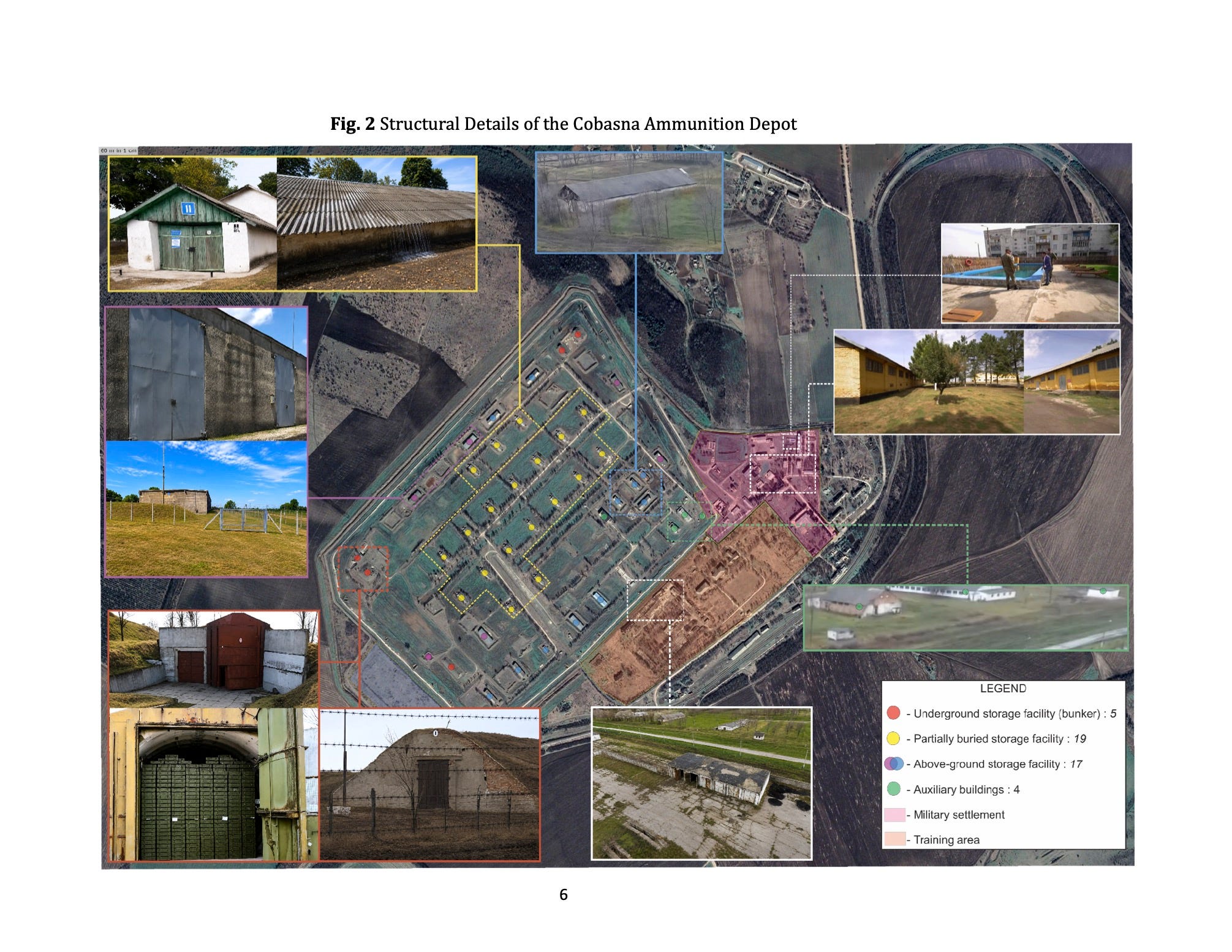
In essence, different munitions carry different levels of threat and are therefore stored accordingly7. Here are pictures of the 3 types of storage facilities:


The report provides illustrations of each as well as an indicative illustration of how each one would explode if the munitions inside were to detonate.


Just as important as the types of facilities is how they are arranged. The report states:
“The depot covers a total area of approximately 132 hectares and has a perimeter of about five kilometers. The technical storage area covers approximately 1.03 km² and contains 42 ammunition storage facilities of three different types. These facilities are located approximately 80–200 meters apart and are separated by natural and man-made barriers.”
You can see the type and distribution of these storage facilities here:
At the core, the report is making 2 separate arguments here, one explicitly and one implicitly.
Explicit: “Nuclear” explosions are simply not how ammunition depots blow up. If this facility was subject to fire, bombing, lightning or some other catastrophe, it would operate as intended and either keep damage contained to some sections, or be destroyed by a creeping calamity as fires spread slowly building to building over hours or days.
Implicit: By and large, this facility is not only designed to work as described, but maintained as such also.
On the first claim, experts I spoke to were unambiguous in agreement, with one former OSCE staff member speaking on background about the instantaneous explosion scenario saying simply “that’s not how ammo depots blow up.”
As we will see in the next section, this isn’t a matter of professional opinion - the last few years have given us numerous examples of exploding ammunition depots to consider and the report studies them as well.
On the second, implicit claim, I asked Ambassador Hill about how the base was maintained when the OSCE still had access. He stated that at that time, an American military officer with the Defense Threat Reduction Agency (DTRA) lived on the base in the bachelor officers’ quarters and that the OSCE team observed it up close. Ambassador Hill described the depot as “well-run,” noting that while the Russian military “did things in slightly different ways” from the American military, this base was “state of the art” on its own terms. It had precautions against lightning, fire and other hazards. Even if the materiel was “stacked primitively” it was “stored separately and segregated carefully.”
He added that it was “done carefully so that they wouldn’t blow themselves up.”
In March 2023, TV8 ran an investigation on the safety of Cobasna in relation to the ongoing war in Ukraine. In it, they quote Cobasna Mayor Leonid Ivanovich Kuratov stating that the villagers living around 1 km away from the depot are not afraid because it is their place of work and they have good salaries.
This human angle was also important to a former OSCE staffer who served later than Ambassador Hill and spoke to me on background. I asked if there was any reason to believe that the conditions Ambassador Hill described from the early 2000s should have substantially deteriorated. The staffer told me that “the lives of the people there depend on them doing their jobs,” and that unless they have a material shortage, for example, not getting the right wire for a fire protection system, then “I have no reasons to think things would have gone bad.”
So the report’s claim that the materials are stored in a competent, if Soviet, manner that is inconsistent with a single mass detonation holds up. The report then moves on to a discussion of the worst-case scenarios modeled by the Moldovan security services.
Claim 4: Worst-Case Scenarios
In modeling a real-world worst-case scenario, the report chooses to present a highly simplified case with a lot of caveats. You can see the worst-case scenario model on this graphic:
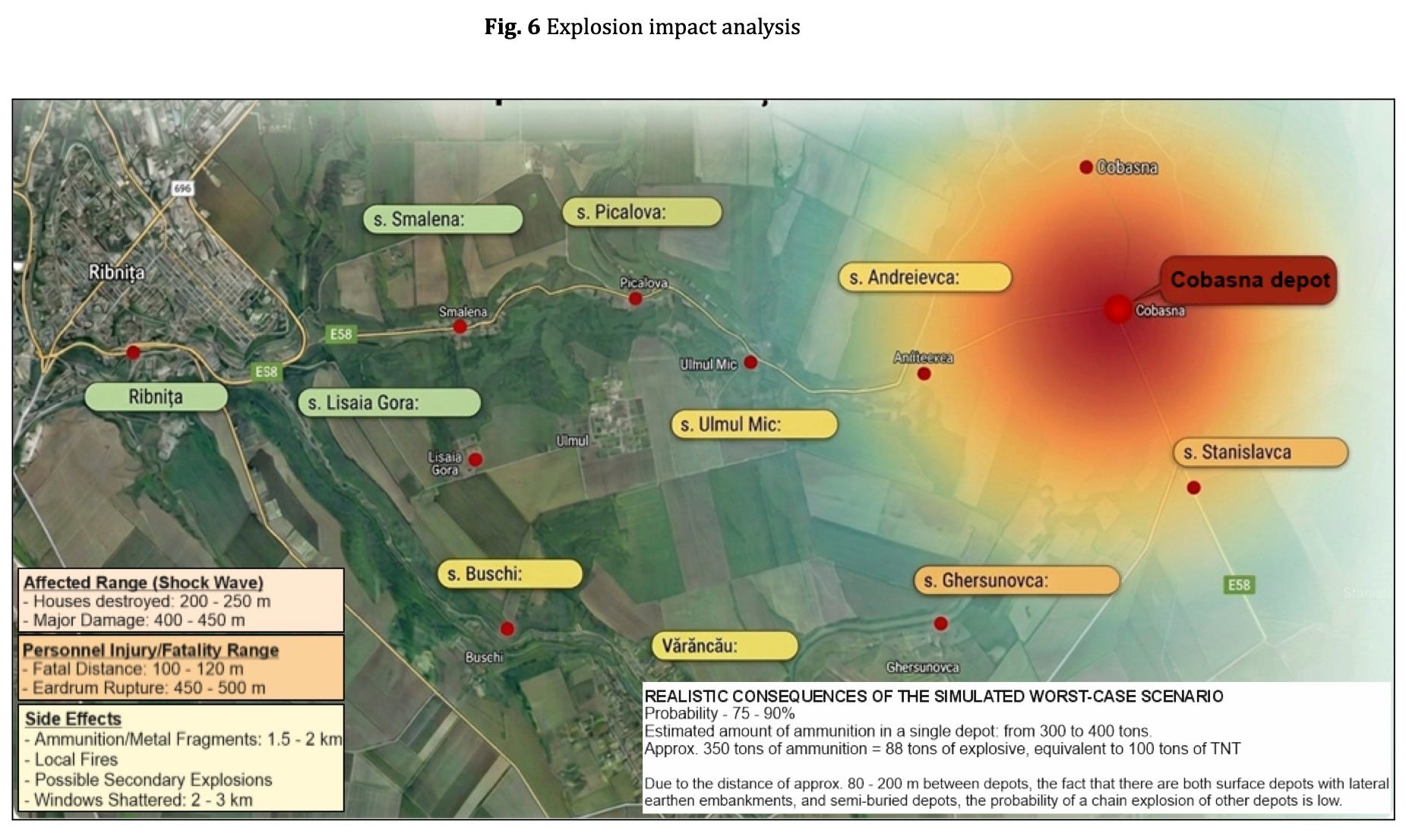
In their model, no chain reaction takes place and explosive shockwaves occur one by one. Fatalities would be limited to some people on the base with serious damage occurring in the village of Cobasna 1 km away. Even then, no shockwave would level the village.
The model used is the UN SaferGuard Blast Damage Estimation methodology, which has a helpful online calculator here. Importantly, this is a “free-field” explosion model focused on direct blast effects. This means that it does not factor in the bunkers and embankments which would serve to slow the detonation, nor does it take into account topography. The report notes that changing elevations and intermittent tree lines would further slow or divert the blast wave(s).
Instead of a blast wave, the report suggests that:
“the primary hazard would remain the dispersal of ammunition components, metal fragments, and infrastructure debris over distances of up to two kilometers, as well as air pollution, which could have minor adverse effects on the population and the environment.”
As one former OSCE staffer told me on background, life would be “really bad” for people living 1 km away, but it would not be Hiroshima.
Bringing it All Together
I asked Ambassador Hill about the report as a whole and how he felt it stood up against his knowledge of the facility. He replied:
“I think it’s probably accurate. I recognized a lot of stuff - they used a tremendous amount from OSCE records and photos... For the purpose of their report, they’re right. It’s dangerous - but not in the sense of the metaphor I used on Transnistrian TV, that it’s like two atomic bombs going off. It’s dangerous, but within limits... They’re quite right to point out that the total weight is not the same thing as the explosive power.”
The report itself concludes on a powerful argument that dispenses with descriptions of bunkers and models and simply notes that since the early 2000s a substantial number of munitions depots in Europe and Russia have exploded. These included depots that were much larger than Cobasna, including:
Balakliia (Ukraine 2017) - Approx. 138,000 metric tons. One civilian death.
Ichnya (Ukraine 2018) - Approx. 88,000 metric tons. No deaths reported.
Toropets (Russia 2024) - Approx. 30,000 metric tons. No deaths reported.
Across these and other comparable incidents, casualties have been in the single digits despite the scale of material involved - a small fraction of what a true mass detonation of even a portion of this tonnage would imply. In each case, the slower, rolling nature of the explosions gave civilians time to evacuate.
Conclusion - Too Big to Verify
At some level, 20,000 metric tons of munitions and 10 kilotons of TNT are numbers the brain simply thinks of as “really big.” When you add in “Hiroshima” and “as large as an atom bomb” then really big = really scary. For many years, I took this story as truth. I had read it repeated in many news stories and heard about the “largest ammunition depot in Eastern Europe” (false). I also heard the story that it would be an explosion equivalent to an atom bomb (also false) many times.
After spending multiple weeks looking into this story, evaluating the SIS / Military Intelligence Report and speaking to numerous experts on and off the record, I’m convinced that the broad strokes of this report are accurate. That Cobasna has no reason to behave differently or worse than Toropets and that the people of Ribnita can sleep well at night knowing that no black circles on a map will be coming for them in the form of a single bright flash.
At the same time, I find myself coming to another deeply uncomfortable conclusion - that this myth should not have persisted for 20 years.
The report from the National Academy of Sciences by Gheorghe Duca is the “scientific” source that has done the most to propagate fears about Cobasna. While Academician Duca told Moldova Matters that he stands by that report’s conclusions and that it was “scientifically independent,” there are clear elements that should have raised eyebrows long ago.
Most nuclear weapons, including the “Little Boy” bomb dropped on Hiroshima, are designed for an air burst. That bomb detonated 580 meters above the city on August 6, 1945. If detonated on the ground, the same explosive yield produces far less of a result as buildings and terrain absorb the blast wave.
Even without a sophisticated modeling of terrain and bunker distribution, we can look at what a 10 kiloton nuclear explosion at the depot would look like with online modeling software (click for a modeled scenario from NUKEMAP). Such an explosion would destroy the ammunition depot, and it would break windows and cause light damage in some parts of the town of Cobasna 1 km away, but it would not level even that town. That’s a far cry from reducing every town in a 50 km radius to ruins.
Similarly, claims of a 75 m deep blast crater should also have raised red flags. The first hydrogen bomb, 10.4 megaton “Ivy Mike,” tested in 1952, only left a 50 m deep crater8.
For more than 20 years, the ammunition depot at Cobasna has produced frightening myths that were used to suit various political ends. Today, the Russian Federation continues to claim that its control of this “exceptionally dangerous” depot is the reason that its army must continue to illegally occupy Moldovan territory. This new report, “Cobasna: Separating Myth from Reality,” is, in my reporting, a highly credible effort to right-size the threat. Cobasna is a serious security problem for Moldova - but one that can be managed.
It is not a “ticking time bomb,” and it never risked being “Hiroshima.” After more than 20 years, it’s time to put that myth to bed.
Recall, that’s 42,000 tons - 21,000 tons withdrawn from 2001-2004 = 21,000 tons remaining
Human Intelligence
Open-Source Intelligence
Geospatial Intelligence (satellite photos, etc)
Signals Intelligence
Note: This basic claim is an error as an equivalent for the yield of the Hiroshima bomb which has been estimated at 15 kilotons.
A box of rifle rounds will “cook off” in sequence rather than exploding while an aerial bomb will behave very differently.
It was a surface detonation as well
A brilliant pair of articles, thank you.
Personally, (without deep analysis), it had always seemed to me that the threat was overstated, though judging by this, not for sound reasons...
In the initial stages of the invasion of Ukraine I followed a chap called Trent Telenko on Twitter obsessively - he was a logistics expert, and pretty much immediately predicted that the Russian vehicles would not get very far, as they had clearly not had the most basic levels of routine maintenance. (He was VERY good at explaining how he could tell, in this case almost universal rust in the lower parts of wheel hubs and similar, showing they had not been moved for a long time)
So my assumption was that the ammo had been similarly poorly maintained.
This seems to have been a dodgy assumption.
But given the mess in Transnistria since Russia cut off energy, it seems possible things have got worse. And highly unlikely they have got better.
Excellent reporting. It was a mood booster to see these articles in my inbox.
“'Moldovan and Transnistrian administrations are thoroughly penetrated by each other' and that the Human Intelligence (HUMINT) cited is likely to come through cousins, family connections[...]."
I have an irrational image in my mind of the "inner-Moldovan" border being akin to the inner-German border of the Cold War era. Little things like this in in your reporting do a good job of dispelling the idea that I (and I assume many Westerners who have never been to Moldova) have of the nature of the Transnistrian entity.
One question I still have is: What would be the best option for dump if convergence happened tomorrow? On-site disposal? Shipment to a third party nearby to the east?