

In the north of Transnistria sits the Cobasna ammunition depot, a huge facility often described as the largest munitions storage site in Eastern Europe. It sits right on the border with Ukraine and is guarded by the Russian army contingent in Transnistria. This ammunition depot is one of the most important and least understood elements of Moldova’s foreign relations. Russia uses it to justify the continued presence of Russian troops in the region, while the EU wonders how it can absorb a country that does not control such a facility on its territory. Finally, there is a persistent narrative dating back more than 20 years that the facility itself is a ticking time bomb - that one day it will simply explode with a force equivalent to the Hiroshima atom bomb.
Today Moldova Matters is publishing a 2-part investigative series looking into Cobasna in order to better understand what is really there, what threats it poses and what it means geopolitically.
This series comes in the context of a new report titled “Cobasna: Separating Myth from Reality” that has just been released by Moldova’s Military Intelligence Agency in collaboration with the Security and Intelligence Service (SIS). In this article, we’ll first look at the history of Cobasna from 1949 through 2006. In the second article (in your inbox now), we’ll dive into the new report and assess its credibility and put the new findings into context.
Ready to Supply the Southern Front of World War 3
The origin of the Cobasna military depot dates back to 1949 and the earliest days of the Cold War. Originally designated Artillery Depot No. 1411, the Cobasna facility grew over time to be part of the infrastructure of the Soviet Union’s WW3 plans for South Eastern Europe. The reason for this was that while Romania was a Warsaw Pact member, it never hosted Soviet troops or military bases directly. Romania’s Communist leader, Nicolae Ceaușescu, also charted a somewhat independent course, refusing for example to participate in the 1968 invasion of Czechoslovakia. This meant that Moldova, and modern-day Transnistria in particular, hosted large stores of munitions and heavy weaponry that was ready to be utilized in the event of a war with NATO.
As the Soviet Union approached its collapse, ammunition that was withdrawn from other Warsaw Pact countries such as East Germany, Hungary and Czechoslovakia, was transported to Cobasna and stored there. By the time the Soviet Union itself collapsed, there was a vast quantity of munitions in Cobasna, as well as a massive supply of heavy weaponry also in Transnistria.
While this depot was now officially on the territory of the newly independent Republic of Moldova, the 1992 Transnistrian conflict created a significant dilemma. Russia’s 14th Army was still stationed in the region and maintained control of the depot as well as most heavy weaponry. They ultimately intervened in the war on the side of the separatists and froze the conflict. The 14th Army did not turn itself or its weapons over to the Transnistrian “authorities” or to Moldovan control and eventually became the Operational Group of Russian Forces (OGRF) which is still there.
In the mid 90s, General Yevnevich, commander of the 14th Army began to destroy old armor and unstable ammunition. This took place at the same time as a gradual reduction in forces, and a withdrawal of some equipment back to Russia. At the same time, negotiations of a full Russian withdrawal failed as Transnistria sought to keep them there as their protectors. When the OSCE began negotiations on the withdrawal or destruction of this ammunition, Cobasna contained 42,000 metric tons. This was in addition to the heavy weaponry elsewhere in the region.
Dr. William H. Hill served as the Head of the OSCE Mission to Moldova from 1999 to 2001 and from 2003 to 2006 where he participated in the two major efforts at brokering a resolution to the conflict. Ambassador Hill was also deeply involved with OSCE efforts at the time to remove or destroy the munitions. I spoke to him for this article, and he explained that when the OSCE first got an inventory for Cobasna it included millions of rounds for pistols, AK-74 assault rifles, tanks and much more. The OSCE’s later final report indicated 135 million rounds for AK-74 assault rifles alone.
That was in addition to the heavy weapons in the region, which included more than 500 tanks, APCs, towed and tracked artillery, anti-aircraft guns and missile systems and much more.
1999 - 2003: OSCE Negotiations and Partial Withdrawal
As the 1990s came to an end, Russia and the West entered into a period of significant collaboration on Cobasna. The OSCE led an effort to remove this equipment back to Russia or destroy it on site. Initially, this involved the large-scale removal of heavy weaponry.


At the same time, some equipment was destroyed on site. This included more than 100 T64 tanks and large numbers of APCs, multiple rocket launch systems and artillery.


This ultimately resulted in the full removal of all heavy weaponry from the region. But that left the 42,000 metric tons of munitions at Cobasna. This spanned small-arms munitions, hand grenades, artillery shells, mines, tank shells, aerial bombs and more.
Initially the OSCE and the Russian Army developed a plan for the large-scale destruction or disassembly of the munitions on site. Ultimately though, this was not required as almost all the munitions were found to be in good enough condition to transport.
This process saw the removal of around 21,000 tons of ammunition back to Russia from 2001 through March 2004. The vast majority of that ammunition, over 16,000 tons, was transported in 2003 alone. At that point the OSCE estimated that it would take no more than 6 months for the full withdrawal of the remaining 21,000 tons of ammunition and with it, the full Russian military contingent.


The final phase of the process stalled and eventually talks completely broke down. This was due to a separate process that was happening in parallel that sought to find a political solution to the frozen conflict with Transnistria. At the time, there was an official OSCE negotiating format, and a secret Russian-led effort that produced an unequal federalization plan that is now called the Kozak Memorandum.
If you’re interested in the political track, I suggest the podcast I recorded in 2024 with Ambassador Hill or his excellent book: Russia, the Near Abroad, and the West: Lessons from the Moldova-Transdniestria Conflict.
Russia’s failure to impose a political solution that would see Transnistria (and therefore the Kremlin) dominate Moldovan politics led to a substantial deterioration of relations between the countries. The final OSCE inspection to Cobasna took place on 13 November 2006.


Speaking to me in July 2024 for the aforementioned podcast episode on Transnistria, Ambassador Hill emphasized the significance of the total removal of heavy weapons from the region saying:
“There was no second front on Odessa in 2022 because of what happened back in from ‘99 to 2003. And while the process was working, the Russians were forcing the Transnistrians and working hard to get all of their stuff out. The process stopped when the Kozak memorandum fell apart and the geopolitical alignment started to deteriorate in 2004.”
In essence, Cobasna remains filled with ammunition, but there are neither the tanks nor the artillery pieces in the region to use it. So without an offensive capability, how dangerous is Cobasna?
In the Absence of Facts, Myths Grow
According to Ambassador Hill, the OSCE mission and partners had very good insights into the Cobasna facility in that period from 2000 through early 2004. But before and after that time things are much murkier. Even during this period of cooperation things were sometimes less clear regarding other potential ammunition storage areas in Transnistria.
In 2023, Moldovan journalist Ilie Gulca wrote a story in Balkan Insight called Cobasna: Russia’s ‘MacGuffin’ Between Ukraine and NATO. He opens it by comparing the depot to a Hollywood narrative device called a MacGuffin that drives the plot along without ever being fully understood by the audience - the classic example being the suitcase in Pulp Fiction.
For years now, Cobasna has been the MacGuffin in many stories that have driven political narratives or been shaped by their times. Our next article will examine the new report from the Moldovan government titled “Cobasna: Separating Myth from Reality.” But before we get there, we need to look at these dominant myths - some still current, some mostly forgotten.
The Blast Circle 1999 - 2000
After the OSCE began seriously engaging with the problem of Cobasna, but before the agreements and beginning of equipment and ammunition withdrawals, there was a long period of negotiations. During this process the Transnistrian “authorities” repeatedly tried to block the withdrawal of both weapons and ammunition. On one hand, they saw the Russian forces as their protectors, on another, they hoped to profit from the process in some way, according to a former OSCE official who agreed to speak on background.
In this period, then-OSCE Ambassador William Hill was invited on Transnistrian Sheriff TV for a live call-in program. During the show, a woman called in and asked “why are you so against us having this ammunition?” To which he replied “I’m glad you asked” and he held up a poster board showing a map with a purported blast radius drawn on it.
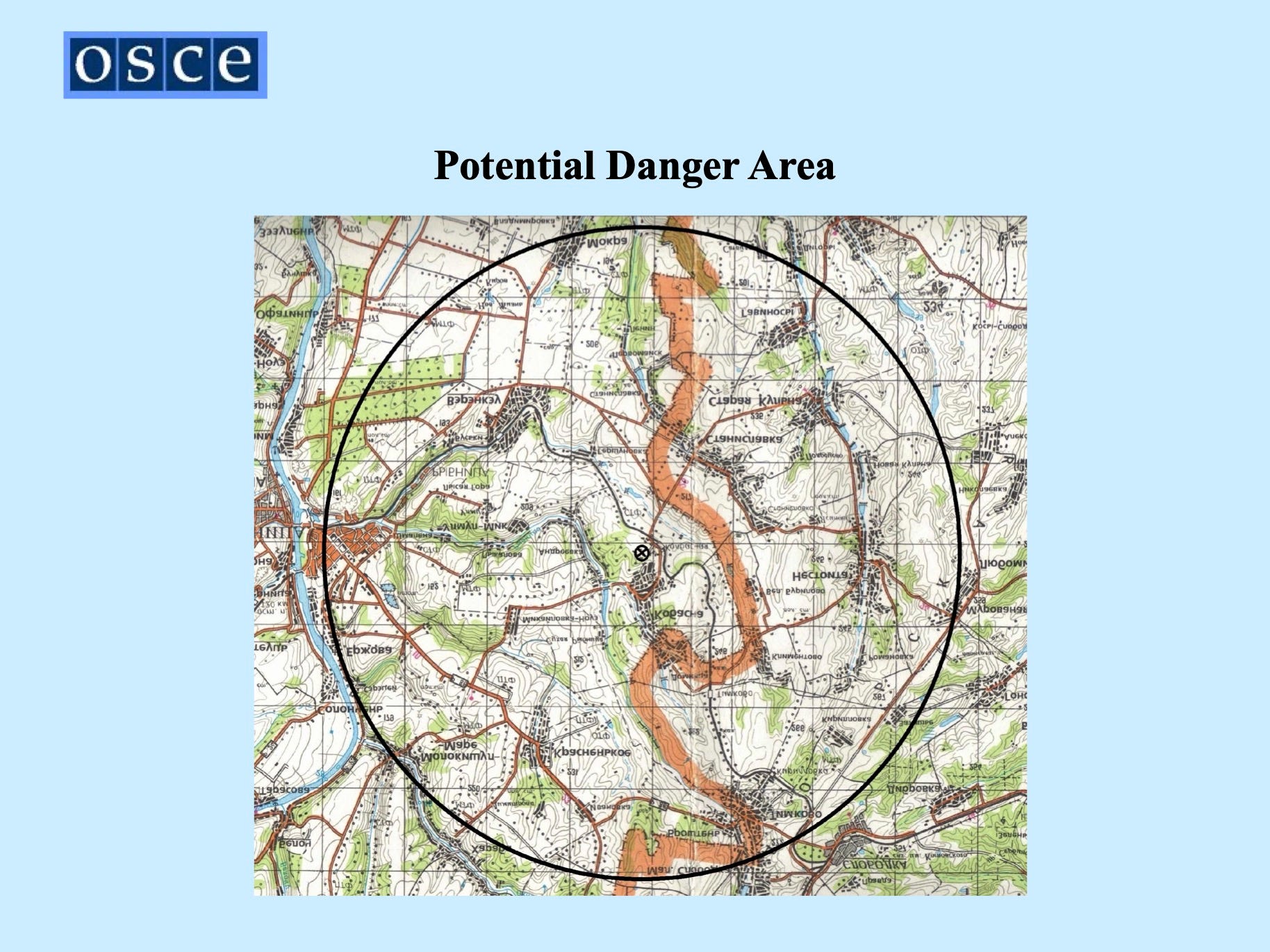
This circle shows a roughly 15 km radius around the Cobasna ammunition depot. This includes multiple small villages in Transnistria and Ukraine as well as a considerable part of the Transnistrian city of Ribnita, seen on the left side of the image. According to Transnistria’s 2004 census, the city had a population of more than 53,000.
Ambassador Hill spoke of how the depot could go off and “devastate Ribnita.” Recounting the event he told me that “the Transnistrians were livid, and so I was the last Westerner on Transnistrian TV live.”
When I asked Ambassador Hill about the basis for this circle - whether it reflected what the OSCE thought was a credible worst-case scenario, he told me that he told his people to draw a radius around the depot to reflect an explosion equivalent to an atomic blast, with the main purpose being “working against the Transnistrians” and getting publicity.
“Dirty Bomb Warheads Disappear”
That was a December 6, 2003, headline in the Washington Post setting up an article about Cobasna and weapons in Transnistria more generally. This article, and another in the Washington Times in January 20041 paint the region as an open-air weapons bazaar for terrorists and al Qaeda. The article quotes multiple sources from Moldova, and the US, on and off the record, describing factories running all night producing missiles and Soviet weapons being removed from storage and smuggled to the Caucasus, Central Africa and elsewhere. It quotes William C. Potter, director of the Center for Nonproliferation Studies, saying:
“It’s one-stop shopping for weapons and all kinds of other illicit goods. Very possibly, that includes the materials for weapons of mass destruction.”
This story has serious issues, many of which should have been apparent at the time. It cites unnamed “Western and Moldovan officials” saying that 50,000 metric tons of munitions remained at the end of 2003. By this time, the OSCE had facilitated the removal of all of the heavy weaponry and 20,000 of the 42,000 tons of munitions.
Ambassador Hill told me that he and his successors in the OSCE spent lots of time trying to chase down these rumors, which turned out to be a “mix of fact, speculation, and hype, mostly the latter two.” In particular, they focused on allegations of nuclear materials, but found no evidence of any radiation linked to weaponry,2 nor any large-scale sale or smuggling of weapons from the storage depots3.
The Washington Post article was written by Joby Warrick, who later went on to win 2 Pulitzer prizes, so it is hard to write this off as shoddy reporting. The “dirty bomb” reports seem improbable in retrospect - they involved retrofitting anti-hail rockets with radioactive materials (not a bomb). But at the time, post 9/11 and in the early days of the Iraq War WMD discussions, it was pretty par for the course in the United States. At the same time, Ambassador Hill stressed to me that all factions in Moldova were actively spreading narratives trying to discredit the others.
While these “dirty bomb” stories have faded away, the narrative of a “Hiroshima at Cobasna” has not. This idea, which has become commonly accepted knowledge in lots of Moldova, comes from…
The 2005 National Academy of Sciences Report
By far the most pervasive narrative about Cobasna is that it is a serious danger of exploding and consuming the towns and cities around it. Colloquially, people in Moldova will often say "when, not if” it explodes, windows will break in Chisinau. People talk about how old and degrading munitions could simply go off, and how the amount of munitions there would make this one of the largest non-nuclear explosions ever - equivalent to Hiroshima.
This narrative is based on a 2005 National Academy of Sciences of Moldova report that was written by a team led by Academician Gheorghe Duca. The report itself remains classified, but its key findings have been reported widely. As recently as 2023, it was discussed in detail at a Moldova State University conference.
Here’s a summary of how multiple outlets have described the report’s findings over the years:
Blast Crater: 1.5 km wide and 75 m deep (equivalent to a 27-story building)
Death Zone: The blast wave would kill all living things in a 4.5 km radius
Property Destruction: Towns in a 50 km radius could be “reduced to ruins”
Chisinau: The blast would be felt in the capital 85 km away
The 2005 report explicitly compares an explosion at the depot to the bomb dropped on Hiroshima in terms of total explosive power. It cites a total explosive equivalent at Cobasna as 10 kilotons of TNT.
Note: This key claim is itself an error as estimates for the yield of the Hiroshima bomb are 15 kilotons.
Multiple sources, including Ambassador Hill, described this as part of a broader pattern in Moldovan politics: using alarming narratives about Cobasna to attract Western attention, support, and funding. Several suggested the 2005 report fit this pattern, commissioned under President Vladimir Voronin at a moment when his government had strong incentives to raise the alarm4.
I reached out to Academician Gheorghe Duca to ask about his report. He stands by it as a “scientifically independent” product and stated that:
“The presidential office did not ask for a specific result, nor did it impose any conditions on our findings. Our sole objective was to assess, as objectively as possible, the potential consequences of a catastrophic event at the depot.”
A key element of the report’s findings is that it modeled a simultaneous detonation of all the explosive material in Cobasna. I asked Academician Duca about this, and he defended it as a “theoretical worst‑case scenario” which was based on their concerns of a fast-moving chain-reaction. In the next article, we will examine these claims, as well as the 10 kiloton estimate, in more detail.
The “Hiroshima” narrative has endured up through the present and has been cited again and again, by Balkan Insight (2023), Arnika (2022), Deutsche Welle (2015), Newsweek (2023) to name a few. Wikipedia cites it as fact (citing Deutsche Welle) and Grokipedia and other AI regurgitate it (likely citing Wikipedia). Of those cited articles, only the one by Newsweek treats the “Hiroshima” claim skeptically, while all the others accept it as a fact of the situation.
In our next article, we’re going to look at a new report by Moldova’s Security and Intelligence Service (SIS) and Army Intelligence that examines these narratives, and the 2005 report explicitly.
You can read Part 2 online here:

Very similar to the Post article but not behind a paywall
Interestingly, he told me a story about how his team wore radiation detectors and did pick up trace amounts at a steel plant in Ribnita. They found that the plant was recycling watches and that the glow in the dark paint was building up. The OSCE brokered a deal with Chisinau and Tiraspol to bring in the IAEA to train the plant operators on new and safer proceedures.
They found lots of evidence of general smuggling between Transnistria and Ukraine
This was 2 years after Voronin had broken with Putin over the Kozak memorandum and begun to pivot west
Fantastic piece David
Thank you for your time and information. Regards Janice