

Was Russia Targeting Zelenskyy’s Plane in Chisinau?
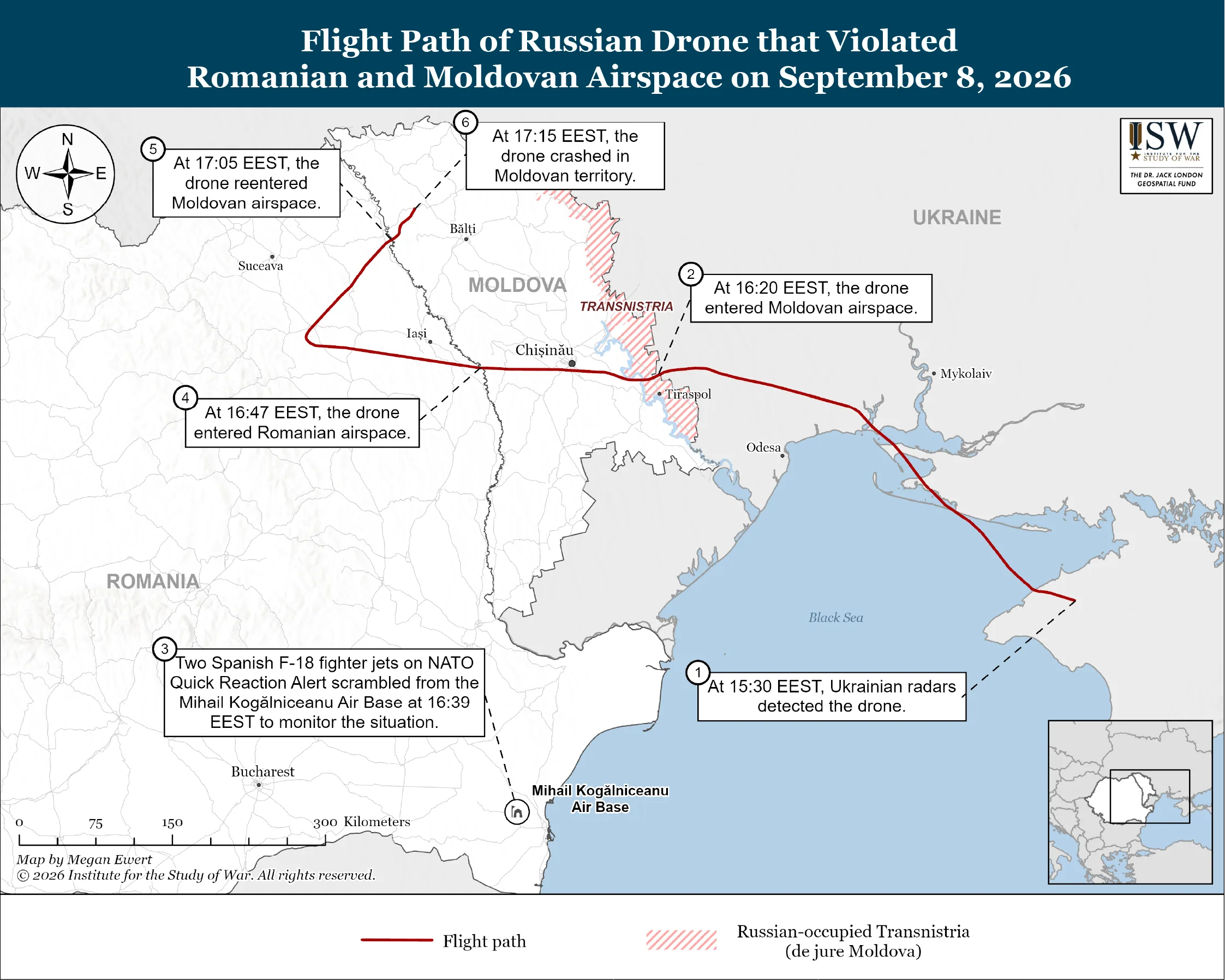
Last week, we wrote about how an overflight by a Russian missile-drone caused the diversion of 7 planes in Moldova. Of those, 3 were held on the ground at Chisinau’s Eugen Doga International Airport, 3 were diverted to holding patterns in the air and one diverted to Iași for an unscheduled landing.
Ukrainian President Volodymyr Zelenskyy’s plane was among those which were delayed in this incident. At the time, he was flying from Chisinau to Oslo to attend the funeral of Norway’s King Harald V. Zelenskyy has been using Chisinau for flight transit since early June when a diplomatic spat between Ukraine and Poland caused substantial tensions between the countries1.
On September 9, Euronews reported that Norwegian Prime Minister Jonas Gahr Store stated that:
"His [Zelenskyy’s] flight was almost hit by a drone when it was taking off from Moldova. That is the reality he lives in,"
Some outlets like Euronews reported this statement as fact, while others such as CNN more cooly noted that a “Russian drone incursion delayed Zelensky’s departure from Moldova.” Official statements from the Moldovan Presidency and Government confirmed this characterization, explaining that the drone overflight and eventual crash more than 160 km from Chisinau caused flight delays which impacted President Zelenskyy’s itinerary .
Not (Necessarily) Targeted, but Not a Coincidence
Immediately after the event, Moldova’s Ambassador to the United States characterized the incident as “not an accident,” telling CNN:
“We do not believe in jet propelled drones just flying into Moldova’s territory for surveillance purposes while [the] Ukrainian president’s airplane is on the ground at the airport,”
In an interview with CBS News, released on September 15, Zelenskyy himself seemed to confirm this characterization, saying:
"In Moldova, my presidential jet was there, and that's why they attacked Moldova,"
In the interview, President Zelenskyy clarified that by “attacked” he was referring to an airspace incursion, and that he was not sure he himself was targeted. In a back and forth with the interviewer he implied that the aim was intimidation2. Zelenskyy also stated that when he returned to Moldova a few days later another drone entered Moldovan airspace at the same time - an incursion that CBS stated had not previously been reported3.
A Pattern of Escalation
As we’ve written before, this comes in the context of a huge spike in drone incursions and explosive crashes in Moldova - a situation that is not unique to Moldova. Russia recently targeted a train near the Poland-Ukraine border at the same time as various dignitaries, including former CIA director David Petraeus and former UK Prime Minister Boris Johnson, passed through. NATO air patrols have been shooting down drones entering alliance airspace with increasing regularity.
In Moldova, it is clear that some of these attacks are targeted at ports of entry. Russia has sought to justify recent strikes on the Tudora-Starokazache crossing saying that they were targeting weapons transfers to Ukraine. Moldova’s Ministry of Foreign Affairs called these accusations “false,” saying that “No weapons are transported to Ukraine through the territory of the Republic of Moldova” and noting that only “People pass through these points - families, children, mothers and the elderly, who travel between the two countries.” Recall that this attack killed 2 Ukrainian civilians and wounded one Moldovan.
Drone incursions and attacks on border infrastructure are becoming more brazen, whether or not there were attempts to target President Zelenskyy directly.
Other Security News
Here’s a roundup of the other top security and Transnistria stories of the week:
Russian Ambassador Designate4 Oleg Ozerov disputed the recent report on Cobasna. He suggested that the report was of “highly questionable quality” and that even (unnamed) “Western experts” disputed its findings. Ozerov suggested that the efforts made by SIS and Moldovan Army Intelligence to disprove decades old narratives about the stockpile are designed “to pave the way for a military solution to the Transnistria problem.” In case you missed my 2 part investigation on this topic you can find it here:


Anthropic’s September 2026 “Detecting and countering misuse of AI” report mentioned Moldova 16 times. The report detailed how Claude was used by various Russian propagandists to facilitate multi-language disinformation and create “false verification loops” whereby disinformation appeared in multiple places and languages. This allowed various spreaders of this disinformation to cite multiple sources for the same lies. These reports were only a small subset of the global Russian disinformation and cyberwarfare campaign outlined across the report.
“Protestors” have gathered at the “border” checkpoints in Tighina (Bender) to protest against taxes levied on Transnistrian businesses. According to Transnistrian state TV, they included 300 “representatives of Transnistrian public organizations and labor collectives.” The same group with the same signs first appeared on September 10 to protest outside of the Joint Control Commission during the visit of the new OSCE Ambassador Christopher W. Smith. They then moved to the “border” points on September 15 and 16. Promo-LEX lawyer Vadim Vieru told Newsmaker that these protests are not real and are organized by the local “authorities,” noting that if anyone protests anything in Tiraspol they are arrested for extremism.
Politics
Here’s a roundup of the top politics stories of the week:
Prime Minister Tofan announces major “managerial rotation.” The director of the National Health Insurance Company (CNAM) was moved to the role of director of Public Property Agency (APP), the director of the Republican Clinical Hospital “Timofei Moșneaga” became the director of CNAM, the director of the National Social Insurance Company (CNAS) will become the director of the State Tax Service (SFS), the outgoing director of the SFS will remain as deputy. Interestingly, the former ANSA director (and Minister of Agriculture for 3 days) Radu Musteață will take over the Agricultural Intervention and Payments Agency (AIPA). Tofan stated that “manager rotation is a practice used in developed countries” when describing the highly unusual moves5.
Tofan announces “Moldova Project” National Infrastructure Development Office. This new entity will be tasked with overseeing implementation of major strategic projects. It will be headed by Mircea Eşanu, who is leaving the Public Services Agency (ASP) after a 5 year tenure where he led successful modernization and digitization efforts there. He will lead a team of 26 in the new office within the State Chancellery. The Prime Minister explained that responsibility for large projects is spread across too many structures with too few specialists - leading to slow implementation. He stated:
“Moldova needs major projects, and they need to be implemented quickly, not years later. For over a decade, we’ve been talking about modern regional hospitals in Bălți and Cahul, irrigation projects in the south, an airport in the north, and transport infrastructure. The modern prison project in Chisinau began back in 2013, and it still hasn’t been completed. And these are not the only examples,” (…)
“We want to build a small but very strong team: engineers, project managers, procurement and tender specialists, contract management, finance and legal experts. We’re looking to the experience of countries like Lithuania, Ireland and Montenegro,”
Parliament appointed 2 new committee chairs. MP Marcel Spatari became the Chairman of the Committee on Economy, Budget and Finance while Adrian Băluțel took over his role as Chair of the Commission for European Integration.
Reports of “intense and coordinated activity” across social media targeting the Gagauzia elections. Analysis from Stopfals.md outlined a ramping up of pro-Kremlin propaganda painting a picture of “Gagauzia on the brink of conflict.” Narratives focus on how Chisinau is trying to “take control” of the autonomy as well as stoking traditional fears of union with Romania6. With the election campaign only getting started, we should expect serious hybrid attacks and interference over the next months.
Prime Minister Tofan unveiled a major deregulation and debureaucratization package aimed at cutting red tape for businesses. The plan touches roughly 100 pieces of legislation and targets duplicate permits, repetitive inspections and outdated procedural requirements. At the same time, the government insists that health, safety, environmental and consumer protections will remain robust. On the enforcement side, the government wants to move toward risk-based, more predictable inspections after entrepreneurs flagged unannounced tax audits and disproportionate penalties as top complaints in a public consultation that drew over 200 submissions. The package is now in final review at the Justice Ministry and the National Anti-Corruption Center before heading to parliament.
Economics & Infrastructure
Here is a roundup of the top economic and infrastructure news of the week:
Fuel prices continue to rise as crisis in the Middle East deepens. Gasoline hit a price of 33.67 lei / L (42% higher than February) while diesel hit an all time high of 35.53 lei / L (74% higher than February). The National Energy Regulation Agency (ANRE) cited Houthi advances and strikes on Saudi infrastructure as the drivers of price increases, calling it “an atypical situation, generated entirely by external factors.” Alternative Bloc MP Ion Chicu agreed, saying that the country needs to prepare for 40 lei fuel since the “situation in the Middle East won’t end anytime soon.” He stated:
“There’s a shortage of diesel fuel on international markets. I hope the government has a plan to ensure the country has diesel fuel. As for the price, that’s beyond our control,7”
The government approved a bill on restructuring Moldovan Railways (CFM). The proposed bill would break the company into Moldovan Railway “Passengers and Freight” and CFM Infra. The first company would do exactly as the name implies, while CFM Infra will manage the rails and infrastructure. Neither company is being privatized. The restructuring is being done according to EU norms with the goal is inviting competition into the system, where new entrants would pay for the right to use infrastructure without being blocked by a national monopoly. The restructuring will be completed by the end of the year.
The National Bank has raised the base rate by 1.5% to 9%. They cited inflationary pressures and “geopolitical uncertainties,” and estimate a 6.96% inflation rate for August 2026. Executive Director of the think-tank Expert-Grup, Adrian Lupușor, projected a “period of stagflation” that may stabilize in the second half of 2027.
Prime Minister Tofan has stated that airport expansion “must begin in October at the latest.” In an announcement on facebook, the Prime Minister stated that “The good news is that we have over 6 million passengers, the number has doubled in two years. The bad news is that, effectively, we can no longer cope.” He stated that temporary measures including extra seating and mobile food and coffee points will be arranged in the short term. At the same time, he stressed the need to move forward with the planned terminal expansion as son as possible. The massive number of Hasidic pilgrims heading to Uman makes September a particularly challenging month for the airport’s infrastructure, but passenger traffic has grown steadily over the last few years driven largely by Ukrainian transit.
The Novodnistrovsk reservoir is still in trouble. The water inflow at the Ukrainian reservoir averaged 22.7 cubic meters per second in the first half of September, but with steady and daily declines. Meanwhile, the outflow has been maintained at 60 cubic meters per second. On September 14 the Dnister Commission met and Ukrainian representatives recommended reducing outflows to match inflows. Moldova did not agree and the meeting broke up inconclusively with a plan to reconvene in the coming days. Minister of the Environment Gheorghe Hajder stated that neither Moldova nor Ukraine is at fault here noting that “This is the effect of climate change.” He also noted that “We cannot negotiate something that is not there.” Major reductions in outflow risk the water supply to Chisinau and many other towns, as well as agricultural irrigation across the eastern half of the country.
International Affairs
Here’s a roundup of Moldova’s top international affairs stories of the week:
Romanian President Nicusor Dan nominates MEP Siegfried Mureșan for Prime Minister. Mureșan is supported by the Save Romania Union (USR), the National Liberal Party (PNL) and Democratic Union of Hungarians in Romania (UDMR). That is not a parliamentary majority so he will need to try and build bridges with other parties to break Romania’s political stalemate. Siegfried Mureșan is an MEP and Vice Chairman of the EPP as well as the EPP group in the EU Parliament. He is one of the strongest voices in Europe supporting Moldova’s EU accession and for sustained support for Moldova.
The US Embassy held an event to commemorate the victims of the September 11 terrorist attacks on the 25th anniversary. President Maia Sandu, Prime Minister Tofan and Speaker Grosu attended the event. Speaking at the event, President Sandu stated:
“We reaffirm a simple belief that unites our nations: terror and totalitarianism can take lives, but they cannot defeat the freely expressed will of the people. (…) Terrorism, extremism and authoritarianism take different forms. But they all share the belief that fear and force can defeat human freedom. September 11 showed us something else. It showed us extraordinary courage in the face of terror. It showed us the power of solidarity. And it reminded us that free societies are strongest when they are united,”


Both countries officially deny that the change is political but the timing of the change means it was clearly tied to the UPA (Ukrainian Insurgent Army) spat.
Zelenskyy’s English is a little difficult and in the clip it is pretty clear that he is discussing intimidation and airspace incursions, not saying that this was intended as an attack on the airport.
That’s according to CBS news and was picked up by ZdG. We don’t know when Zelenskyy flew back, but on September 12 there was another mid-day incursion that cause airspace closures that was reported.
President Sandu has refused to accept his credentials.
I have found no evidence of this being a normal practice in my research. It’s one thing to rotate junior managers so that they get experience. It’s another to move someone with 25+ years in experience in the tax service to the national insurance company and vice versa. Personally, I don’t know what’s going on here - if you have a theory, feel free to leave a comment!
Gagauzia is overwhelmingly pro-Russia, but the underlying reason for this is a much much larger sentiment against Romania.
Opposition MPs agreeing with the government that this is outside of their control (rather than suggesting buying from Russia or something) is unusual. The energy crisis begun by Israel and America’s attack on Iran has proved useful political fodder, but also seems to be unsettling people enough that there is some cooperation on mitigation efforts.