

A series of recent reports have shown that all is not well in Transnistria. Veaceslav Ioniță, economic expert with think-tank IDIS “Viitorul, presented an analysis of the region’s economy that showed that “Transnistria is going through the most serious economic and social crisis in the last 25 years.”
Here are some key comparisons between the Transnistria region and the rest of Moldova1:
Additionally, industrial output from Transnistria has fallen 30% in a single year. The region is now operating at 75% of their 1989 industrial output.
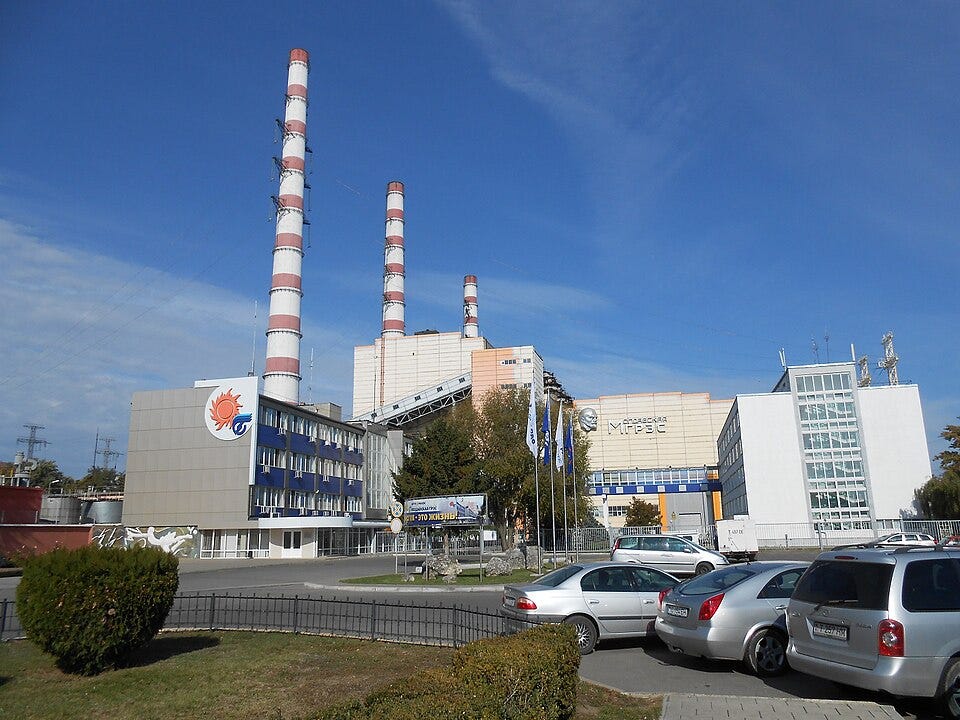
Veaceslav Ioniță estimates that 60% of the region’s economic activity relies on Russian gas. On February 5th the MGRES power station switched over from natural gas to coal. No reason was given and they switched back to gas on Monday February 9th. The interruption implies continued difficulties getting deliveries of Russian gas. Transnistria now has an extremely limited emergency supply of coal after last winter’s long crisis. They are unable to resupply as the coal required comes from a specific mine in the Donbas under Russian occupation.
Quick Analysis: Ukraine’s President Zelenskyy has again offered to provide coal to Transnistria. Moldova’s Deputy Prime Minister for Reintegration Valeriu Chiveri stated that he doesn’t know the specifics of this offer - but that the key stumbling block is that the Transnistrian “authorities” need to be willing to accept help. He then pivoted to say that gas crises will likely keep happening every 10-15 days because Russia keeps changing the company making the payments (largely due to blocks by EU sanctions). He called on the Transnistrians to accept Chisinau / Europe’s offer of alternative supplies. As I wrote - Ukraine does not have this coal. So there are multiple levels to the messaging game being played here. I wrote about this last year and the analysis largely still holds up.
Looking at the big picture, Ioniță explained the depth of the crisis writing:
“In 2025, the left bank of the Dniester River entered the deepest economic and social crisis in at least the last 25 years. Industry has collapsed, GDP has fallen dramatically, exports are at a historic low, and the population - both employees and pensioners - lives worse than a decade ago. All these developments show an extremely complicated situation, unprecedented for the region”
I’ve written before about how the inherent contradictions in the Transnistrian economic and governance model have become impossible to reconcile. Now we are starting to see clear indications of the structural collapse of the region’s economy.
In parallel, human right’s NGO Promo-Lex reports a sharp deterioration of human rights in Transnistria in 2025. They particularly cite total control of the information space, increased propaganda, militarization of eduction - with specific focus on disabled children and those in institutions - and inhumane conditions in detention facilities.
The region’s “authorities” are pushing for even more control of the information space and have rolled out their own messaging app this week called IDC Matrix. Transnistrian “President” Krasnoselsky has urged people not to use “imported apps” claiming that IDC Matrix is safer. Journalists who have tested the app have shown that there is no end to end encryption - meaning that all messages are available to the operator.
Other Security News:
Here are the other top security stories of the week:
Another Russian drone crashed in Moldova. The authorities confirmed this one was also a Gerbera model without a warhead. It crashed in the village of Sofia in the Drochia district.
Moldova was ranked 5th globally in cybersecurity. The annual ratings, called the National Cyber Security Index (NCSI), from Estonia’s E-Governance Agency, listed the top 5 countries as the Czech Republic, Canada, Estonia, Finland and Moldova. Foriegn Minister Mihai Popșoi called the ranking “proof that Moldova is becoming a safe and resilient digital hub.”
Prime Minister Munteanu Visits Kyiv
The Prime Minister led a delegation including Minister of Energy, Dorin Junghietu, Minister of Internal Affairs, Daniella Misail-Nichitin, Minister of Infrastructure Vladimir Bolea, and State Secretary of the Ministry of Foreign Affairs, Sergiu Mihov. In Kyiv they met with their counterparts and announced various joint projects including a new bridge across the Nistru at Cosăuți-Imapol2. In joint remarks with Ukrainian Prime Minister Yulia Svyrydenko, Prime Minister Muntean stated:
“My special attitude towards Ukraine is well known, given that I have lived here for more than 20 years. As Prime Minister, on my first visit to Ukraine, I returned with respect and solidarity towards the Ukrainian people, who are on the front lines in defense of peace and human values”
He expressed strong support for Ukraine and presented a new humanitarian package from Moldova. This package, valued at over €700,000 euros, includes emergency vehicles, generators, medical supplies and food.
Prime Minister Munteanu also visited the Wall of Remembrance of the Fallen for Ukraine and met with President Zelenskyy. Following their meeting, President Zelenskyy wrote on facebook:
“During the meeting with the Prime Minister of the Republic of Moldova, Alexandru Munteanu, bilateral projects between our countries were discussed. Energy, railways, infrastructure - everything must be implemented.”
Thank you for your support for Ukraine and our people. We have a common vision of the future in the European Union, and the path of Ukraine and the Republic of Moldova to the EU must be common, so that all residents of our region benefit from the strengthening of our peoples and Europe as a whole,”


Other International Affairs Stories
Here’s a roundup of the other international news of the week:
Maia Sandu on her nomination for the Nobel Peace Prize. President Sandu responded to questions this week on her nomination speaking in the context of the news of a new prisoner exchange between Ukraine and Russia saying:
“I’m grateful that people are watching our country, that they appreciate our courage and resilience, but there are many people nominated for this award.
Today I looked at the Ukrainians who returned home from Russia, and these are the people who deserve the Nobel Peace Prize. These are the people who sacrifice their lives for peace, because they want to bring peace back to their country, to their villages, to their cities, and to our continent,”
Politico - the EU plans to bring Ukraine into the block in 2027. The outlet reports that EU leaders are working on a plan for a “multi-speed” Europe that they are calling “reverse enlargement.” Under this idea, Ukraine, and theoretically Moldova and other candidate countries, would be brought into the EU before negotiations are fully complete. The countries would start as members with limited voting rights and limited responsibilities. They would then complete the qualifications for full membership and phase into full membership. The idea is to make membership inevitable and allow a solid timeline to be incorporated into draft peace proposals supported by the United States. This idea is opposed by Germany but being pushed by France, Italy, Poland and others. The plan outlines 5 steps for implementation which are all focused on neutralizing the veto from Hungary. Viktor Orban stated this week that Ukraine is an “enemy” of Hungary and vehemently opposes Ukrainian membership in the EU. The plan envisions an unofficial negotiations process, where Ukraine works through negotiating clusters and reforms even as Hungary opposes officially opening these clusters. Then, they wait for Orban to leave - ideally by losing the Hungarian elections in April. If that fails, they plan to lean on Trump to force Orban to support the agreement in the context of a peace treaty. As a final option, Hungary’s voting rights can be suspended under EU Article 7. Politico quoted an unnamed Moldovan official’s reaction saying that Moldova…
“wants to join a European Union that functions effectively beyond 27 member states, and we welcome discussions on the internal reforms needed to make this possible.” (…) [but]
“full membership - with equal rights and full participation in EU decision-making - must remain the clear and final destination.”
Author’s Note: If you are interested in following the Hungarian election with coverage in English I strongly recommend the “Days Until Hungarian Elections” substack. Written by veteran journalists they detail both the campaign as well as the major election interference being conducted by the Kremlin to force a pro-Orban outcome.


Hybrid War Updates
Here are the top stories in the Kremlin’s hybrid war against Moldova from the week:
Watchdog reports another connection between the FSB and Mayor Ion Ceban. Their investigation shows that FSB affiliate Nidjat Askerov held an “assistant” badge giving him access to the Chisinau Primaria (city hall). Askerov has been documented as working alongside FSB agent, and Ceban campaign consultant in 2019, Iurii Gudilin. ZdG has previously reported that Gudilin worked with Askerov to provide financing to the MAN party “like the PSRM” (Socialists) with a total of €600,000 euros per month. Askerov also recently appeared in the treason trial of Denis Cuculescu, who claimed that Askerov recruited him as an FSB asset to funnel this money into Moldova via crypto and other illicit schemes. Mayor Ceban’s people deny this and claim that the “assistant” badge was fabricated with AI.
One man and 2 women sentenced for preparing violent provocations and attempting to create mass public disorder. They were convicted in the context of the paramilitary training camps in Bosnia and Herzegovina that were organized by Russian agents and the Shor network. The trio was arrested while trying to cross back into Moldova with drones and incendiary devices. After arrest, the man was held for 12 months in pre-trial detention and then released as this is the maximum allowed by law. One of the women was released on judicial control, the other was released on house arrest in Tiraspol3. All have now fled and are now wanted. They were sentenced to 4 and 5 year terms.
Lukoil no longer accepts credit cards. Gas stations in the Russian network have now been cut off by local banks which are implementing US sanctions against the company. For now they are trying to work in cash but the viability of the network is in real question as they await buyout offers for the parent company’s assets in Europe.
Political News
Here’s a roundup of the top politics stories of the week:
Moldova may ban social media for children under 16. The government has announced the beginning of public consultations on the plan which Minister of Education Dan Perciun has called “very realistic.” The government envisions the start of a national conversation and consultations with the potential for a decision being made by the end of the year. President Sandu, speaking on the occasion of the global “Safer Internet Day,” called attention to the problems facing children saying:
“Our children are growing up in a very different world than the one we grew up in. Real, social life, with friends, colleagues, and family, is gradually being replaced by a networked life - inauthentic, without physical presence, without real relationships.”
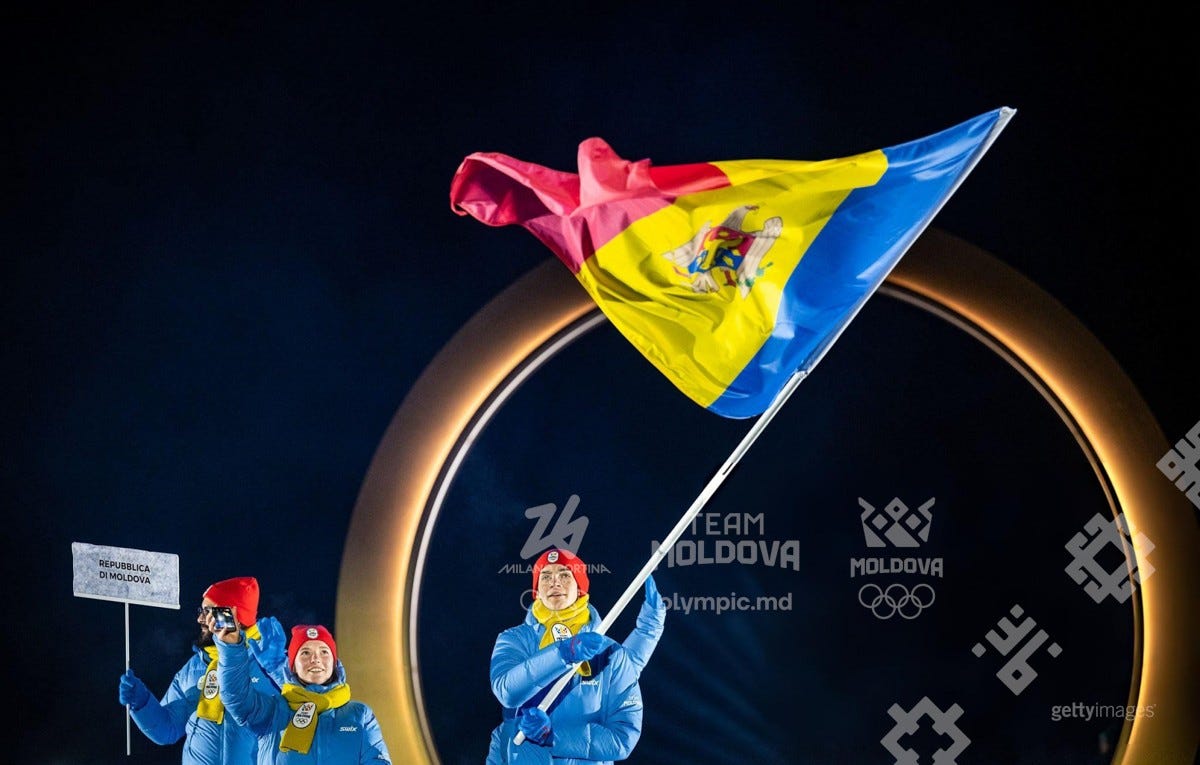
Moldova is represented by 5 athletes at the olympics. The team consists of 3 biathlon athletes and 2 cross country skiers. The flag was carried at the opening ceremony by skier Iulian Luchin.
Gagauzia’s elections are tentatively scheduled for May 17. The Central Election Commission (CEC) is now in dialog with the People’s Assembly of Gagauzia to resolve issues with the election legislation in the region. The core problem is a pickle of the People’s Assembly’s own making. The CEC demands that they amend recent legislation that named the Central Election Committee of Gagauzia as the governing body for the vote. Because there can only be 1 CEC under the Moldova constitution this body must be renamed as the “Electoral Council.” Unfortunately, the People’s Assembly adopted legal amendments in 2024 that had 2 effects: 1) their term of office expires exactly 4 years after the last elections, and 2) they are unable to pass any legislation in the lame duck session. Now, with their terms expired in November they are unable to rename the commission / council and have frozen themselves in place. They are working on a technical solution (which I’ll leave in a footnote4) that will allow elections by May.
Crime, Corruption & Justice Reform
Here are the top stories of the week in the justice sector:
Polls show people believe the justice sector is improving. The think-thank IPRE released a poll on “integrity in the justice sector” (full results in English) that showed 49% of respondents saying that the situation has improved in the last 3 years while 20% said that things got worse. 56% credit government actions with the improving situation. Of the remaining issues, 57% named corruption as the top problem, 15% cronyism and 15% unprofessionalism.
Moldova slides slightly in Transparency International’s Corruption Perception Index. In 2025 the country was ranked 80th of 182 countries and territories with a score of 42 points (0 means total corruption, 100 is no corruption). This is a slide from the 2024 rankings where Moldova was 78th with 43 points. Within the EU, both Bulgaria and Hungary are ranked worse than Moldova with 40 points. Moldova is tied with Kosovo and China. Romania was slightly better with 45 points and Ukraine worse with 36 (placed 104th). Transparency noted that the global average has fallen to 42 points - a 10 year low.
For convenience, Moldova Matters will often refer to the separatist region as “Transnistria” and the portion of the country under constitutional authority as “Moldova.” This is for clarity as terms like “right bank” and “left bank” often confuse people. To be clear: all the territory in question is Moldova.
This is a small town right next to Soroca. Currently there is a ferry crossing there.
That’s like a judge putting a criminal under house arrest in a non-extradition country. You can’t make this stuff up.
Basically, when these amendments were passed in 2024 they were opposed by the Executive Committee of Gagauzia and wound up in court. The People’s Assembly is now considering dropping their opposition to this lawsuit with the idea that the amendments would become undone and they can pass legislation in the lame duck. Not all members of the assembly agree and some have threatened to countersue. Yes, this is among the dumbest and most tedious problems you can imagine - but it’s important as it represents both the national government bringing the region back into line after years of Shor rule and will determine when these important elections are ultimately held.