

New Investigations Shed Light on Shor Financing and Activities
This week 3 new investigations were published into various aspects of Ilan Shor’s network. In each case investigative journalists have published sweeping looks into various aspects of Shor’s operations and detailed how they have grown beyond Moldova to become a core part of Russia’s financial and foreign influence infrastructure.
Each investigation is well worth reading in full - here we’ll link to them and summarize some of the key findings.
The Big Shor: A7 and the illusion of Russian financial innovation.
Published on 12 June by the Open Source Centre (OSC) in partnership with TRM Labs, authored by Zachary Tvarozna, Hamish Macdonald, James Byrne, Lucas Kuo, Denys Karlovskyi, Vasyl Yurkuts, Gary Somerville and William Gibson.
This 114 page report tracks the growth and evolution of the A7 network in great detail. The authors argue that past investigations focused on the A7A5 cryptocurrency have obscured a much larger set of financial infrastructure that largely relies on traditional banking but is optimized for sanctions evasion. The report centers Ilan Shor as the architect of Russia’s most important sanctions evasion network and documents its global reach as a financial clearing house for both large corporations and individuals needing small scale financial services. In this network A7A5 plays an important role, but only in support of more traditional infrastructure including Russian banks and entities in Kyrgyzstan which the report calls a “captured state.”
The main takeaway is the fact that Ilan Shor now sits at the center of a critical financial network that is fully backed by the Russian state. This network is growing rapidly and has global ambitions. At the same time, its very complexity highlights how challenging it is for Russian individuals and companies to access the global financial system right now.
“Corrupts everyone he sees”
Published on 17 June by Novaya Gazeta Europe, written by Alexey Stepanov and Olesya Shmagun
This brilliant report tracks Shor’s rise to the center of Russia’s sanctions evasion system. It takes his name from a 2016 report by Kommersant which quotes a Russian government source on why Ilan Shor was at that time banned from entering Russia. Because he “corrupts everyone he sees.”
The investigation looks at how Shor went from being banned from entering Russia to sitting at the center of the country’s financial architecture. According to a source cited by Novaya Gazeta Europe the key moment was a meeting between Ilan Shor and Russian oligarch Roman Abramovich in Israel. Shor had fled Moldova when PAS won elections in 2019 and was hiding in Israel at the time. According to their source:
“It’s all the same crowd, how can I explain it? Shor’s wife, singer Jasmine, is best friends with Tatyana Navka1. Abramovich and Shor bonded over Jewish topics. All these people are essentially part of the same circle and interact with each other. They become useful to each other. Then they go their separate ways.”
According to their reporting Abramovich personally introduced Shor to Vladimir Putin. Now, Shor’s unique value proposition in the business world is the fact that he’s been vouched for by people at the highest level of the Russian state.
Much of the article focuses on a company owned by Shor called “Diamant Estate” (sometimes “Diamond Estate”). This company was sanctioned by the UK for connections to Shor / A7 on May 26, 2026 and Novaya Gazeta Europe uncovered a series of corporate filings related to its activities. They report that Diamant Estate is at the core of Shor’s operations and funds all of his business and political projects - including A7, Evrazia, TV stations and others. Diamant Estate borrows money which it then loans to these companies. Critically, companies closely linked to Roman Abramovich are some of the key funders of Shor’s operations.
Interestingly, journalists with Novaya Gazeta Europe wanted to test out the smaller time financial services of A7 and called the company with the goal of buying a car in Germany. An operator at the A7 call center stated this was no problem and said:
“You transfer rubles to an A7-Agent account and provide us with an invoice from the German recipient. We use our infrastructure to select the route, and the money arrives within five days,”
So whether you need to send your rubbles abroad to buy a car, or invest in military drone construction, the Shor network has you covered.
From Chisinau to Yerevan: How Russia’s Evrazia brought its Moldova playbook to Armenia
Published on 5 June as a joint investigation between DFRLab and CivilNet by Victoria Olari, Sopo Gelava, Givi Gigitashvili, Ani Grigoryan, and Salome Tsetskladze
This report tracks the operations of Ilan Shor’s Evrazia NGO in Armenia and shows how election interference strategies and infrastructure used in Moldova was redeployed in Armenia. It maps how Evrazia is able to openly operate in Armenia where it positions itself as Russia’s answer to USAID2, Open Society Foundation and Konrad-Adenauer-Stiftung. The organization nominally provides Russian language classes, cultural events, Robotics classes, animation schools and more. In reality it is a platform for organizing election interference via social media campaigns, campaigns to mobilize the orthodox church, organized (paid) transportation of diaspora voters, etc. The report concludes:
“Evrazia’s operations in Moldova and Armenia are not separate initiatives; it is one operation running across two countries, which seems to share the same objective: to build political leverage for Kremlin-aligned forces ahead of elections. This constitutes an interference operation that uses the language of civil society to do the work of political campaigning. In Moldova, that operation has been widely documented, and Evrazia’s activities were designated a national security threat. In Armenia, Evrazia continues to operate freely.”
Other Shor / Hybrid War News
Outside of these amazing investigations, here are the other related stories of the week:
The EU has added 6 people to their sanctions list for "actions destabilising” Moldova. This included former Bashkan of Gagauzia and leader of the Heart of Moldova Party Irina Vlah who was sanctioned for her work organizing paid election rallies in July 2025. It explicitly identifies her as a Russian agent who coordinated her role in the elections with the Kremlin and then took part in illicit financing efforts. Also sanctioned was Anton Tregub, the Russian coordinator of Victoria Furtuna’s Moldova Mare Party, and Anton Usov who has been reported as the coordinator of election interference efforts involving the Orthodox Church.
A Moldovan court has issued a new arrest warrant for Ilan Shor. This warrant is related to an ongoing case where Shor is alleged to have embezzled $100 million dollars from Banca de Economii. In the same case the bank’s interim president from the time has already been sentenced to 10 years in prison. This is the second outstanding arrest warrant for Shor in pending cases, in addition to warrants related to his conviction in the “Theft of the Billion” case for which he has been sentenced to 15 years in prison.
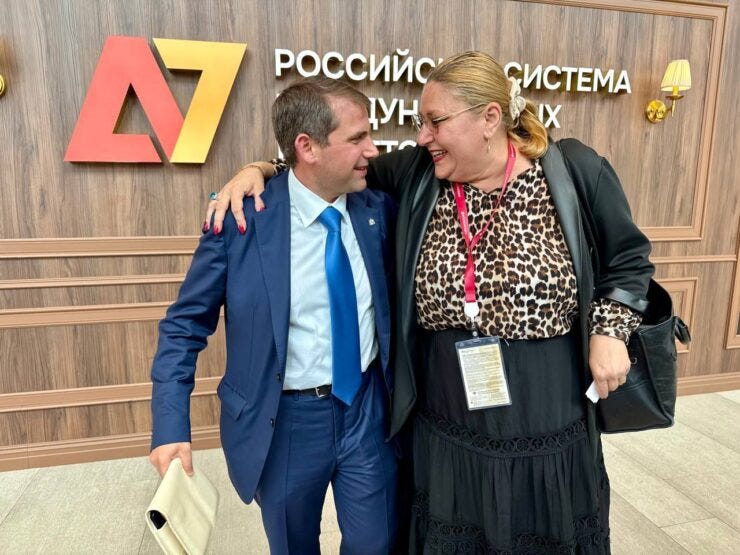
The usual suspects attended Putin’s Saint Petersburg Economic Forum. From Moldova, Igor Dodon, Zinaida Greceanîi, Vasile Tarlev, Victoria Furtuna and other Socialist MPs attended the “Russian Davos.” Ilan Shor and Marina Tauber were also in attendance. Romanian Member of the European Parliament (MEP) Diana Șoșoacă also attended and had her photo taken with Shor at the event. The event was held under a literal cloud as black smoke from Ukrainian long range strikes drifted over the city.
Politics, Security & Other Updates
Here’s a roundup of some of the top stories of the last 2 weeks:
Transnistria’s economic crisis deepens. According to reporting from Zona de Securitate street lighting in many towns and cities in the region was turned off starting June 1. Residents who called the power company were simply told that it was an “order from above.” Meanwhile, budget shortfalls have led to the region’s “authorities” announcing that teachers’ summer vacation salaries will be paid in multiple tranches. Against this backdrop the region’s “Supreme Soviet” is proposing to outlaw the word “Transnistria” in any language and impose fines for its use3.
Vladimir Voronin has stepped down as leader of the Communist Part of Moldova. This was announced at the 11th party congress where the longtime leader was named the “Honorary President of the Party of Communists of the Republic of Moldova.” MP Diana Caraman will now lead the party.
Metropolitan Vladimir has a fancy new apartment. An investigation by TV8 has shown that the leader of the Moldovan Orthodox Church4 recently registered an apartment worth over €200,000 euros in his lay name. The building is immediately adjacent to church headquarters and the apartment was apparently a gift from the developer in exchange for a sign off on the building’s construction. This comes in the context of a fairly scandalous5 construction process for the building where the developer lied to city hall and authorized a 3 story building while approving a 7 story building with the church and then constructing that. The new apartment joins a number of luxury apartments owned by Vladimir as well as a large house which is technically owned by his mistress but was actually bought with church funds6. Asked for comment Metropolitan Vladimir called it a smear campaign designed to undermine the church.
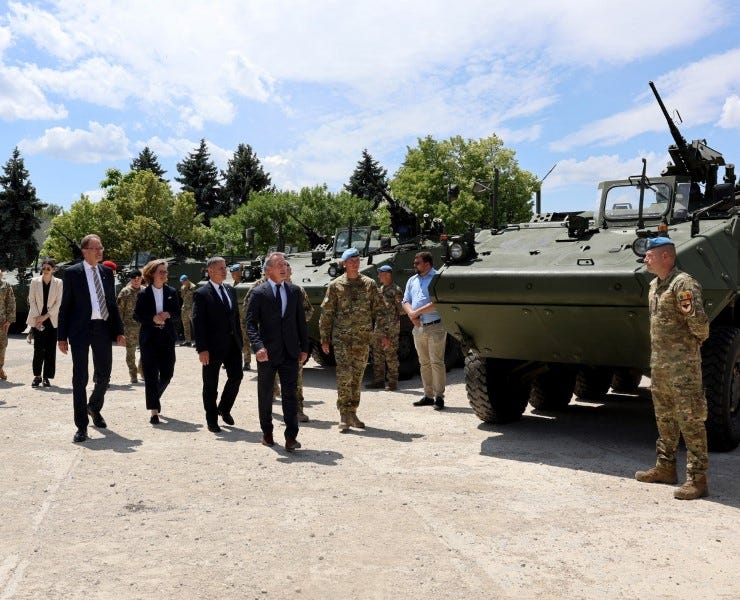
Germany delivered 5 Piranha-V armored personnel carriers (APCs) to the Moldovan Army. These state of the art APCs join older model Piranha’s that were previously donated by Germany in support of Moldova’s defense.
Igor Grosu was re-elected leader of the PAS Party. He ran unopposed at the Party’s 4th Congress.
PAS has proposed Alexandru Vornicu as their mayoral candidate for the 2027 Chisinau local election. In the meantime, Vornicu will lead the PAS Chisinau Municipal Organization. Alexandru Vornicu is currently the Mayor of the suburb of Stauceni. As mayor he successfully broke Stauceni away from Chisinau municipality and attracted significant investments leading to a quadrupling of the town budget and many substantial infrastructure projects. It is highly unusual for any political party to name a candidate this far out - and more unusual as Vornicu is not a prominent politician in PAS.
The Legal Resource Center of Moldova (CRJM) launched a website dedicated to tracking cases of electoral corruption in Moldova. The website gives details on ongoing cases, convictions, fines and more. It also has a map showing the geographic distribution of election corruption case around the country. This website was financed by the EU in a project implemented by UNDP and is meant to support journalists and international partners in tracking Moldova's electoral integrity cases.
Crime & Corruption - Telephone Fraud is Exploding
Since COVID-19 telephone fraud scams have been steadily growing in scope and sophistication. Originally referred to as “a relative got into an accident” schemes, whereby a caller would say just that and ask for money to help them, now these schemes peddle phony investments, pose as state officials and take other innovative approaches.
Parliament held hearings on the topic last week and found that financial scams are up 19% in the first months of 2026 when compared to 2025. This crimewave took on a geopolitical angle this week when the Security and Intelligence Service (SIS) announced a link to Russia stating:
“SIS has come into possession of information indicating a coordinated process of collecting personal data of citizens of the Republic of Moldova by Russian special services. The data is collected through various methods, such as private databases illegally sold on the Dark Web, databases illegally extracted by hacking private servers, as well as the database collected by the Shor organized criminal group in recent years, which contains about 145 thousand citizens who provided personal data. The evaluation of the information held indicates detailed databases containing names and surnames, e-mail addresses, telephone numbers, home addresses, as well as copies of identity documents,”
SIS went on to note that this information is then passed by the Russian government to criminal networks as part of a “hybrid war to undermine national stability.”
Our Party leader and MP Renato Usatii also weighed in this week stating that he had gotten access to a server linked to a telephone scam network that had financially harmed 100,000 Moldovan citizens. He said that Moldova was only a small target of this international network with their primary target being Argentina. He described a new mechanism stating:
“It’s a new scheme where children and teenagers are turned into accomplices of criminals under the pretext of a mission from the authorities. They will call the children, pretend to be from the prosecutor’s office or the police, offer them to participate in a secret mission, tell them not to tell anyone, otherwise the parents will have problems. The mission is to search the house for money, documents and cards, take pictures and transmit personal data to the scammers, and hand over money and packages to strangers. This is a new phase ,”
In response to this growing issue the government has approved Moldova’s accession to the “Second Additional Protocol to the Council of Europe Convention on Cybercrime” which will ban the purchase of sim cards without a government ID.
Economics & Infrastructure
Here’s a roundup of the top stories of the last 2 weeks in economics:
Parliament will force taxi companies to process payments in Moldova. A new draft law would require payments for taxi companies through apps like Yandex Go to be processed by Moldovan banks. Currently, when you take a Yandex cab in Chisinau the payment goes to Dubai. Moldova loses millions of lei in taxes yearly from this and similar arrangements and parliament has been extremely slow to act7.
An auction has been launched to privatize the Chisinau Glass Factory. The Public Property Agency has set the starting price at 773 million lei and will require the purchasing investor to incest €20.3 million over 3 years.
Annual inflation reached 6.8% in May causing the national bank to raise rates. The cost of eggs is up 36% year on year as high energy prices accelerate inflation across the board. The National Bank raised the base rate from 6.5% to 7% and now projects inflation to continue rising through the end of 2026 before starting to contract in Q1 2027.
Noted by Novaya Gazetta as “a figure skater and the wife of Putin’s press secretary, Dmitry Peskov”
RIP
Clearly they are focused on the big issues.
Recall, this is the one that is under the Russian Orthodox Church. For a refresher on the churches see this article.
If not abnormal
It’s more complicated than that - a businessman loaned the church money for a house which the church then gave to his mistress. The businessman is now suing and it’s in court.
ZdG wrote about this specifically in 2025 but I’ve been talking about it for years. Every time a business goes online - taxies, food delivery, scooter rental, etc - they depart Moldova’s financial ecosystem. It is insane that no one has acted until now… and that they are only going after taxi companies.
Thanks for covering the OSC piece on A7! We spent so much time on it!
Additionally, I've added a separate piece on A7 that didn't make the cut for our story on my own substack regarding A7's use of ChatGPT: https://evidenceofabsence.substack.com/p/chat-kgb