

Religion has long played a role in politics in Moldova, but during the 2024–2025 election cycle it became a key vehicle for foreign influence operations. In a new report published in collaboration with WatchDog, I examine how Kremlin-aligned actors leveraged religious narratives, church structures, and faith-based media ecosystems to shape political messaging both inside Moldova and abroad.
This article is the first in a four-part series based on that report. Here we begin with the historical context that makes these influence operations possible: the existence of two parallel Orthodox church structures in Moldova. The Moldovan Orthodox Church, subordinate to the Moscow Patriarchate, and the Metropolis of Bessarabia, subordinate to the Romanian Patriarchate.
Understanding how this ecclesiastical split emerged - and how it compares to the better-known church schism in Ukraine - is essential to understanding how religious narratives later became intertwined with election messaging and foreign influence campaigns.
You can read the whole report online from WatchDog.
Part 1: Understanding the Church Schism
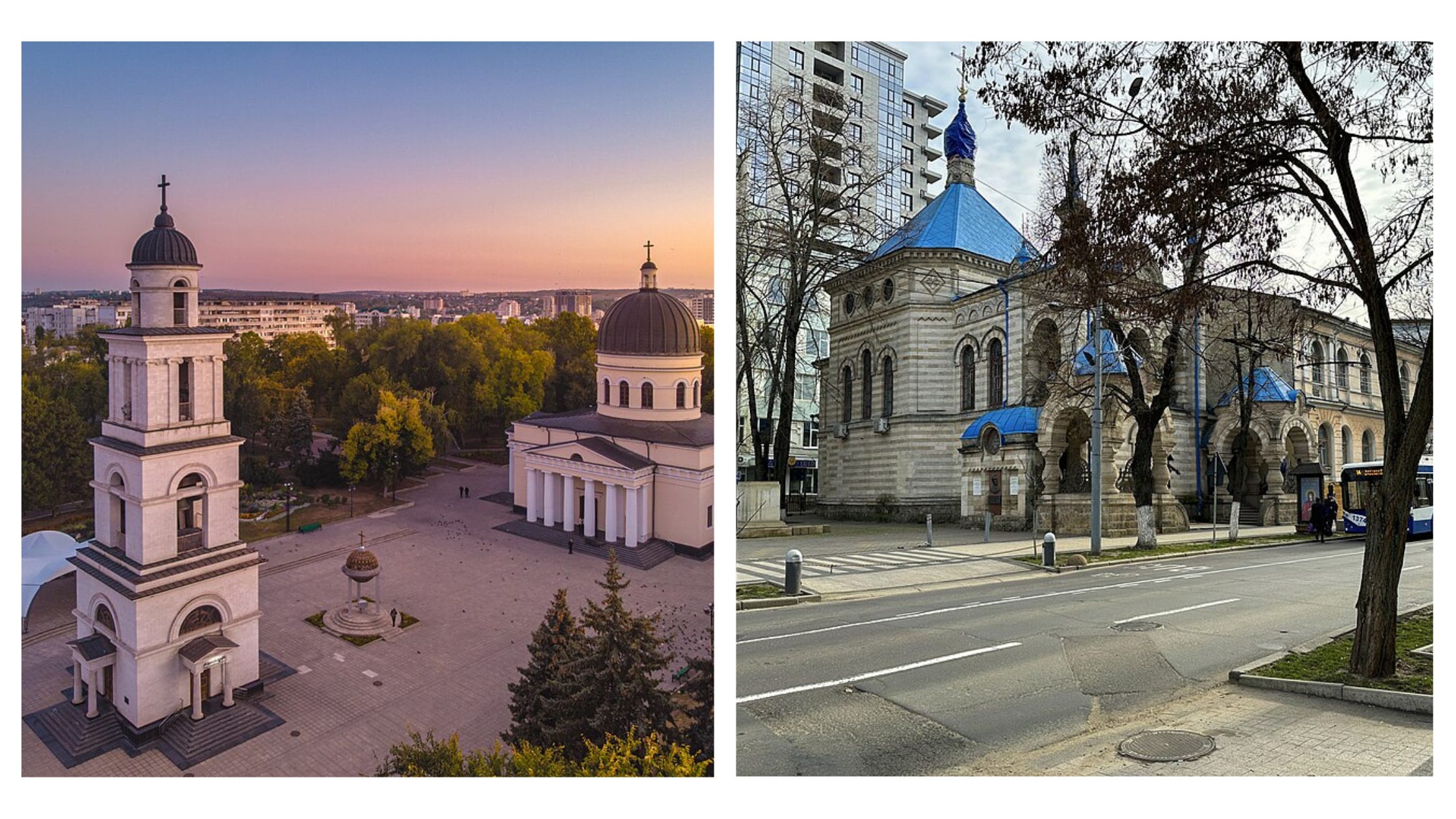
In terms of self-identification, Moldova is among the most religious countries in Europe with 2.27 million people, 94.3% of the population1 self-identifying as Orthodox in the 2024 census. While the census does not break down affiliation within the Orthodox faith, Moldova has 2 different churches that represent different cultural and historical affiliations for believers. They are:
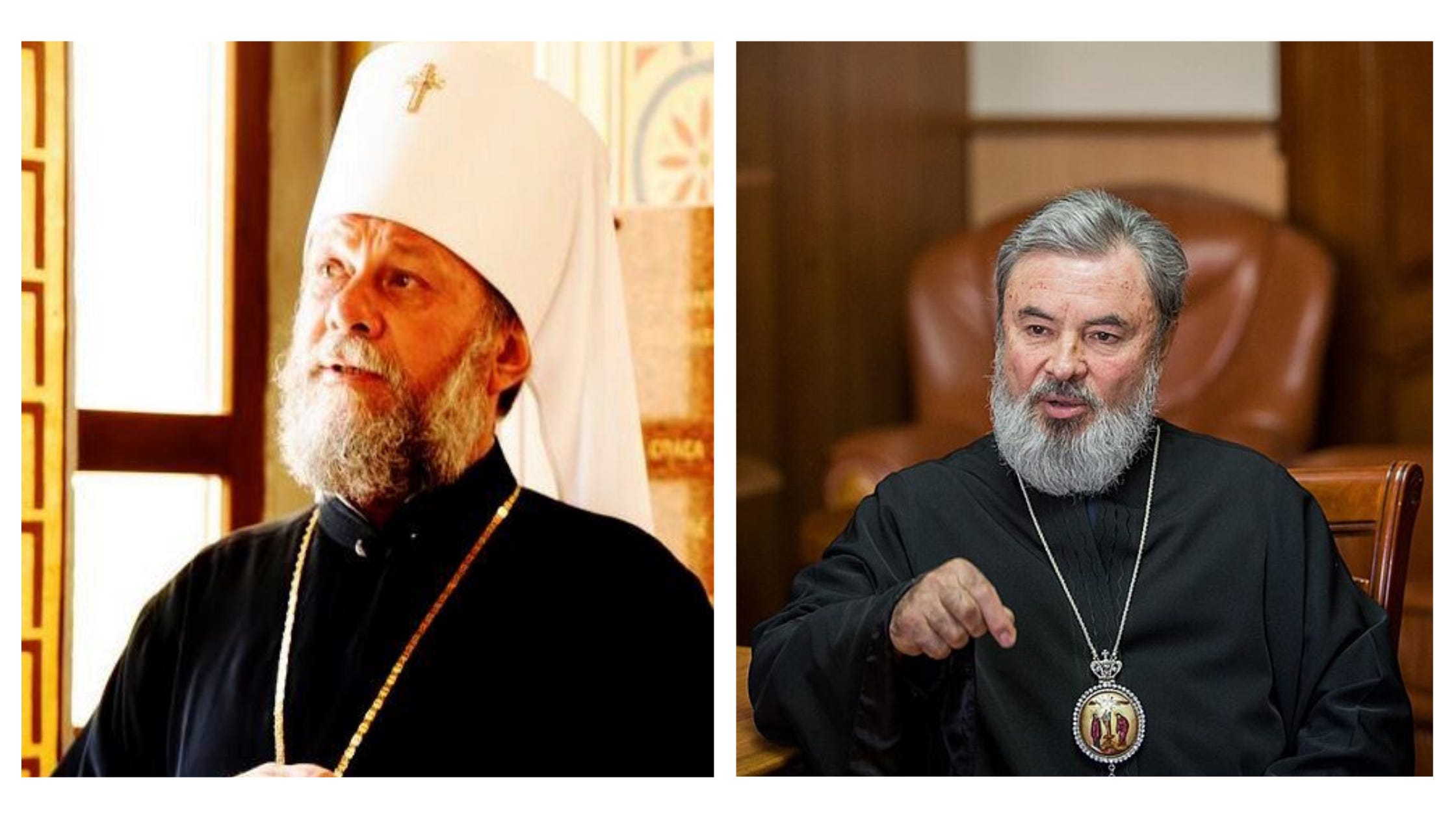
Metropolis of Chișinău and All Moldova - Often called the Moldovan Orthodox Church, this branch is an autonomous self-governing church within the Russian Orthodox Church that is subordinate to the Moscow Patriarchate. The Moldovan Orthodox Church governs day to day operations locally but is canonically subordinate to Moscow and the head of the church, currently Metropolitan Vladimir, is officially confirmed by the Moscow Patriarch.
Metropolis of Bessarabia - This church is directly subordinate to the Romanian Orthodox Church under the Romanian Patriarchate. The church is headed by a Metropolitan, currently Metropolitan Petru, who is appointed and confirmed by the Romanian Holy Synod. Unlike the Moldovan Orthodox Church, the Metropolis of Bessarabia is not autonomous and is an integral part of the Romanian Patriarchate.
There are no firm estimates of membership in the 2 churches, sources generally cite 80% of believers belonging to the Moldovan Orthodox Church and 20% to the Metropolis of Bessarabia2.

.jpg)
A Brief History of the 2 Churches
Prior to the Annexation of Bessarabia by the Russian Empire in 1812, the local Orthodox Church was integrated into the Principality of Moldavia which was under Ottoman suzerainty. The church was under the Ecumenical Patriarchate of Constantinople but was locally integrated with Romanian as the primary language of daily life and Romanian operating alongside Old Church Slavonic
for church functions.
Following the Russian Annexation in 1812 the Diocese of Chișinău was created under the Russian Orthodox Church and administration shifted to St. Petersburg which began a process of Russification. The Romanian language was sometimes tolerated, sometimes sidelined, but the church was consistently used as a tool of imperial control and integration.
In 1918 the Moldavian Democratic Republic was created and then quickly voted to form a union with Romania. Following this, in 1925, the Metropolis of Bessarabia was formally established to govern the church in the region under the control of Bucharest. Throughout the period of Romanian control (1918 - 1940) church life was re-Romanianized.
Following the Soviet Annexation of Bessarabia (1940) and then during Soviet control after WW2 the Orthodox Church entered the turbulent world of Soviet state-church politics. After initial waves of suppression, Stalin introduced limited toleration during the Second World War and following the war the church was allowed to function within strict state control, including KGB infiltration of the clergy.
The modern church schism dates from Moldovan independence in 1991 when the Metropolis of Bessarabia once again became active and began contesting legitimacy with the Moldovan Orthodox Church. Both churches claimed historical legitimacy by leaning on different historical interpretations and political traditions. The Moldovan Orthodox Church attempted to ban the Metropolis of Bessarabia with state support from successive governments in the 1990s, but lost in the European Court of Human Rights in the case Metropolitan Church of Bessarabia v. Moldova which forced legal recognition of the Romanian church in Moldova in 2001. Since then both churches have legally operated in the same territory.
Linguistically, the Metropolis of Bessarabia operates exclusively in Romanian. The Moldovan Orthodox Church also primarily operates in Romanian (which it calls “Moldovan”) but also operates Russian speaking parishes in parts of the country with majority Russian populations.
Growing Schism (2023 - Present)
While geopolitics began to fuel the schism with the outbreak of war in Ukraine in 2014, the full scale invasion in 2022 acted as a major shock to the status quo. In Moscow, Patriarch Kirill has framed the war as a civilizational struggle and has openly supported Russia’s war of aggression and conquest in Ukraine. This left the semi-autonomous Moldovan Orthodox Church institutionally tied to a war of aggression and believers and church leadership struggled to manage these geopolitical challenges.
Beginning in 2022 and accelerating in the following years, parishes began transferring from the Moldovan Orthodox Church to the Metropolis of Bessarabia. The growing schism burst into public attention in October 2023 when Metropolitan Vladimir, leader of the Moldovan Orthodox Church, wrote a letter to Patriarch Kirill which leaked to the press. In this remarkably frank letter, he laid out the challenges facing the Moldovan Orthodox Church and specifically cited the political pressure caused by the war. Metropolitan Vladimir noted an increasing exodus towards the Metropolis of Bessarabia and how the actions of the church in Moscow are forcing people to decide between their “Latin roots” and the clear ambitions to reincorporate the country into the “Russian World.” In the letter he pleads for additional funding and resources to offset growing costs associated with energy prices and competition with the Metropolis of Bessarabia who, he claims, pay priests €800 - €900 euros / month in addition to healthcare and a pension.
While the hierarchy of the Moldovan Orthodox Church remains opaque, there are publicly 2 competing factions with different approaches to politics and geopolitics. Metropolitan Vladimir has publicly tried to chart a pragmatic course while remaining closely tied to Moscow3. More aggressive is the Bishop Markell of Bălți and Făleşti, who pushes aggressive Russian talking points and appears frequently in Kremlin organized Foreign Information Manipulation and Interference (FIMI) campaigns (as we will see below).
,_2018.jpg)

Factors Driving the Schism
Here are some key factors driving parish-level decisions on defections to the Metropolis of Bessarabia:
History & Proximity - Parishes in communities with stronger Romanian identity ties - particularly along the Prut river - were among the first to switch.
Geopolitics - Russia’s war in Ukraine and the bellicose rhetoric from the Patriarch has caused both priests and parishioners to switch allegiance due to a crisis of conscience.
Politics - The Moldovan Orthodox Church has repeatedly been drawn into schemes by the Kremlin and Shor-network to become involved in Moldovan elections. Political speeches from the pulpit have anecdotally driven away parishioners who are uncomfortable mixing politics and spirituality.
Money - The Metropolis of Bessarabia is a direct funder of their parishes in Moldova. According to expert Andrei Curararu, salaries for priests are closer to €300 euros / month, rather than the propaganda claim of ~€900 (or much higher as we’ll see below). But this number disguises a different relationship with the church organization. In the Metropolis of Bessarabia resources flow downward from the center through the bishoprics and to the parishes. In the Moldovan Orthodox Church funds flow upward with a portion of the “fees” gathered for church services being directed towards the upper echelons. Thus, regardless of monthly salaries, it may be more lucrative for a priest and local parish to be part of the Metropolis of Bessarabia as they are more able to keep their “earnings.”
Opportunity - The hierarchy of the Moldovan Orthodox Church is opaque and many priests feel that they do not have opportunities for advancement. Some switch to the Metropolis of Bessarabia because they feel that their own careers will advance more quickly.
Of these factors, Andrei Curararu says that top-down motivations of priests are more common in the decision to switch allegiance than bottom-up movements of parishioners. Motivations are complex, but neither church is “reformed” in the western parlance and parishioners exercise limited democratic functions within church decision making.
Opposition to switching churches is often rooted in tradition and the calendar. While a majority of Moldovans self-identify as Orthodox there are no solid numbers as to how many go to church regularly. Many, likely a large majority, are culturally orthodox and primarily interact with the church through family milestones (births, deaths, marriages) or through holidays such as Christmas and Easter. The Moldovan Orthodox Church uses the Julian Calendar while the Metropolis of Bessarabia uses the Georgian Calendar. As such, a change between the churches requires people to re-order their holiday calendar and change traditions that they have often celebrated all their lives.
Role of the Church in the Community
For western readers, it is important to note that the Moldovan Orthodox Church and the Metropolis of Bessarabia have a lot in common both structurally and theologically. On the question of EU accession, the Metropolis of Bessarabia is considerably more pro-EU than the Moldovan Orthodox Church which largely aligns with the Kremlin’s anti-EU position. But that is not because they differ on key issues - e.g. LGBTQ+ rights, “traditional values,” etc. The Romanian Orthodox Church has many of the same anxieties but has seen the process of EU integration firsthand and knows that it is not directly threatening to their church. They may pursue many of the same culture wars but they do so within the EU’s infrastructure.
Both churches draw on the same elite and same seminaries and schools. Both churches see their role in their communities as the keepers of tradition and ritual and as enforcers of community rules. Neither church shows aspects of the reformed traditions of Western Europe, including democratization of parish governance or a role in the community’s social welfare. It is worth stressing that during the great crises of these past years - COVID lockdowns and the 2022 Ukraine Refugee Crisis - neither church played an organized role in providing supplies, donations or aid to those in need. The schism is about hierarchy, language and history - but not about theology, or the role of the church in community life.
Comparison with Ukraine
Many Kremlin FIMI narratives compare the church schism in Moldova with the parallel upheaval in the orthodox church in Ukraine. They are not similar and it is important to quickly explain why. Here is a short comparison:
This article is Part 1 of a four-part Moldova Matters series based on a new report published in collaboration with WatchDog. In Part 2, we examine how religious messaging was mobilized in Moldova during the 2024-2025 elections and how networks of clergy, activists, and online channels helped translate theological language into political influence.
You can read the whole report online from WatchDog.
Of the 2.41 million people tallied in the census, 2.35 million answered the religion question with 2.27 million declaring themselves Orthodox. This comes to 96.5% of those who declared a religious affiliation or 94.3% of the total population.
Neither the census nor polling firms have a history of asking for a specific breakdown between the churches. The US State Department’s 2022 Report on International Religious Freedom Moldova estimates 90% of adherents belong to the Moldovan Orthodox Church and 10% to the Metropolis of Bessarabia. The Hague Research Institute’s report The “Moldovan Orthodox Church: losing influence, but still valuable for Russian soft power” cites 70-80% for the Moldovan Orthodox Church against 10-20% for the Metropolis of Bessarabia. These numbers come from a 2023 study so like the State Department’s report they do not account for parish changes that came after the schism accelerated in 2023.
Various local news outlets have reported without definitive proof that he was himself a product of the KGB, or in some telling a KGB Colonel.
Wow, what a complex issue and I see how the differences work compared to my minimal exposure while living in Moldova 2015-2017. What a difference since the war for Ukraine, I'm surprised there isn't more of a shift in Moldova. Religion is a fickle thing. Interesting work, look forward to the next edition.