

On the night of May 28 - 29 a Russian drone struck the roof of a multi-story residential apartment building in Galați Romania. It exploded on impact and resulted in 2 people suffering from burns and 70 people being evacuated.

The city of Galați is around 20 km from the port of Reni in Ukraine and around 60 km from the larger port of Izmail. Galați is even closer to the Moldovan border and port of Giurgiulești. Russian attacks against Ukraine’s Danube delta ports have been frequent since the start of the war and Romania’s adjacent counties often push out “Ro-Alerts” to residents telling them to seek shelter1. This is the first time though that any Russian drone has stuck such a large piece of civilian infrastructure outside of Ukraine.
The Romanian authorities report that 2 F16 fighters had been scrambled with permission to shoot down the drone. Evidently they did not.
Romanian President Nicușor Dan condemned the attack and promised a "firm response at the national, allied, and international levels" saying that “Romania is a NATO member state and will under no circumstances allow Russian aggression to spread to its citizens.”
Support for Reintegration Grows in Transnistria
Journalists with Zona de Securitate partnered with the think tank Watchdog to conduct a study on the perceptions of the residents of the Transnistria region. The most interesting outcome was for their question:
“If a referendum were held next Sunday (you were asked to vote) on the reintegration of Transnistria with the Republic of Moldova, would you vote for or against integration?”
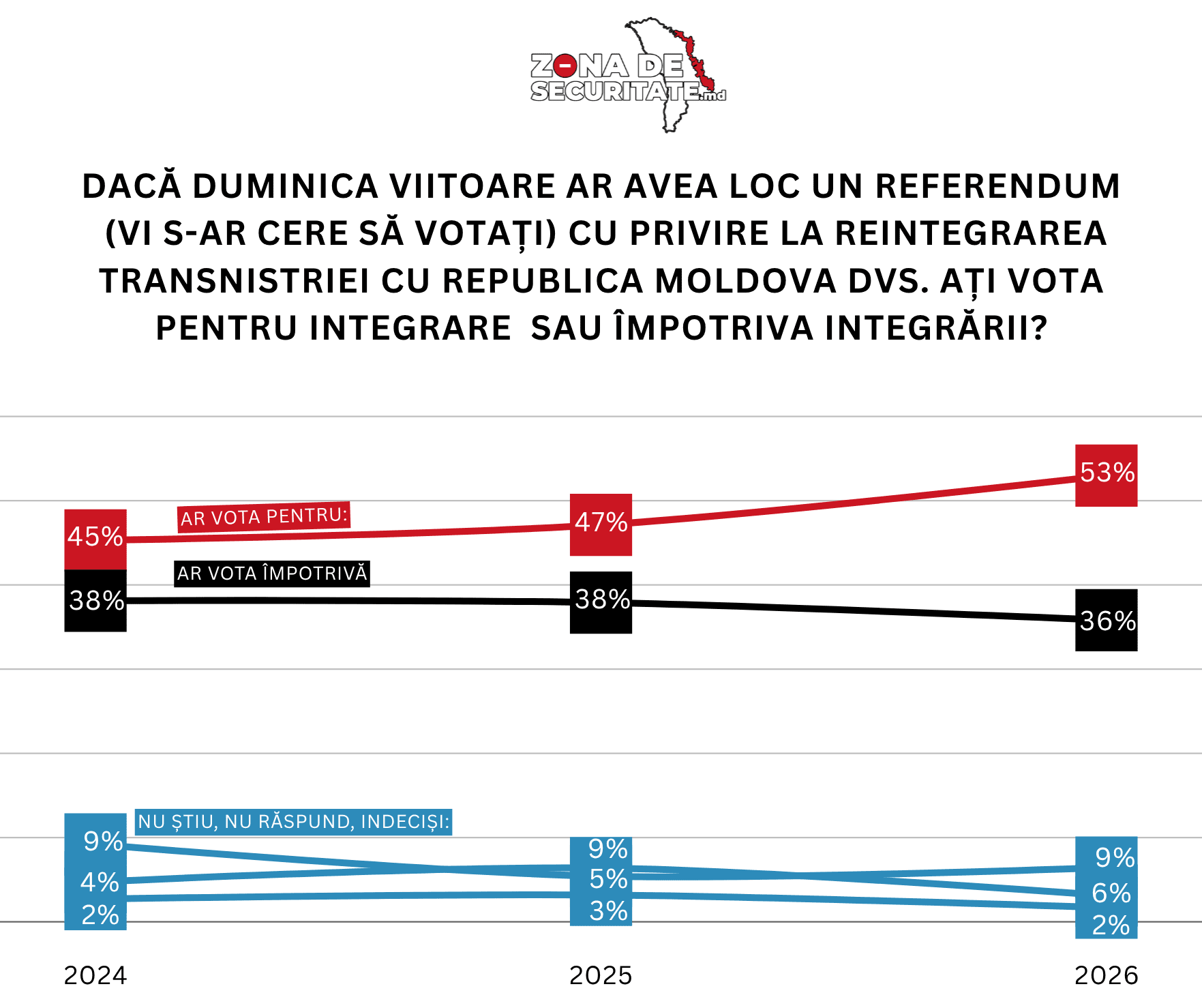
The results showed more than half of the region’s residents would vote for reintegration with Moldova given the chance. This followed a broader trend of dissatisfaction with the region’s leadership, people reporting that they are “tired” of the unrecognized status of the region and a desire for freedom of speech. When asked about what problems they face in their lives, the most common response was “the unrecognized status of the Transnistria region” which was selected by 38% of the respondents. That beat out “low salaries / low pensions” which came in at 37.5%. Both numbers rose since 2025.
Polling, journalism and freedom of expression are prohibited in Transnistria so these numbers come with some caveats. The study was conducted via an online survey which was “cross-checked” via a series of focus groups. The authors stress that these results are unweighted and that as such “the opinion of women and young people in the region is under-represented.”
Even with these caveats, the study shows real movement over time and attests to a directional change in the region in favor of Moldova and against Moscow.
5 More Transnistrian “Officials” Lose Their Moldovan Citizenship
President Sandu stripped 5 people resident in Transnistria of their citizenship. No official reason was published, but Zona de Securitate reports that they are employees of the MGB (former KGB).
This is the latest in a series of such moves to strip regional “officials” involved in human rights abuses of their Moldovan passports. Former Deputy Prime Minister for Reintegration Alexandru Flenchea recently speculated that these moves are the proximate cause of Russia’s recent threats against Moldova - including offers of expedited Russian citizenship and threats of military force. He stated:
“Here Moscow probably doesn’t fully understand what Chisinau is after by withdrawing citizenship, because what interests them is the action against the Russian military. Why is Chisinau punishing them? It’s a signal. It’s a signal that Chisinau wants to do what? And because they don’t know exactly what, just in case, they are warning Chisinau through direct threats,”
International Affairs
Here’s a roundup of the top international affairs stories of the week:
President Sandu attended the GLOBESEC Forum in Prague. There she was presented the GLOBESEC Award for “her commitment to defending democracy under pressure and her role in anchoring Moldova’s future in stability and reforms.”
Foriegn Minister Mihai Popșoi visited Beijing. In meetings with his counterpart, Minister Popșoi spoke of cooperation in the area of culture and tourism. Specifically, he announced an interest from Chisinau in establishing direct flights to Beijing, and discussed including Moldova on China’s “Approved Destination Status (ADS)” list. Countries on the ADS list are approved destinations for Chinese tourists and Moldova’s inclusion would allow tour agencies to organize group tours to the country2.
US Senator Mark Kelly traveled to Chisinau and met with President Sandu. They discussed Moldova’s resilience against hybrid attacks and President Sandu thanked the United States for the recent announcement of $8 million dollars of cybersecurity support over the next 4 years.
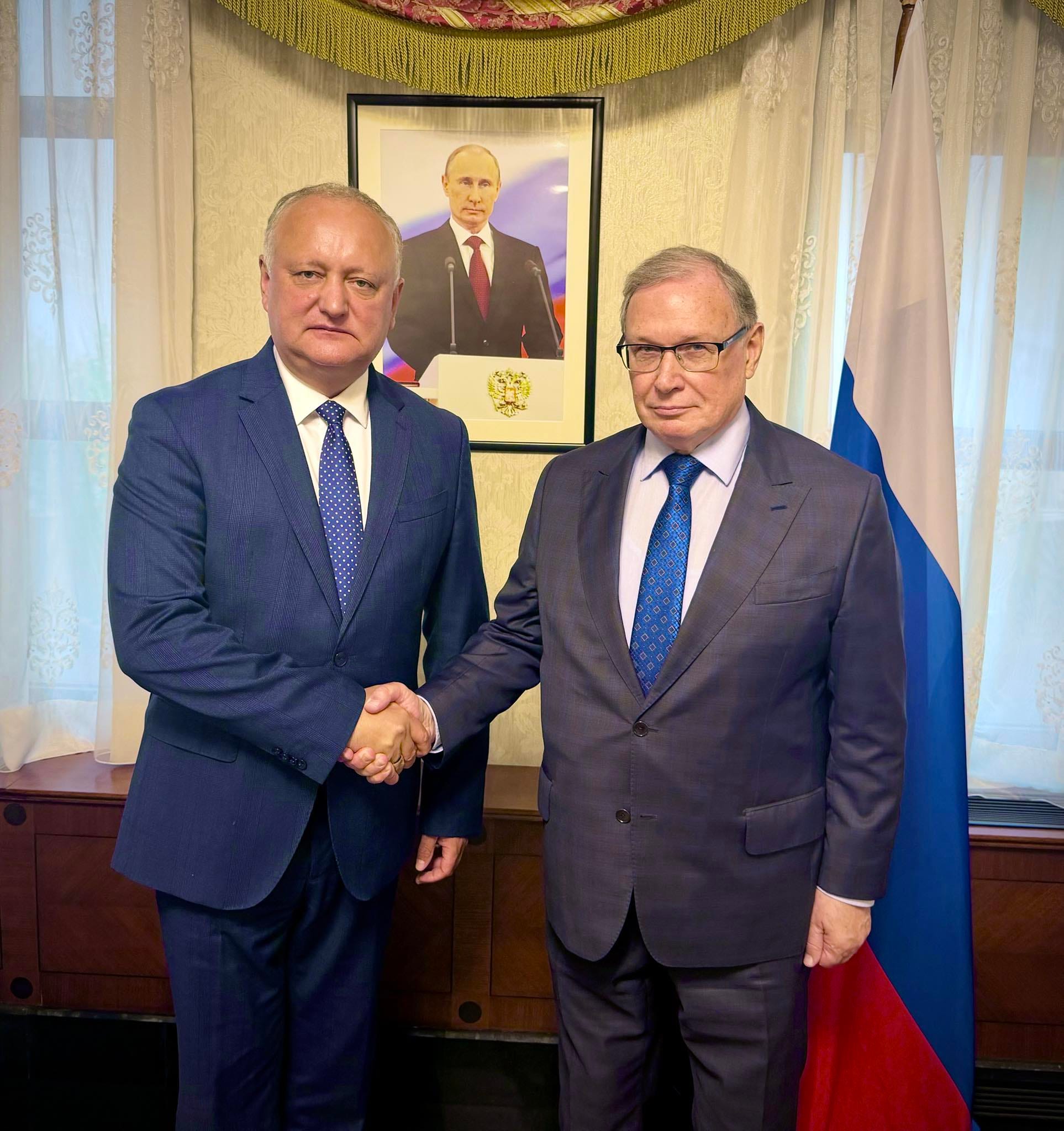
Igor Dodon announced that he will travel with a Socialist Party delegation to the Saint Petersburg Economic Forum in June. He made the announcement with Russia’s ambassador delegate posing in front of a photo of Putin. On his way, Dodon stopped in Belarus and met with Alexander Lukashenko who warned Moldova against giving up its sovereignty and turning its back on traditional friends.
Major New Sanctions Against Shor’s A7 Network
This week the UK expanded their Regulation 17A Russia sanctions to crypto-asset exchanges. These new sanctions target a broad array of entities facilitating sanctions evasion and supporting Ilan Shor’s A7 group of companies.
Regulation 17A previously applied to sanctioned banks. It is a powerful tool that blocks indirect transactions as well as direct ones. Previously, sanctions against crypto operations only covered direct counterparts, but these new sanctions regulate backwards and forwards assurance as well. Effectively, if funds have ever interacted with a sanctioned entity they remain sanctioned no matter who has them now. The UK is the first country to bring these banking style sanctions into the crypto space.
The most prominent entity that was immediately hit with these sanctions is the crypto exchange HTX. The designation stated:
“The Secretary of State considers that there are reasonable grounds to suspect that HUOBI GLOBAL SA is or has been involved in obtaining a benefit from or supporting the Government of Russia by providing financial services, or making available funds, economic resources, goods or technology, to a person, namely A7 LIMITED LIABILITY COMPANY, which is carrying on business in a sector of strategic significance to the Government of Russia.”
HTX distanced itself from Huobi Global S.A. claiming that the Seychelles based exchange was a distinct entity3.
HTX is one of the largest crypto exchanges in the world with trading volumes surpassing $3.3 billion last year. It is reported to be owned by Chinese crypto-billionaire Justin Sun. The American SEC had previously investigated Sun and his TRON blockchain over allegations of selling unregistered securities, “wash trading,” and market manipulation. They further were investigating allegations of sanctions violations and terrorist financing including Hamas. Sun was previously reported to be avoiding travel to the US for fear of arrest.
In late 2024 Justin Sun invested $75 million into Donald Trump’s World Liberty Financial and soon after all these investigations were dropped. He is now suing World Liberty Financial claiming “extortion” and they have sued him as well.
Other Shor / Hybrid War News
Here’s a roundup of the other top stories of the week:
Former Bashkan Eugenia Gutsul released an e-book from prison. The book is allegedly comprised of 30 letters she wrote from prison alleging political persecution, complaining about her conditions and more. Titled “The Gutsul Case: Anatomy of Political Persecution” the book got quite a rollout with a special website and downloads in English, Turkish and Russian4.
The Court of Appeal upheld Gutsul’s conviction. While her lawyers promise to appeal to the Supreme Court of Justice, this effectively confirms her 7 year prison sentence. Gutsul will be transferred from Prison 13 to a women’s penitentiary to continue serving her sentence.
Politics and News
Here are the top political stories of the week:
Local Public Administration (LPA) reform is progressing. 608 decisions on voluntary mergers have been made as local councils respond to the government’s proposed financial incentives. President Sandu put out a statement on the process encouraging all communities to have an open discussion on the issue and consider mergers. She stated:
“The reform has been put aside for too many years because it is extremely complicated and does not bring either votes or applause. But postponing the reform means depriving our villages of the chance to develop. 87% of the municipalities in Moldova have under 3,000 inhabitants. If we compare the average population per municipality, in Moldova it is 17 times smaller than in Lithuania, for example. Large municipalities are stronger and have the capacity and resources to provide better services to people.“ (...)
“We want developed localities and encourage city halls to unite. The government announced that it will offer three times more money than previously: 3,000 lei for each inhabitant, multiplied by the total number of inhabitants, for localities that voluntarily unite their administrations. The village and local identity are preserved, only the administrations unite ,”
Mayor Ceban put on a show in parliament. Chisinau’s mayor entered parliament while in session with the apparent goal of making statements protesting LPA reform. After some heated words he attempted to speak from the parliamentary rostrum and was removed after a scuffle with security.
Moldova will create emergency fuel stockpiles. The parliament passed this law in the first reading. It would mandate fuel stocks of 61 days of consumption of 90 days of net imports. Storage responsibility would be split between a government created or designated “Central Storage Entity” and private sector importers. The law was motivated by the current global oil crisis and aligns Moldova with EU norms.
Parliament will reduce taxes on renewable energy infrastructure. Customs duties will be dropped to zero for wind turbines (previously 8%) and energy storage (previously 5%). VAT on these imports will still be paid but can be deferred for up to 20 months. These moves follow similar actions for solar panels that are already in effect5. In 2026 Moldova has become a net exporter of renewable energy and storage is now the main need in the sector.
Economics and Infrastructure
Here are the top economic stories of the week:
The National Bank nor projects 8.1% inflation in 2026. In their announcement they call this “a significant increase compared to the initial forecast, before the conflict in Iran, of approximately 4.7%.” GDP growth is now projected at 2% for the year.
Ending on a High Note
This week the film Fjord won the Palme d’Or trophy at 79th Cannes Film Festival. The film starred Sebastian Stan and was directed by Cristian Mungiu, a Romanian director with Moldovan roots. 15 year old Moldovan actress Vanessa Ceban also played a leading role.
The film explores how a Romanian-Norwegian couple with 5 children adapts to life in an isolated coastal town in Norway.
President Sandu issued her congratulations writing:
“It’s a great joy to see a world-renowned director with Moldovan roots, whose originality and talent create memorable films that touch and inspire audiences across the continent. Mungiu’s films are, above all, a discussion about the values that define us as a society. It is his ability to honestly and boldly raise crucial issues that has once again earned him recognition on the world’s highest filmmaking stage,”

It’s interesting to consider that both Romania and Ukraine have sophisticated warning systems telling residents to seek shelter when drones fly over. Meanwhile, Moldova is largely ignorant of drones entering the country’s airspace and has no mechanism of alerting residents short of using Soviet Era air raid sirens.
China uses ADS as a political tool. ADS does not affect wealthy tourists who travel alone and plan their own trips. It does impact the huge number of group tourists from China. Inclusion in the ADS list can be a major economic boon and China grants it as an indication of political favor. Similarly, removal from the ADS list is used to punish countries that take decisions Beijing does not like.
Most likely many distinct but not independent shell companies set up for this purpose.
I guess they kinda gave up on the Romanian speaking audience?
While I haven’t dug into the specifics here, most likely this is about new vs old equipment. Tax breaks already existed for new equipment and since solar panels are almost all new (from China) they were exempt. Wind turbines on the other hand are mostly used / older models imported from Germany after their lifecycle there expires and so they were taxed at a higher rate.
The reunification item was VERY interesting!
I'd expect young people to be more Europe leaning, which suggests that the real number might be higher...
Crazy things happening, saying this as a Galați native. I felt the explosion, but first I thought it was from Ukraine. It was only after I got up that I saw the real deal. Prayers for the family who got injured and also lost their apartment due to this. It's madness.