

Drone Report
Unfortunately, drone overflights, crashes and explosions in Moldovan airspace and territory are becoming so frequent and so dangerous that we’ll start highlighting them up front in the newsletter. Here’s this week’s report:
September 26 (11:16 am) - Drone overflight in-and-out of South Moldova in the Transnistria region.
September 26 - Drone fragments found on the outskirts of Volintiri, in the Stefan Vodă district. This was not linked to the morning’s overflight and the drone itself appears not to have been reported or detected in flight.
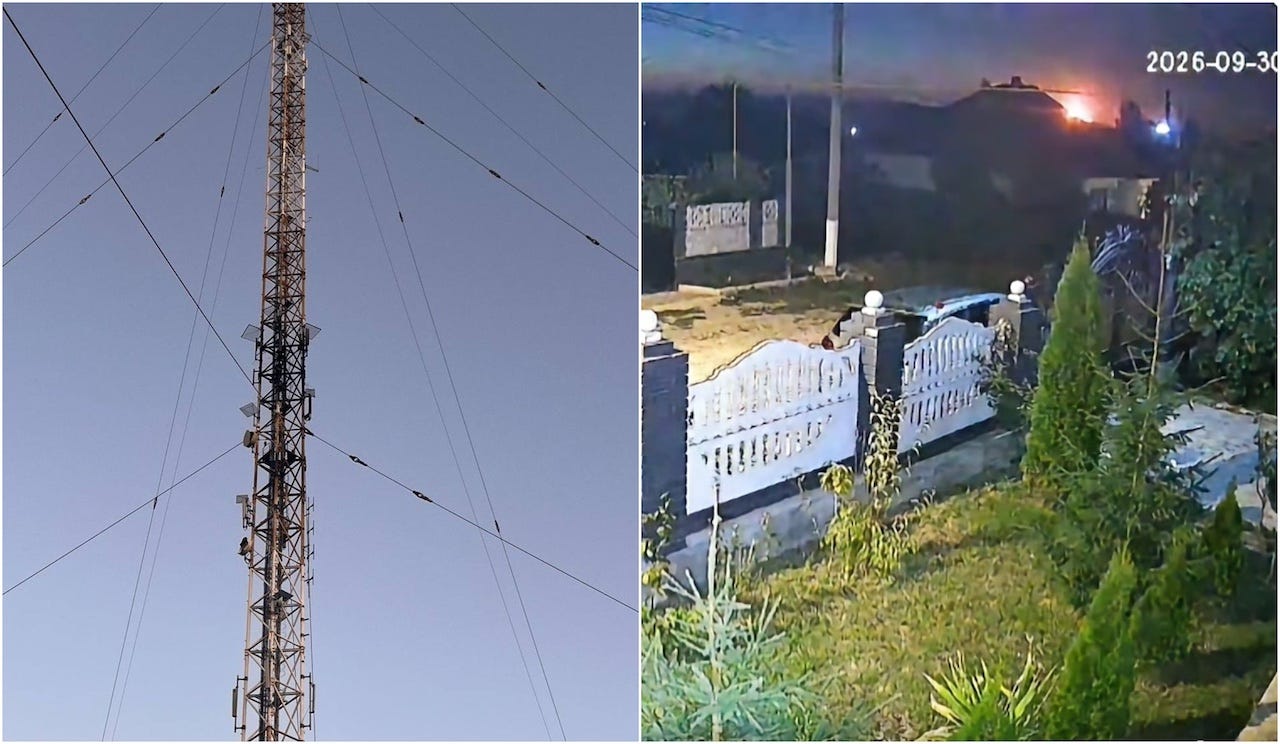
September 30 (5:40 am) - A drone crashed and exploded in the countryside near the village of Hîrbovăț, Anenii Noi district. The explosion was caught on video by a home security camera. Police reported that the drone hit a large antenna tower 40 m in the air, exploded and scattered debris in a large radius.
September 30 (10:26 am) - A drone was detected entering Moldovan airspace near the town of Lunga in the Dubasari district in Transnistria. It then turned north and headed towards Soroca, causing airspace closures in the Center and North of the country. Reports indicated that it was a jet powered drone moving at approximately 400 km/hr. It apparently exited the national airspace.
September 30 (8:45 pm) - A drone crossed into Moldovan airspace in the northernmost part of Transnistria near Rezina. It then turned South and was lost from radar near Brănești, Orhei. Central airspace was closed in the incident and reopened at 9:07 pm. Local residents near Brănești called the police to report an explosion and police found the impact location close to the road connecting Ivancea to Brănești. Traffic was stopped in both directions as debris was cleared and the site was made safe. Tourists to Moldova will know this stretch of road well, as it connects the main North-South highway to Brănești (famous for its wine cellars) and on to Orhei Vechi. Police reported that the drone was a turbojet powered “Geran-type” drone.1


What Are the Authorities Doing About it?
Asked about the government’s response to the massive uptick in drone incursions and explosions, Defense Minister Anatolie Nosatii stated that:
“We are in the process of implementing projects that will allow us to equip the National Army with systems capable of shooting down these drones or missiles,”
What this means in terms of strategy or capabilities remains unclear. Previous statements from the Ministry of Defense have indicated that Moldova does have limited tools to shoot down drones but that these are deployed to protect critical infrastructure. They also noted that Russian drone flights may partly be intended to test these capabilities and map them out.
Enter Igor Dodon. In the midst of the multiple incursions and explosions in populated areas on September 30, the former President and leader of the pro-Russian Socialist party posted these 3 photos on his facebook account:


In his post, he revealed the location of the air defense assets and publicly demanded that the government be maximally transparent about where such units are positioned because “people are worried.”
Naturally he is silent on condemning Russia for the drones themselves or the explosions in people’s neighborhoods… apparently, that isn’t worrying to Mr. Dodon.
MD-Alert
The Moldovan government is working to implement an emergency broadcast system called MD-Alert - currently scheduled to be active sometime in 2027. This system would be similar to Romania’s RO-Alert system which uses the cell phone networks to broadcast warnings that quite literally cause your cell phone to blare an alert when drones are in the air nearby2. Radio Europa reports that the National Crisis Management Center is now working with the E-Governance Agency to create a temporary warning module via the EVO app. This should be ready by later this fall.
Other Security & Transnistria Updates
Here’s a roundup of the other top stories related to security and Transnistria:
Moldova proposes convergence infrastructure. The Ministry of Reintegration announced that it has proposed 2 infrastructure investments for the Transnistria region. These would be a new center for family doctors and social assistance in Bender and a sewage treatment plant in the same city. Minister for Reintegration Valeriu Chiveri stated that these would be early investments from the newly created convergence fund and that they have been presented to the Transnistrian “authorities,” who have not yet responded to them.
Transnistria’s economic crisis continues to deepen. A new study by think tank IDIS Viitorul estimates that 25,000 Transnistrians now work in constitutionally controlled Moldova, primarily in the HoReCa sector. It estimates that their combined annual salaries are approximately $240 million, exceeding the region’s total annual exports of $224 million. The study estimates a 20% contraction in the region’s GDP in 2025 and that the current GDP per capital of the region is less than half that of the rest of Moldova. It highlights a “structural crisis” in the region’s economy and budget and states that:
“The real public policy choice [for Moldova] is not between maintaining the current situation and immediate reintegration, but between a planned adjustment and one imposed by the crisis,”
New American sanctions against Shor’s A7 network. The Office of Foreign Assets Control (OFAC) sanctioned the A7 companies as well as subsidiaries as part of “Operation Economic Outcast” targeting “Iran and other adversaries.” To date there has been little to no public indication that Shor’s network is laundering Iranian money, and while much of the announcement focuses on Iran it is clear that the “other adversaries” noted by Treasury Secretary Scott Bessent is primarily referencing Russia. This is a major action that should stand as a warning to entities in China and other countries that facilitate A7’s work.
International Affairs
Here’s a roundup of the top international affairs stories of the week:
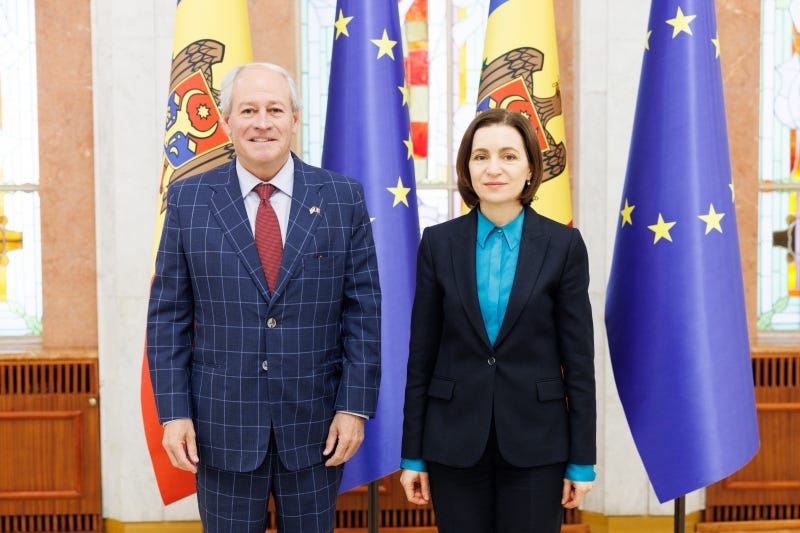
Moldova has a new American Ambassador. President Sandu accepted the credentials from Ambassador Joseph Mark Burkhalter this week alongside 4 other new Ambassadors. These included Turkey, Canada and Saudi Arabia who both have new Ambassadors at Large based in Bucharest, and Algeria, whose Ambassador at Large is based in Kyiv. This marks the first time that Moldova has had an official American Ambassador since Ambassador Logsdon left in June 2024.
The Romanian political crisis deepens as parliament rejects Siegfried Mureșan’s government. President Nicușor Dan continues to reject calls for an early election and stated that he will announce a new candidate for Prime Minister on October 5 following consultation with the parties. He warned all parties against forming a coalition with the far-right Alliance for the Union of Romanians (AUR). The news comes in the same week as an explosive Wall Street Journal story reported that American Ambassador to Greece Kimberly Guilfoyle threatened Greek politicians saying that the US government was involved in the collapse of Romania’s previous government under Ilie Bolojan and that the same thing could happen in Greece.
Prime Minister Tofan addressed the UN General Assembly. In his speech (which is worth watching in full) he spoke of Moldova’s journey as a small country emerging from the domination of its neighbors to determine its own future. His speech highlighted agency in difficult times saying “Small countries choose neither their geographical location nor their size. But being small does not mean being powerless.” The Prime Minister went on to speak of Moldova’s decision to join the European Union as the country’s national project, saying that:
“For us, joining the European Union does not mean replacing one sphere of influence with another. It means exactly the opposite. It means that our citizens exercise their right to choose. To choose democracy. To choose prosperity. To choose peace.”
He concluded with an address to Moldovan citizens in Romanian saying that while “a hard winter awaits us” people must “stick together” and help those in the most need. He concluded:
“Moldova may never be a great power. But we have everything it takes to be a great country“
Energy & Water Crisis Updates
Here is a roundup of the top stories in Moldova’s dual crises this autumn:
Outflow from the Novodnistrovsk Reservoir has been reduced to match inflows. Ukraine has announced that the reservoir no longer has reserves and that they are substantially reducing outflows. Already some Ukrainian towns along the river are rationing water according to scheduled on/off basis. Currently the much smaller Dubasari Reservoir has sufficient storage to ensure adequate flows for the Chisinau pump station, but there are questions about whether the pumping station will be able to continue accessing water at the river’s level for much longer. The government has provided the pumping station with more supplementary pumps that reach into deeper sections of the river as a stopgap measure. Moldovan members of the Dniester Commission have criticized Ukraine for taking action unilaterally and abruptly, leading to a rapid drying up of some parts of the river that killed large numbers of fish. The Moldovan government has sought to deflect blame from Ukraine by noting that you cannot negotiate with an empty bucket, but the opposition is seeking to blame water shortages on Ukraine and on Moldova’s government for not being “firm” enough with the Ukrainians. Near Soroca, the river’s level is already catastophically low as you can see in this video from Observatorul de Nord:
Gas and heating prices spike ahead of winter. The National Agency for Energy Regulation (ANRE) approved new prices for centralized thermal heating, raising prices 62% for customers in Chisinau and a 53% in Balti. At the same time, the ANRE set a new natural gas tariff of 26.14 lei / cubic meter starting on October 1. This is a 29% increase on the current price of 20.3 lei / cube, which was itself a jump of 41% on September 1 of the prior price of 14.42 lei / cube. That is a cumulative 81% increase in prices over 2 months. The agency cited skyrocketing natural gas prices for both changes.
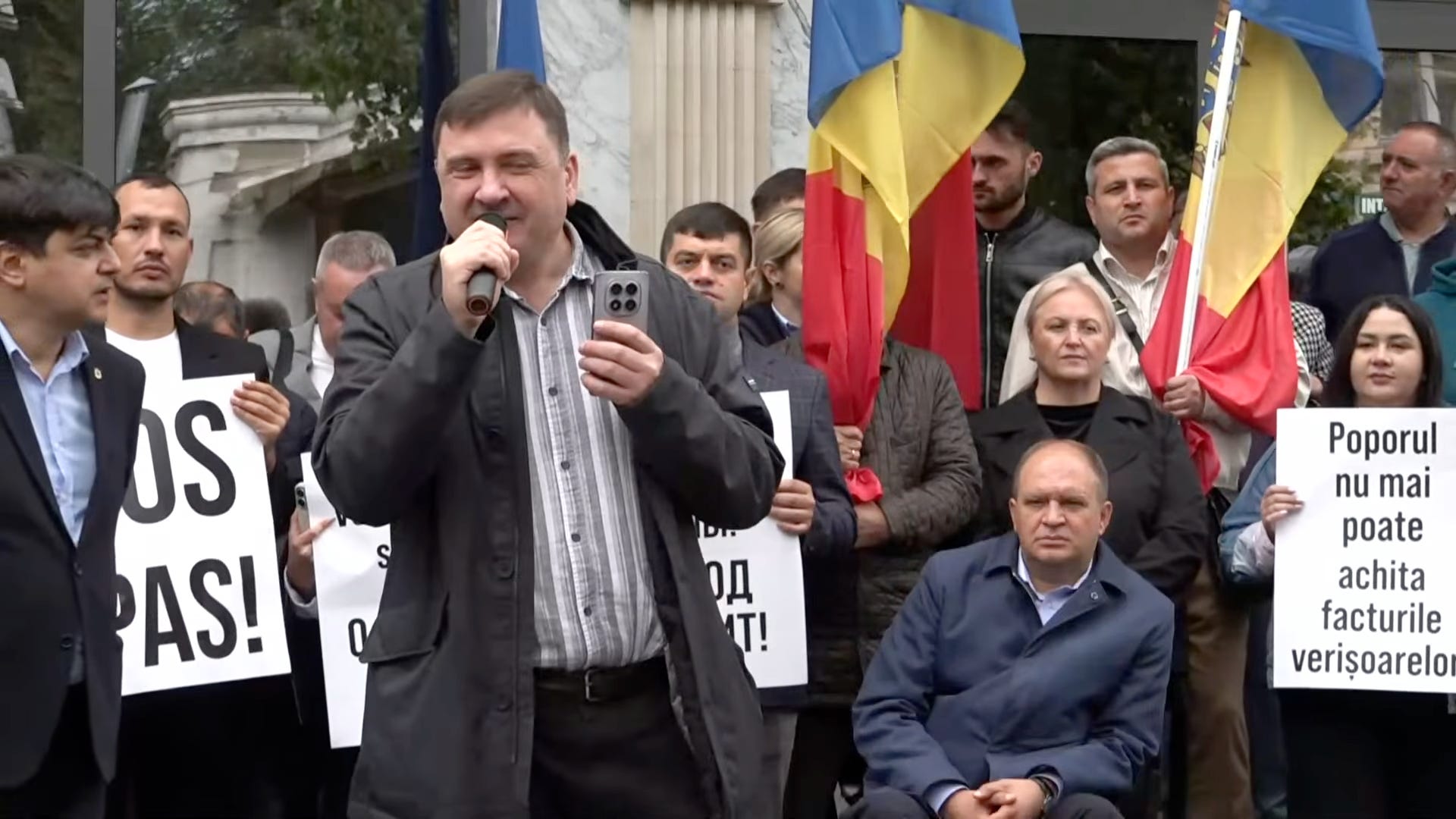
Opposition parties staged a protest outside of ANRE headquarters. Representatives of the MAN party, Socialist and Communist parties, Our Party, PSDE and PPDA parties gathered a crowd with slogans about high prices and “down with PAS” posters. Organizers claimed 500 participants in the protests. PAS representatives responded to ZdG requests for comment by noting that they cannot control global energy prices but that the government is preparing targeted compensation for the hardest hit consumers.
Moldova to seek long term gas supply contracts. In a major pivot, Prime Minster Tofan announced that the government would seek out long term supply contracts to blunt market instability. He noted that government projections anticipated a market price of $360 per 1000 cubic meters and the actual prices are higher than $1000. He stated that “Wherever the gas is, that’s where we’ll go to find it for Moldova. We’ll go to Qatar, Azerbaijan, and Turkmenistan, no matter how difficult it may be” clarifying that “We won’t go to the Russians or Putin, though. All other options need to be considered.” This comes in the context of a reported meeting between Tofan and (former3) Russian oligarch and gas billionaire Igor Makarov to discuss long term contracts. Makarov is a Moldovan citizen, but is sanctioned by Canada. This meeting reportedly followed an introduction by former American official Kurt Volker.
Political Updates - Major Change in LPA Reform
Prime Minister Tofan announced a major shift in direction for the Local Public Administration (LPA) reform, stating that Moldova’s current 32 districts will be replaced by 3 regions - north, center and south. Chisinau, Balti and Gagauzia will retain their status and Taraclia will be reorganized into a level 2 municipality as planned. Under the new plan, public services will remain at the town and village level while the consolidated regions will focus on larger strategic infrastructure projects. The goal of the new plan is to reduce bureaucracy and cut overlapping functions while building smaller more specialized regional teams. The Congress of Local Authorities of Moldova (CALM) called the announcement a “pleasant surprise” but noted that complicated questions of detail will follow.
Prior to becoming Prime Minister, Vasile Tofan wrote an op-ed for Moldova Matters criticizing the planned LPA reform and calling for bolder steps to reduce the number of regions. You can read that article here:

46 MPs Sign a Petition to Impeach Maia Sandu
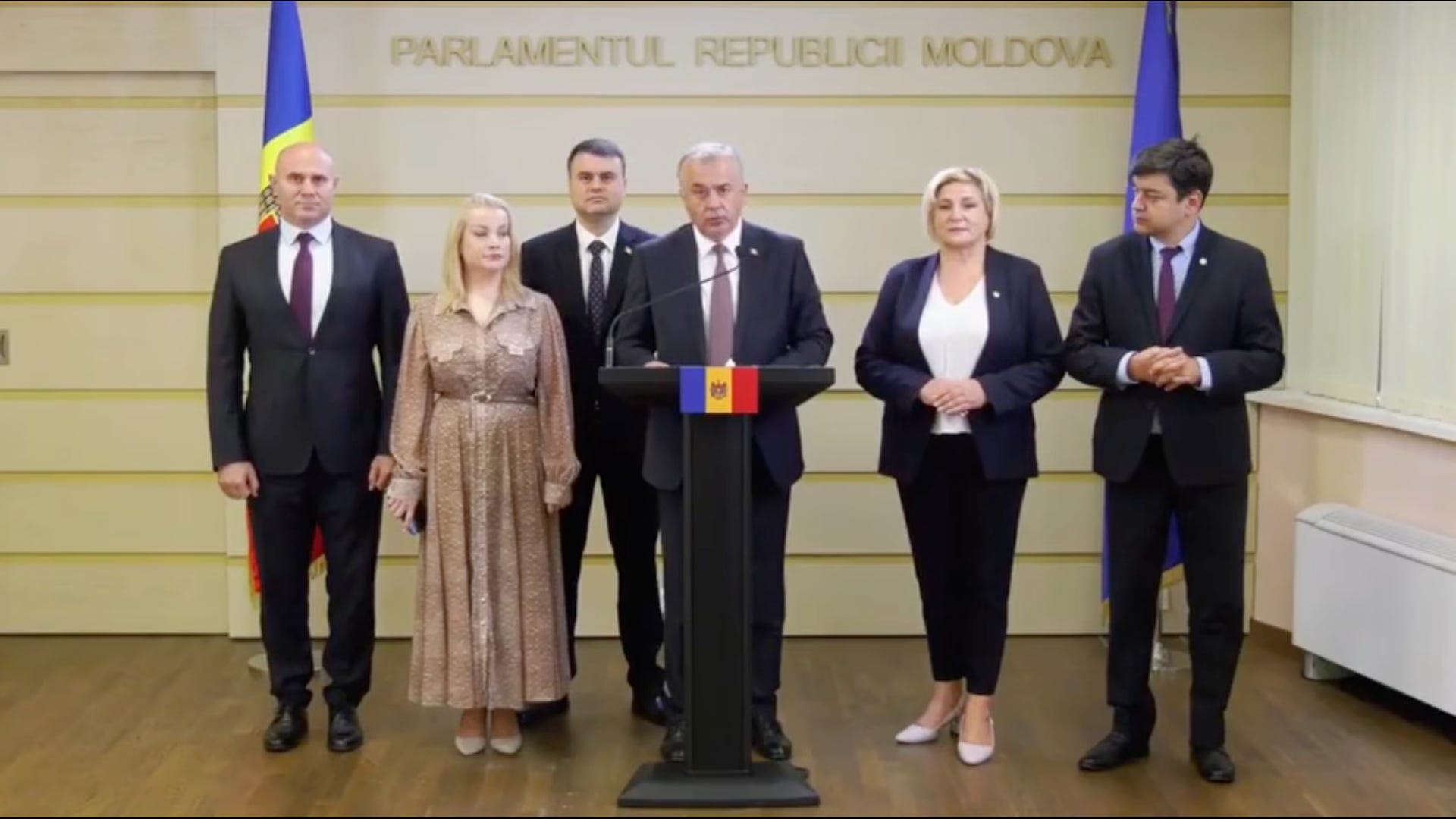
All opposition MPs signed this bill seeking to suspend President Sandu. The announcement was led by PDCM leader Ion Chicu who was flanked by members of the Socialists, Communists, Our Party, MAN and PPDA. Interestingly, no other party sent their leaders or even senior leadership to the announcement. Speaker Grosu commented on this fact saying:
“They united to overthrow President Maia Sandu. It’s strange that the leaders of these parties didn’t come out either. They must be ashamed of their own initiative. Maybe it’s an order from above and they don’t want to be associated with this order either.“
He went on to note that the doomed initiative was being made in lieu of similar unity in condemning Russian drone attacks or productive proposals around the energy or water crisis.
Likely a Geran-4. Geran-type is used to describe a Shahed 136 form factor (even though the Geran-5 has a cruise missile form factor). The turbojet powered Geran-3 is no longer in production making the mark 4 most likely.
From firsthand experience I can tell you that sudden cacophonous noise telling you to seek shelter really gets your attention.
He gave up his Russian citizenship to dodge sanctions. Canada amended their sanctions law to fix this technicality and put him back on the list.