

Moldova Suffers Massive Power Outage
On Saturday, January 31st 2026 the lights went out across most of Moldova. The time was 10:42 am. This was only the second such occurrence since the beginning of the full scale invasion of Ukraine, with the first being November 23, 2022.
Minister of Energy, Dorin Junghietu explained:
“Due to serious problems in the Ukrainian power grid, on the morning of Saturday, January 31, the voltage dropped on the 400 kV Isaccea-Vulcăneşti-MGRES line, causing the damaged disconnection of the power system.
The electricity transmission system operator, Moldelectrica, is working to remedy the situation, with voltage already restored in some localities,”
In Chisinau, Mayor Ceban called for calm and requested police take over traffic directions at intersections. With trolleybuses offline, people streamed into the streets wherever the busses happened to stop. At the same time, give that it was Saturday morning, things were quiet compared to the rush hour blackout in 2022.


Border crossings switched to generators and processed passports by hand until they were brought back online at around 4 pm. Hospitals and medical institutions also went to generators for critical systems and were also online by 3:40. By 3 pm Chisinau’s trolleys were starting to operate and by 4:30 most of the country was connected to the grid again.
During that time, backup generators kept all critical infrastructure operating, police responded to control traffic and dozens of people had to be rescued from stopped elevators. Emergency plans developed after the last outage, combined with light weekend traffic, meant that the outage was an inconvenience, not a disaster.
Still, power was out in much of the country for 4-6 hours….
What Happened?
To answer this question we need to refresh ourselves on Moldova’s electrical infrastructure situation.
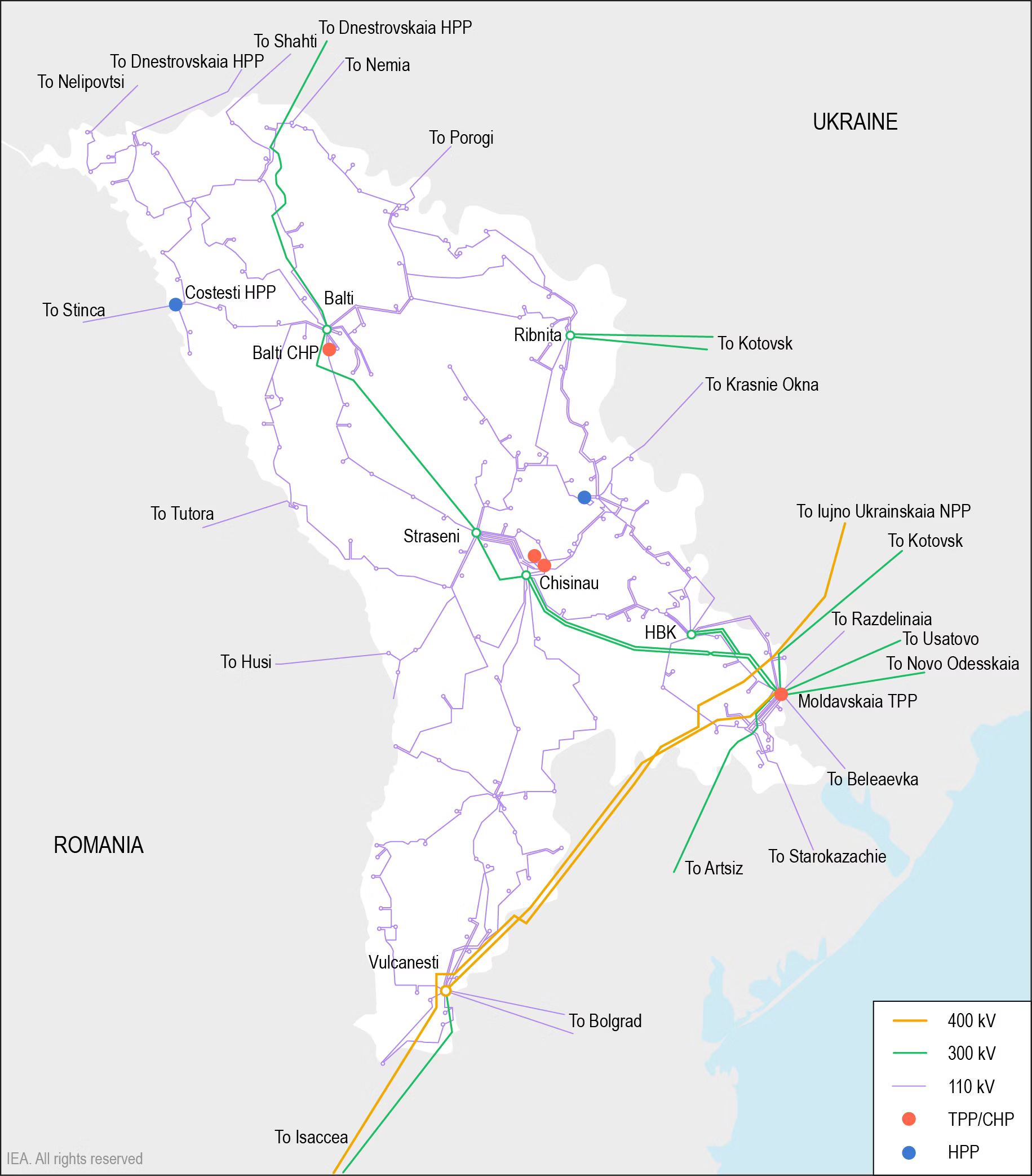
While we don’t know exactly what the trigger was, it has been reported as an equipment failure / fault in Ukraine. This is likely due to Russian attack, or due to damage sustained in past attacks. In the map above, you see the Isaccea-Vulcăneşti-MGRES (MGRES is marked “Moldavaskaia TPP) 400 kV high voltage line in yellow. This is how electricity transits from Romania (EU grid) through Ukraine to Transnistria. From there it supplies the Odesa region in Southern Ukraine and Moldova.
A voltage drop on this line cause a cascading automatic disconnection of power stations all across Moldova (and presumably Southern Ukraine). Equipment that cannot survive below a certain voltage threshold disconnects automatically to prevent damage. This first took down all the green 300 kV lines, followed by the purple lines on the map above which are largely 110 kV regional lines. Below those, the 10 kV feeder lines disconnected themselves as well.
This made the Romania connection lines at Stinca, Tutora and Husi, seen above as purple lines crossing into Romania, go into “island mode.” This contingency had been tested and planned for but never used. Basically, those lines, which are normally inactive, begin supplying power to small “islands” of towns in Moldova within their vicinity. This way any parts of the country that could be directly supplied from Romania kept power due to the emergency plan.
Technicians restored power in basically the same order in which it went out: big lines to small ones. By 3:40 pm all the 110 kV lines were re-energized and local crews were bringing online the 10 kV feeders in stages.
In remarks after power had been restored, Minister of Energy Dorin Junghietu said:
“Today’s incident shows how important the interconnections with Romania that we are currently working on, Bălţi - Suceava, Straşeni - Gutinaş and, of course, Vulcăneşti - Chişinău, are. We thank the system operators in Romania and Ukraine for their operative interventions and cooperation,”
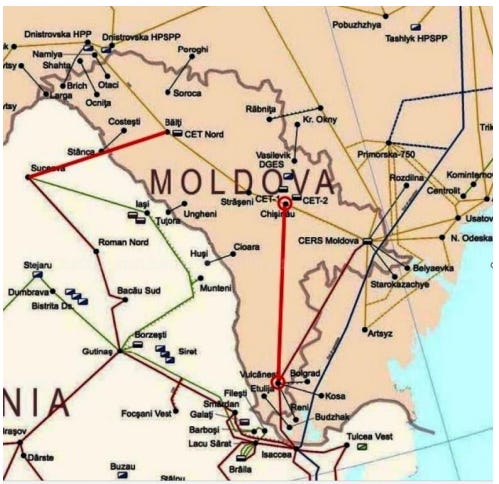
Recall: While Moldova is not reliant on Russia or Transnistria for electricity, it is reliant on high voltage lines that pass through both Ukraine and Transnistria. The government and international partners are working on 3 new high voltage lines to mitigate this risk:
Vulcăneşti - Chişinău (seen above in red stretching south from Chisinau): This line has been completed and tested. It will be operational once the power stations on either end are completed and certified. It was funded by the World Bank.
Bălţi - Suceava (seen above in red stretching west from Balti): Funded by the European partners1 this line is planned to be completed by late 2027.
Straşeni - Gutinaş (not pictured, but between the 2 pictured red lines): The last of the 3 lines is fully funded by a US government grant of $130 million dollars. The timeline is not yet announced.
The Vulcăneşti - Chişinău line alone will be able to handle more than half of Moldova’s peak electrical consumption and will substantially guard against situations like the blackout from last weekend.
International Affairs & Security
Here’s a roundup of the top international affairs stories of the week:
Maia Sandu was nominated for the Nobel Peace Prize. Norwegian MP and Green Party Leader Arild Hermstad nominated her citing Russian hybrid attacks and saying that “protecting institutions, transparency, and democratic elections is preventive peacebuilding.” Nominations for the Nobel Prize close on January 31st each year. Around 300-400 people are nominated yearly by the fairly large number of people who have the right to nominate anyone they please. From those a shortlist is compiled and a decision announced in October.
The US will allocate $36.5 million dollars in security support to Moldova. This was announced by Moldovan Ambassador to the US Vlad Kulminski who stated that the funds would be used for “energy security, cybersecurity, resilience and other related national security priorities.” The ambassador noted that Moldova was among very few regional countries to receive any announcements of support from the US this year saying that it reflects “the level of trust and maturity of security cooperation between the Republic of Moldova and the United States.”
The Security Service of Ukraine (SBU) has banned the use of 1C in public institutions. For those of you lucky enough not to know, 1C is a Russian accounting program2. It has a near total monopoly on both private and public sector use in Moldova, Ukraine and many other former Soviet states. The SBU determined that putting all the nation’s finances through a Russian program was a risk. This has sparked a conversation in Moldova about the use of 1C as well as the use of Russian video conferencing software TrueConf, which is used for all remote court hearings.
Editor’s Note: I am aware that the US House of Representatives Judiciary Committee released an interim staff report that spends some time focusing on Moldova. The report, which basically ignores Russian election interference while claiming that the EU undemocratically manipulates elections, is “absurd and unfounded.” That was the official response of the European Commission, and I haven’t decided whether I’ll just go with that or whether I’ll dedicate an article to how Citizens United is being used to privilege corporate speech over both individuals and other nations sovereignty. I’ll get back to you on this one3.
Crime & Corruption
Plahotniuc “associate” Vladimir Andronachi was released from custody at the end of January. Andronachi had been in pre-trial detention as his trials for major corruption progress. ZdG does a great job explaining the mind numbing nuance of his release, but here’s the gist: The district court claims that the lead prosecutor missed the deadline for filing to extend his detention. They then released him for 30 days under judicial control with electronic monitoring. The prosecutor appealed, and the appeals court agreed that the prosecutor failed to make the deadline, but also dismissed the “judicial control with electronic monitoring” on another technicality meaning he’s just free to do whatever he wants. The prosecutor claims that the court illegally manipulated the filing deadlines due to the holiday schedule. He is being investigated by a disciplinary board now.
It’s a classic case of 2 courts and a prosecutor all “agreeing” officially that a dangerous criminal who is a flight risk should not be released… and blaming others for forcing their own hands in releasing him. We’ll see what comes next in the case, or if Transnistria gains one more oligarch this month.
Economics & Infrastructure
Here’s a roundup of the top economics stories of the week:
The state has officially retaken control of Lukoil’s airport assets. Recall, that due to US sanctions the state took temporary control on November 12th of this strategic asset while paperwork was sorted out. Lukoil was required to officially ceed ownership by January 9th - but missed the deadline resulting in a 5 million lei fine. Now they have officially ceded ownership and paid the fine. Separate reports indicate that the American investment fund Carlyle Group is in negotiations to buy Lukoil assets outside Russia which would include the filling stations in Moldova. This deal still faces regulatory approval.
Parliament has proposed an increase of the VAT registration threshold for small companies. Currently, once a company makes more than 1.2 million lei / year it must become a VAT payer (20% default rate). This means a major increase in taxes and accounting complexity. Parliament’s Committee on Economy, Budget and Finance has proposed raising this threshold to 3.2 million lei. The government has stated that they support a new threshold of 1.7 million lei - picked to align with EU norms. The 1.2 million threshold has been in place since the early 2010s, meaning that an absolute minimum new threshold to simply keep up with inflation would be around 2 - 2.4 million. Small companies have gotten disproportionately squeezed by inflation, but EU norms of keeping this threshold relatively low are likely to win the day. We’ll keep an eye on this story.
Of a €77 million euro budget, €15.4 million is an EU grant, €30.8 million a loan from the EBRD and €30.8 million a loan from the European Investment Bank.
Think Quickbooks by made by lunatics in 1993 and never updated. I cannot begin to stress how horrible this program is - from buying it in a box on a CD in 2025 to the fact that you primarily navigate the program via memorized alpha numeric codes. Want to see last month’s sales? type in A100-B2234. Totally intuitive. Naturally, only professional accountants can navigate it and 1C is essentially required by law. It’s a jobs program for accountants. It also means that a 1 person consulting outfit must hire an accountant because no one without a specialized degree can do their own bookkeeping. Ok, rant over.
Once I finish screaming into the void for a while.
@David, my understanding is the Cabinet already voted that they didn't agree with the higher 3.2M threshold (so their opinion on the law registered in parliament) due to EU requirements limiting the ceiling for voluntary registration at 85,000 eur - hence the 1.7M threshold proposed. I've found some tables suggesting France is above this for some categories as is Germany.
Does AIM or other business groups have an opinion and how it might relate to EU harmonization?