

Hi and welcome back to Moldova Matters! Normally, August is a very relaxed month in Moldova as people go on extended vacations - this year, not so this month! The new government is moving fast and crises keep building up. Today’s roundup is a bit long but filled with important stories - so I encourage you to read to the end.
First though, an appeal - this all takes A LOT of time. If Moldova Matters provides you value, or if you just want to support the work - please become a paid subscriber. And if you are reading this for work - don’t forget, we have organizational subscription options as well.
Heat and Drought Create Dual Crises
This week Moldova is facing a heat wave, but overall has seen a mild summer with one of the best years for agriculture in some time. But sustained heat waves and drought in the region have caused a dual water and electricity crisis that is quite literally flowing down stream to Moldova.
Crisis 1: Reduced Dniester Flow Threatens Chisinau’s Water Supply
A lack of rainfall in the upper Dniester (Romanian Nistru1) has reduced inflows to the Novodnistrovsk reservoir and caused it to fall to a critical level. On July 31 the Dniester Commission held an extraordinary meeting and agreed to reduce outflows from the reservoir from 100 m³/s to 85 m³/s. The current inflow rate is 30 m³/s, meaning that even with the reduction the reservoir is draining rapidly. The commission agreed to maintain this level for 2 weeks but will then need to reevaluate.
According to the Ministry of Environment, a critical problem is the Chisinau water intake station in Vadul lui Voda. This is a fixed intake and cannot adjust to critically low water levels.
The situation has led Environment Minister Gheorghe Hajder to warn that Moldova is consuming its strategic reserve and called on people to save water saying “Every liter saved counts.”
Chisinau Mayor Ion Ceban initially rejected worries, claiming that the water level at the pump station is fine so long as the government does its job of making sure the outflow from the Novodnistrovsk reservoir remains adequate2. Minister Hajder shot back, criticizing Chisinau City Hall’s failure to modernize the pump station. Prime Minister Tofan intervened and answered Mayor Ceban’s simultaneous request for emergency pumps, stating:
“Providing citizens with water should not be a subject of debate and I will not accept its politicization. I have ordered the release of motor pumps from the stocks of the Material Reserves Agency (MAI) to support the works carried out by the Chisinau City Hall.”
The government has continued to supply pumps as the Chisinau authorities install emergency water feeds to the pump station. Simultaneously, Mayor Ceban announced the preparation of 213 water storage and distribution points around the city and noted that city authorities have 253 Eurocubes, 20 tank trucks and 45 specialized water units3 prepared to distribute water in case of disruptions. Additionally, technical water for irrigation and green spaces is being pumped from the capital’s lakes and from the Chisinau mine4.
Crisis 2: Reduced Danube Flow Sparks Electricity Crisis
At the same time, the Danube River is also seeing historically low water levels due to drought. This has created a major electricity crisis as Hungary almost fully shut down Paks, its sole nuclear power plant, and Romania shut down Unit 1 of its Cernavoda Nuclear Power Plant. Both plants require river water to cool the reactors. Paks supplies over half of Hungary’s electricity, while Romania is facing a substantial electricity deficit.
This has created an unprecedented situation where Romania is relying on Moldovan energy company Energocom to supply imported electricity from Ukraine. At the same time Romania is taking radical steps to try to balance its grid. Acting Prime Minister Bolojan has called for voluntary reductions from households and industry, and announced that Dacia and Ford are closing their auto manufacturing plants in Romania through August 19 in order to save electricity.
At the same time, the Romanian military is attempting to divert the Danube in order to raise the water level at the Cernavoda Nuclear Power Plant by a few critical centimeters. The army detonated Pârjoaia rock to partially redirect the flow, while the navy is working to sink barges and partially block one branch of the river in order to redirect water towards the plant.
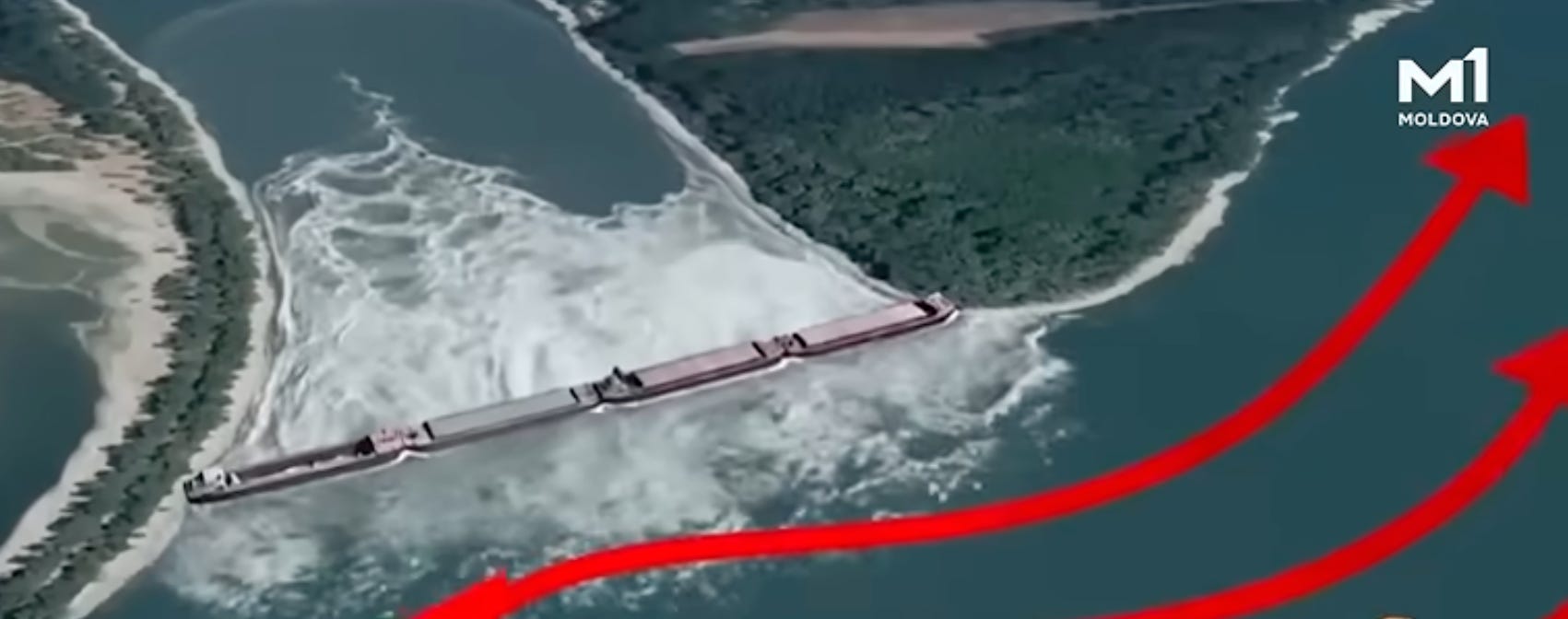
The goal is to offset the continued fall of the water level and keep reactor 2 running.
Moldovan Government Response
Moldova is facing a critical electrical shortage each evening from around 18:00 - 22:00 during peak hours - especially after the sun sets and solar production goes offline. Romania has no electricity to supply, so Energocom is scrambling to purchase power from emergency supply at exorbitant prices. The National Crisis Management Commission (CNMC), chaired by Prime Minister Tofan, met on August 3 and put in place emergency measures. They have limited power exports during peak hours and called on households and companies to conserve power. Government buildings are reducing all non-critical power consumption and turning off fountains and decorative lighting. Companies are requested to do the same. Individuals are urged to avoid elevators between 06:00 - 09:00 and 18:00 - 23:00 in order to conserve power and avoid the risk of becoming stuck in an outage.
Similarly, the government has called on people to conserve water and asked farmers to irrigate overnight and according to specialized schedules.
Speaking of the dual crises, President Sandu called on people to conserve power and water and stated that while the government was working on mitigating the crises, “there are no magic solutions.”
Tax Reform 2.0
On August 6, Prime Minister Tofan announced a second attempt at a major tax reform with a speech laying out principal elements of the reform as well as the government’s rationale for the changes being proposed. In that speech he started by completely rejecting the core philosophy of the previous tax reform laid out under his predecessor saying:
“I want to start with a simple idea: the way a country organizes its taxes influences the way its economy works. If we want more people to work legally, we need to tax labor in a way that encourages legal work. If we want companies to invest more, we need to leave them more capital for investment. If we want to discourage vices — tobacco, vaping, especially among young people, excessive alcohol consumption, gambling, if we want the environment not to be polluted by fireworks — this must also be reflected in tax policy.”
He went on to outline a set of measures that he claims will produce a tax code that is “simpler, fairer and more difficult to circumvent.” The core approach is to reduce taxes on labor and investments, raise taxes on vices and reduce exceptions. Summing it up, he stated that “our approach is not ‘raise taxes.’ Our approach is: put the accents right.”
A deep dive into the proposals will have to wait for a future article, but here are a few of the more important announcements:
Payroll taxes: a 35% increase in the personal exemption. Increased from 29,700 lei annually to 40,000 (the previous reform proposal removed it entirely).
0% taxes on reinvested profits for companies up to 200 million lei revenue (current ceiling was 100 million).
Raised tax on dividends from 6% to 8%
VAT Changes: “Basic” food items5 and medicines remain at 8%, other foods, HoReCa and tourism up to 12%, electricity and gas to go up to 20% in April 2027 for energy consumed above a tax-free / low tax allotment per household.
Sin Taxes: New 6% excise tax on gambling, 50% increase in excise taxes on vaping, new excise taxes on sugary drinks and energy drinks (rates not announced), new 25% excise tax on fireworks, progressively increasing excise taxes on alcohol and tobacco.
Temu / Parcels from outside Moldova: 20% VAT and 12 lei fix tax per package
50% increased taxes on bank profits: one year only for 2027
We will come back to this topic in much more detail later. But for now, there are a few important things to note. Firstly, this reform is slower, and the Prime Minister emphasized predictability as a key goal. Secondly, it is less rushed - there are 2 weeks for public consultations (rather than 5 days) for a reform that is less sweeping. Thirdly, Prime Minister Tofan has thrown his political weight behind it, and, through this speech and subsequent interviews is actively making the case for the reform.
It is explained as setting a direction and tone, with officials indicating a larger reform to the tax code is coming, presumably next year
LPA Reform Updates
Under the proposed Local Public Administration (LPA) Reform, towns and villages had until July 31 to commit to voluntary amalgamation. By that date, 761 of 890 mayoralties had begun the process, with around 430 finalizing plans and many others stuck or delayed in the process. Given this, the State Chancellery announced an extension of the deadline to August 31.
Recall, the goal of LPA reform is to incentivize small villages to voluntarily combine into larger entities. In exchange for this decision, the government is offering substantial infrastructure funding for towns that choose to combine voluntarily.
Frank Bracco, recently Country Director for the Tony Blair Institute in Moldova, published an interactive map showing the progress of this reform. I highly recommend it for anyone trying to get into the weeds on this process.
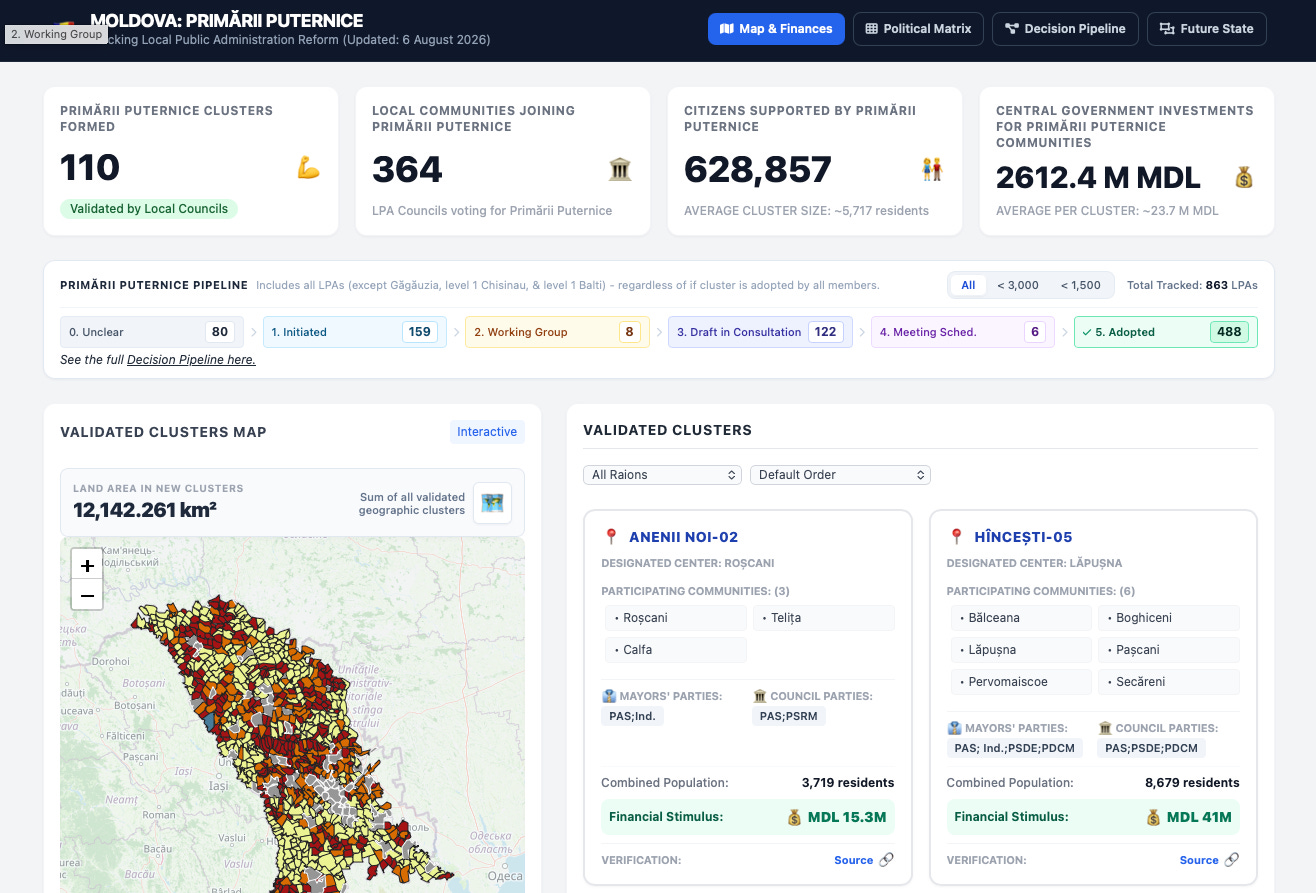
At least 60 mayoralties have refused any participation in the process. Under the rules of the process, they risk “normative amalgamation,” aka being merged with their neighbors with neither a say in the process nor financial incentives.
President Sandu recently warned of this saying:
“I regret that several dozen city halls refused to participate in voluntary consolidation; residents of these communities will not be able to benefit from the financial resources provided by the government. The state will not leave anyone behind; all citizens deserve a decent standard of living. However, citizens should know that city halls that did not voluntarily decide to merge their administrations will be consolidated without financial incentives or the opportunity to choose which city halls to merge with,”
International Affairs
On July 30, Prime Minister Tofan made his first international trip, traveling to Bucharest and meeting with Acting Romanian Prime Minister Ilie Bolojan and President Nicușor Dan. He spoke about Moldova’s important relationship with Romania both for EU integration and for growing the economy, making the pitch for Romanian companies to consider investing in Moldova.
While the government might have hoped this would be the international affairs story of the week… it really wasn’t. Instead, on August 3, the number one story in Moldova was about a delegation from the Taliban government of Afghanistan, which landed at the Chisinau airport on a mission to talk about agricultural cooperation.
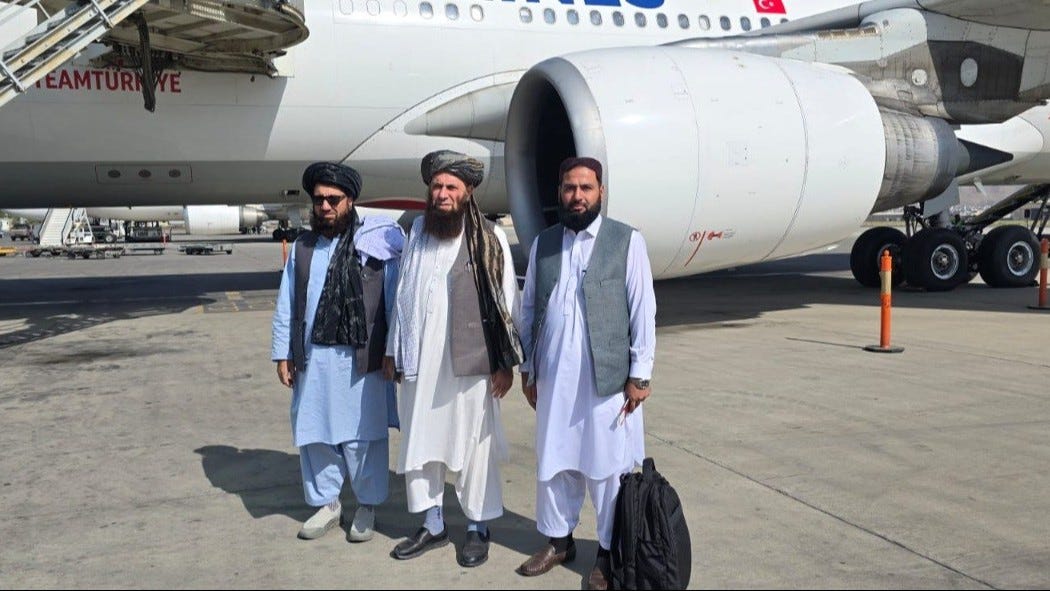
According to the Kabul Tribune, this is a senior delegation from the Taliban’s Ministry of Agriculture, Irrigation and Livestock, led by Deputy Minister Sadr Azam Osmani, which “traveled to Moldova at the official invitation of the Moldovan government to discuss expanding practical and technical cooperation between the two countries.”
This led to an explosion of criticism of the government and a race to figure out what was going on. It turns out that while they did not come at the “official invitation” of Moldova’s government (which does not recognize the Taliban), they did get officially invited via a process that has been reported to be both haphazard and embarrassing.
The process started when a Moldovan agricultural producer who currently exports to Uzbekistan began investigating expansion into the Afghan market. Under their rules, the Taliban require an official visit/inspection when starting up a new trade relationship. The businessman approached the Ministry of Agriculture where State Secretary Vasile Șarban decided to help, later explaining that “I believe it is right for the Moldovan authorities to take care of Moldovan economic agents.” He then sent an official request to the Ministry of Foriegn Affairs to facilitate this access and issue visas, which they did.
Apparently, at no point was the “Taliban Delegation” topic thought important enough to bring to the attention of either Minister. Also, because none of the men is individually under sanctions, neither Ministry was required to notify the Security and Intelligence Service (SIS).
Prime Minister Tofan called the situation “embarrassing and unacceptable” and explained that while all procedures were followed normally and according to the law, “An obviously sensitive case was treated as a routine administrative file. The result was a wrong decision.” He called on all officials to be more responsible, saying “We do not manage papers, we manage a country and we must be more careful when making decisions.”
The “delegation” stayed through their planned trip on August 7, presumably meeting with the businessman but without any official meetings or recognition from the Moldovan government.
Security & Transnistria
Here’s a roundup of the top security stories of the week:
South Ossetian “representative” Vitalii Iankovski was photographed in Tiraspol. The “diplomatic representative” from a non-state to a non-state was previously barred from entering Moldova and declared undesirable for 5 years. Zona de Securitate reported that he attended events there and was conspicuously photographed on July 29. Moldovan officials have stated that they do not know how Iankovski managed to enter Transnistria. Vitalii Iankovski has both Russian and Ukrainian citizenship.
Fragments of a Geran-2 drone were found in the village of Văleni. The crash of another Russian drone in a rural part of the Cahul district triggered the normal round of diplomatic protests.
Other Politics & News
Here’s a roundup of the other top stories of the week:
The National Bank of Moldova (NBM) raised the base rate half a point to 7.5%. They cited the upward trajectory of inflation “caused by factors associated with consumer demand against the background of persistent supply shocks.” NBM estimated the annual inflation rate to have hit 6.51% in June, just above the targeted 5±1.5%. They now estimate that inflation will continue to rise through the end of 2026 and not return to the target range until Q3 2027.
Parliament has approved a new draft electoral code in the first reading. The code would eliminate single member constituency elections in Gagauzia and return the region to a proportional representation system. The coming elections, scheduled for November 15, would still be on the old system with the new one coming into place at the next local elections in the autonomous region. Additionally, new processes are put in place to regulate and coordinate postal voting in elections.
Ana Revenco resigned as director of the Center for Strategic Communication and Countering Disinformation (STRATCOM). She had run the center since she was appointed to start it in October 2023 and did not announce a reason for her departure. In a statement, Revenco stressed the distance they had come from a startup in the midst of crisis to what is now a “functional institution with a professional team and clear operating mechanisms." President Sandu accepted Revenco’s resignation and appointed Liliana Vițu as the new STRATCOM director. Vițu had just announced her resignation as the Director of the Audiovisual Council, which replaced her with her Vice Director Aneta Gonța.
I’ve traditionally used the Romanian Nistru out of habit and will likely continue to do so. But I realized that I should be a bit more clear about what I’m doing so now you know.
A rejection of reality that conveniently puts the blame both on PAS and Ukraine.
Most probably farming trailers that get pulled behind tractors
The Chisinau mine is a flooded limestone mine underneath the Riscani district. Water is constantly pumped out of the mine to prevent its full flooding and a dangerous collapse. This has long been considered a potential source of water - even drinking water - for the city. You can learn more in this video from last year including some shots of the mine.
He did not define this in his speech, but subsequently has implied that locally made non-luxury products would stay at 8% while fancier foods would be at 12%. He compared locally made brinza to imported mozzarella cheese.
Exceptional edition, thanks.
One international thing I noticed on the Moldpress site that REALLY surprised me was this article:
https://www.moldpres.md/eng/society/moldpres-report-green-china-of-tibetan-plateau-aba-region-as-a-modern-model-of-coexistence-between-people-tradition-and-nature
Where they the Chinese approach to Tibet "as modern model of coexistence between people, tradition, nature"
Something I suspect few Tibetans would support. And the idea of Moldova being treated the same way is hardly positive.