

On October 8 and 9 Moldova hosted the 3rd annual Moldova Security Forum (MSF) in Chisinau. The forum focused on the topic of “Strengthening Democratic Resilience in Europe and the Black Sea Region,” and was organized by the Institute for Policies and Reforms (IPRE), the Konrad Adenauer Foundation and the NATO Liaison Office, in partnership with the Ministry of Foreign Affairs and Ministry of Defense.
This article is not a report on the event, it’s an op-ed serving as a reflection on my thoughts after 2 days attending the sessions and talking with participants over coffee. My impressions from the event pull in multiple directions. On one hand, it was clear that MSF is a maturing institution that is representative of Moldova’s efforts to adapt to its complicated security role. On the other hand, it was abundantly clear that people are less and less sure where the United States stands in the global security order.
MSF Comes into Its Own
This 3rd edition of the Moldova Security Forum showed an event that felt mature and institutional. I did not attend the first edition, but I did attend last year. That event was very well organized and featured some substantive conversations which helped shape my thinking of the security environment at the time. This year MSF built on that foundation but felt noticeably more institutional, with a feel of it becoming a part of Moldova’s calendar of events.
That itself is really interesting and highlights how much questions of security have come to dominate the country’s politics and international affairs. At some level that has been true since February 2022, but events like this show an institutionalization of the approach to topics like Black Sea Security and Moldova’s security relationship in the region.
Moldova as a Security Provider
President Maia Sandu gave the opening speech for the forum where she argued that Moldova is no longer simply a security consumer, but a critical security provider for the region. You can watch the whole speech (in English) online here.
In her speech she argued that Moldova has become a critical part of the regional security architecture. She highlighted that Moldova’s 1,200 km border with Ukraine is the longest friendly border that Ukraine has, and she explained the stakes of Moldova’s recent elections saying:
“A Moldova in Moscow’s hands would turn more than half of Ukraine’s borders hostile. It would leave Ukraine exposed from the southwest, pull its troops away from the front, and bring Russian pressure to the Prut River, which is the border of the European Union and NATO. This was Russia’s plan.”
The President also spoke of Moldova’s support for Ukrainian refugees, and stated: “If this winter in Ukraine proves as hard as everyone expects, we’re ready to welcome as many as need to be in safety.”
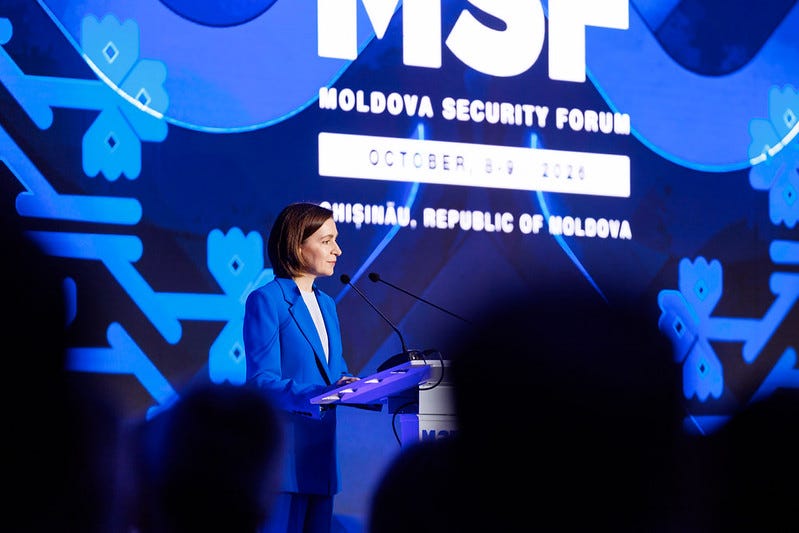
In her speech she stated that Russia spent “close to 2% of our [Moldova’s] GDP” to influence Moldova’s elections in 2025,1 and explained that as the Kremlin tests these tactics here, Moldova can share experiences with partners. She cautioned that while the application of these tactics was “brutal” in Moldova, other countries should expect them to be more subtle.
In conclusion, President Sandu argued that Moldova will be an asset in the European family saying:
“A Moldova left in a gray zone gives Russia a permanent lever against us. Russia has tested our resilience in elections. It keeps testing us with drones, missiles, and lies. Each time, Moldova has held. And many of you in this room helped us.
But a small country on the edge of Europe can only hold the line for so long without the protection of a larger family. Moldova is a security provider today. Inside the European family, we will be a stronger one. Thank you for your interest and for your support.”
Naming the Adversary vs Muted Language
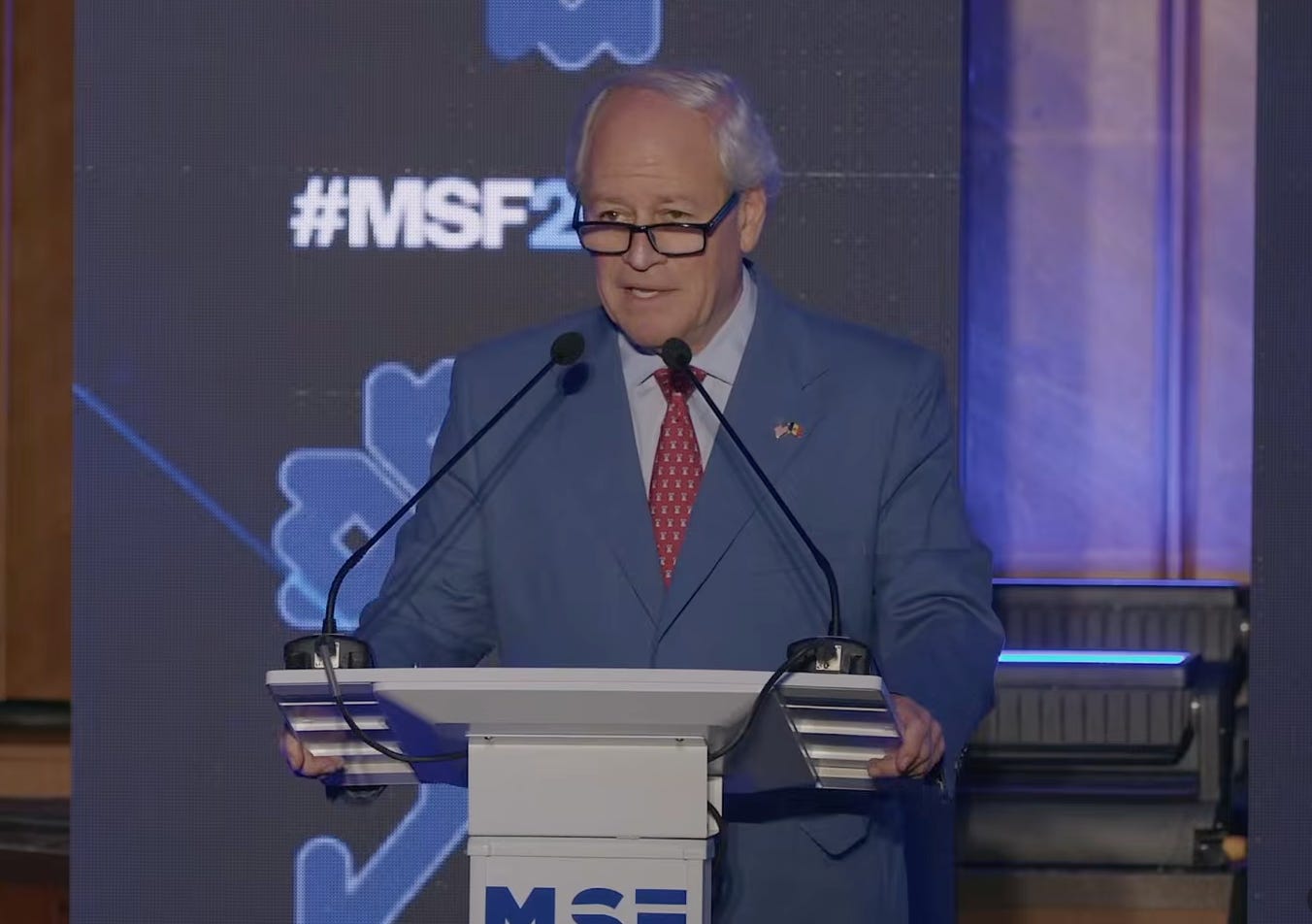
Between sessions, participants sipped coffee, traded business cards and discussed points and ideas that had been presented on the panels and in the keynotes. While there were a number of topics that seemed to grab the crowd’s attention (Transnistria, drones, etc), it was US Ambassador Joseph Mark Burkhalter’s speech that seemed to draw the most controversy. You can watch it online in its entirety here.
Ambassador Burkhalter began by highlighting the challenges Moldova faced, from drones to election interference to cyberattacks, and called them “unacceptable to any nation and unacceptable to the United States.” He spoke of America’s support for Moldova’s democracy, independence and territorial sovereignty - including in the country’s airspace.
Following nearly 2 years without an American ambassador, and with almost zero American presence at last year’s MSF, these statements recentered America’s long standing support for Moldova. They were taken by many as a strong signal of support and that’s largely how they were reported in the local press.
At the same time, Ambassador Burkhalter, when speaking of adversaries, stated:
“and we know who our adversaries are by the way” (...)
“on the note of the adversaries, we know who they are, they know who they are, but even better, they know that we know who they are”
It was lost on no one that I spoke to that these adversaries were never named. Later, in the panel that followed, journalist Teri Schultz posed a question to former Prime Minister Dorin Recean asking about information attacks carried out by “adversaries” to plant false narratives. Mr. Recean replied directly stating:
“Look, we have to name that adversary, and it is Russia.”
Schultz, somewhat offended, responded that she was only non-specific because she wanted to group in Iran and China as well - presumably referring to the larger disinformation environment and not Moldova specifically. There is no indication that Mr. Recean was responding to Ambassador Burkhalter, but it showed a real split on the stage with some participants willing to be specific, and some guarding their words.
This was only one example of Ambassador Burkhalter’s speech using notably muted language about Russia. After praising the work of America’s “special envoys” and explaining that President Trump truly wants to see the war end, he also stated the following about first lady Melania Trump’s efforts:
“and the first lady, Melania Trump, whose efforts recently have ramped up, if you noticed, to work seriously on the project of hers, that is dear to her heart, that deals with the children of the war, and many of the lost children of the war.”
This drew intense anger from Ukrainians I spoke to. They noted that Ukrainian children are not “lost” in a forest somewhere waiting to be found - they were stolen by Russia in a state sponsored campaign. The International Criminal Court has issued arrest warrants for Vladimir Putin and Maria Lvova-Belova for this war crime.
The next day, Friday, October 9, the United States sanctioned the ICC, hours after a former ICC judge won the Nobel Peace Prize for her work promoting human rights.
Dislocation and Our Unrecognizable World
My biggest takeaway from the 3rd edition of the Moldova Security Forum was to reflect on how it highlighted just how unrecognizable our world would look to younger versions of ourselves.
On one hand, diplomats and policy professionals from all over Europe came to Chisinau to discuss regional security in the context of Russia’s war and increasing hybrid aggression across Europe. For Moldova, membership in the European Union is the focus of the nation’s security policy. This was also the key organizing principle of many of the panels and discussions at MSF as participants heard about the country’s plan for reintegration with Transnistria and discussed Russia’s enormous efforts and expenditure to try and keep Moldova away from Europe.
In parallel, US Secretary of State Marco Rubio was giving a speech in Athens laying out a new vision for Europe. In it, he discusses how “we find ourselves at a crossroads. Because the next decade and the decisions we make will write the story of the next century.” Ambassador Burkhalter quoted that line in his speech, noting how important it is to make those decisions. But what are those decisions? Rubio explained:
“Under President Trump, the United States has made its choice. We choose the unapologetic pursuit of national power”
He went on to outline a vision of Europe that involved much stronger nations that are free of “global bureaucracies.” It is no coincidence that this is the only way he referred to the European Union, and that Ambassador Burkhalter made no mention of support for Moldova’s European aspirations.
Further north, on October 7-8 in Vilnius Lithuania, the #Disinfo2026 conference was being held. This annual meetup of people working to combat disinformation found itself in the crosshairs of the Trump Administration. The conference planned a panel titled “USA as a FIMI threat: adapt, acknowledge, push back.” This panel was to feature 3 speakers - all American citizens, including a former CIA officer. The US State Department leaned on the countries supporting the conference to withdraw - resulting in the EU, Lithuania and Canada dropping their sponsorship of the event. France refused to withdraw its support.
Speaking to the Guardian, Nina Jankowicz, former US official and former Executive Director of the Biden Administration’s Disinformation Governance Board, commented saying:
“What this amounts to is a purported defender of free speech at the state department using the enormous power of the US government to try to pressure Americans from criticizing their government,”
The panel in question was focused on how Europe could counter disinformation threats without the United States, and on the possibility that the United States could itself be a disinformation threat to Europe.
Would the United States interfere in European countries’ internal affairs? More and more reporting says yes. Very recently, US Ambassador to Greece Kimberly Guilfoyle was reported to have bragged about being behind the collapse of the Romanian government2. Her lawyer has disputed this account.
Also in the last few weeks there have been reports from Polish media, citing unnamed sources, that President Trump had privately spoken with a senior member of the governing coalition in an attempt to reconfigure Poland’s government to align with his own far-right political preferences.
None of this is truly new, and follows from stated aims of “The Need for Civilizational Allies in Europe” and announced plans for the US State Department to finance politically aligned groups in Europe.
The story isn’t new, but holding a conference panel to discuss it is apparently a bridge too far.
Back in Moldova, Ambassador Burkhalter noted in his speech areas of clear cooperation like the construction of the “Trump Liberty Line.” This is the new name for the $130 million high voltage line that the United States is funding to connect Moldova with Romania. Undoubtedly, the United States remains a key partner for Moldova, Ukraine and the whole region. But sitting at MSF you could feel that people did not really know how to understand that partnership anymore.
Speaking to Moldovan friends, levels of disillusionment with the United States vary from concern to deep betrayal. In his speech, the Ambassador stated:
“some in this world run from their friends when they have challenges or have needs, but I’ll tell you that the United States runs towards our friends.”
I saw people shaking their heads at this statement. Then, on Friday, Donald Trump announced that the United States was suspending sanctions and may be about to start buying diesel fuel from Russia.
These actions will do almost nothing to impact the American economy or the price of diesel3. The amounts cited for immediate release by Russia cover less than half a day’s consumption in the US. The money however is very real for Russia. Experts cited by the New York Times estimate that, under this deal, the United States would inject $4 billion into the Russian economy. Even greater gains would follow if the Trump administration successfully pressures Ukraine into stopping their attacks on Russian refineries.
Ukraine and Russia are in an economic war of attrition and the United States just changed sides.
Why?
To which friends are we running?
Who again are our adversaries?
How might “they know that we know who they are?”
Some Final Thoughts
My experience of the Moldova Security Forum this year was generally very positive. Some sessions were more enlightening than others and moderators didn’t always manage to wrangle guests who chose to ignore the questions and pull out a written speech from their pockets. But, while there is always room to improve, it is clear to me that MSF is becoming an institution through which Moldova will engage with its role in an ever more complex regional security situation.
At the same time, I could not help but feel that the discussions I had and listened to were describing a rapidly deteriorating world.
During the forum, a Moldovan friend, Vlad Șuleanschi messaged me a link to Secretary of “War” Pete Hegseth explaining that the United States is about to revive public executions. On December 3 the US military plans to execute Nidal Hasan, who murdered 13 people at Fort Hood in 2009, by firing squad. According to the Pentagon it will be live-streamed. Vlad was horrified.
Over the weekend, the defense attaché at US Embassy Chisinau, Marcel Bolboaca-Negru, published a personal essay on this platform stating that he supports the execution of Nidal Hasan and does not oppose making it public. He goes on to caution that public executions should not become spectacles. I struggle to think of one that wasn’t a spectacle by design.
In his essay he shares memories of the public execution of Nicolae and Elena Ceaușescu and argues that we should spend less time thinking about the humanity of the condemned and more time considering their victims.
If you had told me 5 years ago that an American diplomat would invoke a 1989 revolutionary tribunal to support a public execution in the United States, I would not have believed you.
In a different conversation, Vlad recently described to me his utter disillusionment with the United States of 2026. At the same time, he spoke about how important American values and moral leadership had been to him when he was younger. He had admired this country that helped support fledgling democracies like Moldova and stood up for human rights around the world.
Now he asked me, was it a lie all along?
At approximately $20 billion in GDP in 2025, that comes to $400 million.
Worth noting that she remains in post after this reporting and multiple serious allegations of corruption.
As with all things Trump the numbers are vague. He stated that Russia would provide 300k tons immediately which is around half a day’s supply for the US. Then in November there would be 500k tons and then 3 million more “within a short period.”
I would assume that Russia’s sudden ability to export so much diesel would be contingent on Ukraine no longer attacking their refineries. So it is possible that Trump is envisioning that he forces that outcome in parallel. Once again, unclear.