

Russian Strikes Cause Oil Spill in the Nistru
March 7th strikes on the Dniester Hydroelectric Station in Ukraine have resulted in an environmental crisis in Moldova. The strikes began the process of a spillage of technical oil into the Nistru river which has since flowed downstream and threatened the water supplies for much of Moldova’s Northeast.
By March 11th the city of Balti was forced to cut off drinking water as oil reached the pumping station and water tests showed high levels of contamination. By March 13th Moldovan, Ukrainian and Romanian teams were working to contain the oil using oil containment booms and other containment technologies. Minister of Environment, Gheorghe Hajder traveled to Soroca to monitor the situation and Prime Minister Munteanu dispatched the army to assist with cleanup and containment. He also requested the activation of the European Union Civil Protection Mechanism “for the rapid mobilization of teams of specialists and the equipment necessary to manage the situation on the ground.” The Prime Minister later traveled to Soroca himself to monitor the situation.
There he stated:
“Together with the Minister of the Environment, Gheorghe Hajder, we are in Soroca to monitor the situation on the ground. (…) Additional filters are being installed, and straw bales are being used in the water – an effective method for retaining petroleum substances. In parallel, the mobile laboratory is taking samples from the field every six hours to constantly monitor the water quality.”
Following this visit the government approved a 15 day “State of Alert” regarding the oil spill. This frees up some resources to prevent the situation from escalating, while falling short of being a full State of Emergency declaration.


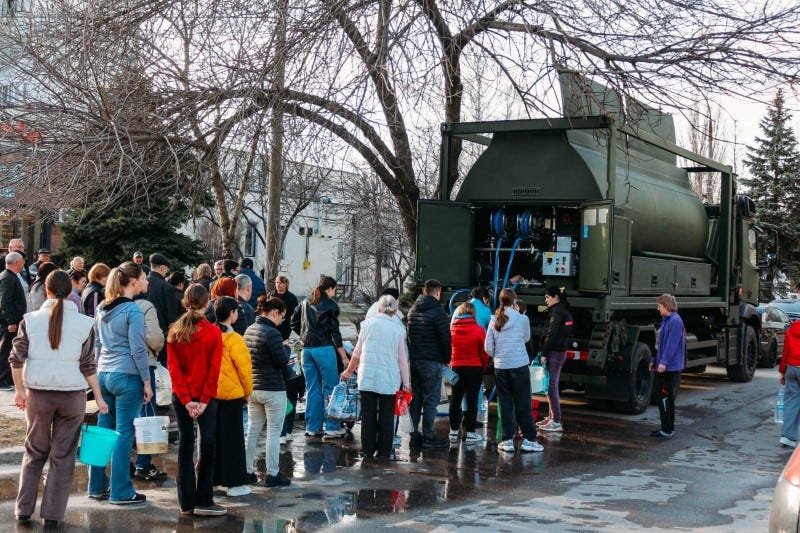
Over the last few days large parts of the North of Moldova have been cut off from their water supplies. Supplies were suspended in Naslavcea, in the districts of Soroca, Florești, Sîngerei and in the Balti municipality. Chisinau’s water authorities have been installing protective dams around the Vadul lui Vodă pumping station.
Villages and towns are relying on their wells and in many cases are rushing to clean older wells and put them back into use. The most acute problems are in the city of Balti which has moved to remote schooling and called for help supplying emergency water. Balti Mayor Alexandru Petkov announced that the city of Iași in Romania was sending a humanitarian convoy of water trucks. Additionally the Moldovan Army has sent trucks and is distributing water to people in affected areas. As of March 17th more than 95 tons of drinking and technical water had been transported to Balti for distribution.
Minister Hajder has stated that the Ukrainian authorities have not explained what caused the oil leak. He stated:
“As soon as we learned of Russia’s attack on Ukraine’s energy infrastructure, we requested official information; we even had a telephone conversation. I was told that several engines were damaged. We don’t know exactly what happened because these hydroelectric power plants are under the jurisdiction of the Ministry of Energy and are protected by martial law,”
He said that they promised more information soon. It remains unclear how long the cleanup will last or whether it will force water disruptions in Chisinau, which relies on the Nistru river for 98% of its water supply.
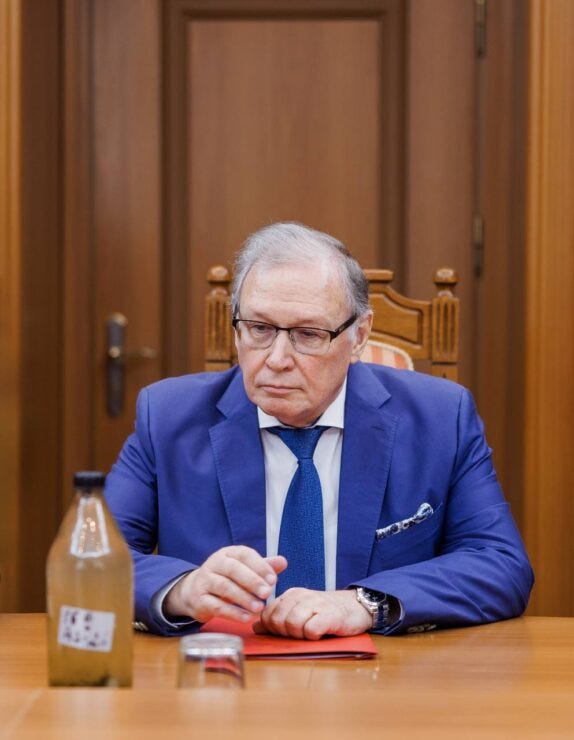
Moldova’s Ministry of Foriegn Affairs summoned Russia’s Ambassador-Designate1 Oleg Ozerov to issue a formal condemnation of the attack against the hydroelectric plant. At the meeting, the Ambassador-Designate was “gifted” with a bottle of oily water from the Nistru.
As of March 17th Chisinau Mayor Ion Ceban has stated that no water outages are expected in Chisinau at this time. He claimed that his team is testing the water hourly and leveled criticism at the government for mishandling the situation in Balti. He demanded transparent testing results and suggested that technical water should continue to be supplied to the city.
Minister of the Environment, Gheorghe Hajder responded with a video where he called the mayor’s statements “extremely irresponsible.” He noted that city hall is able to test the water for pH, not for oil - and therefore the tests Ceban is touting are useless. He also noted that the supply of technical water is a bad idea saying:
“The mayor orders us to provide technical water to Bălți. A dangerous and, again, irresponsible request. How does the mayor guarantee that no child or elderly person or any resident will accidentally drink the water that the mayor proposes to turn on in the taps. Moreover, if we now provide water to the supply network, knowing that it has petroleum substances in it, we will poison the network.”
The Minister went on to note that oily water pumped into the system could take months to clean out.
Iran War Crisis
Moldova continues to feel the aftershocks of the ongoing war in the Persian Gulf as fuel prices continue to rise. Compared to prices before the American-Israeli attack on Iran, prices for gasoline have increased 16.4% at the pump and for diesel 36.1%. The National Energy Regulatory Agency (ANRE) sets maximum prices daily based on a formula that tracks the Platts average (S&P Global) and then factors in merchant margins and taxes. These rates are climbing at an accelerating rate as market uncertainty grows.
Minister of Energy Dorin Junghietu has sought to calm consumers, explaining that imports of fuel are continuing as normal and that the country maintains stocks of 22 days of LPG, 12 days of gasoline and 11 of diesel2. The Minister has called on people to purchase only what they need and avoid hoarding fuel. He noted that while the legislation in force does not permit rationing, he is calling on people to be responsible and noting that gas stations filling illegal containers will be fined.
This Ministry has also been promoting their e-Carburanti (e-Fuels) website which shows the prices of fuel and availability at all gas stations in Moldova in real time. They are promoting the site in an attempt to prevent additional runs on gas stations.


The rising fuel costs are already forcing the government to make difficult decisions. Prime Minister Munteanu has called on all departments in the government to economize. He stated:
“In a tense international economic context and with increasing pressures on energy and fuel prices, the state must set the first example of financial discipline and responsibility towards public money.
Non-critical purchases will be reduced by at least 10%, and expenses for official transportation and the number of transport units will be reduced by at least 20%.
Public resources must be concentrated where they are truly needed: in infrastructure, in the functioning of essential state services and in maintaining economic stability,”
The Ministry of Agriculture has announced tax support policies for farmers seeking to buy diesel ahead of the planting season, and Chisinau Mayor Ceban announced that city hall lost millions of lei over the last 2 weeks due to rising prices.
Moldova Gets Nightly Drone Overflights
Since March 14th there have been numerous reports of Shahed or “Shahed like” drones crossing into Moldovan airspace. One crossed into Moldova on the night of the 14th and then subsequently left the airspace. Another on the 16-17th which crash landed in a field near Tudora and another on 17-18th which exited the airspace and was shot down over Ukraine.
Addressing the second drone, President Sandu stated:
“The Russian drone discovered today in the village of Tudora, Moldova, was assessed as carrying explosives. This is a gross violation of our airspace and a threat to our citizens. Russia systematically violates our sovereignty and puts the lives of our people at risk,”
This drone was a Shahed and was subsequently destroyed by Moldovan sappers in a controlled explosion.


Foriegn Affairs
Here’s a roundup of the top foreign affairs stories of the week:
President Sandu visited Vilnius Lithuania on the occasion of the 36th anniversary of the restoration of Lithuanian independence. On her trip she met with the country’s President Gitanas Nausėda as well as other senior leaders. They discussed Moldova’s EU aspirations, common security threats and bilateral relations. Speaking of Lithuania’s support for Moldova President Sandu stated that "In Brussels, within the European Council and in every room where our accession is discussed, Lithuania is a reliable friend.” President Sandu also addressed the Lithuanian Parliament where she noted that the 1939 Molotov–Ribbentrop Pact sealed the fates of both countries saying "We simply found ourselves in an empire that we had never chosen." She spoke of Lithuania’s leadership as the first country to declare independence from Soviet Occupation and how Moldova was the first country to recognize that - even as Moldova remained officially part of the Soviet Union itself.
The Bucharest Court of Appeal rejected Ion Ceban’s appeal against his ban on entering Romanian (and thereby the Schengen area). Mayor Ceban promised to appeal further in the courts. Vasile Tarlev and Natalia Morari have also appealed their bans and the cases are in the lower courts.
The European Commission dispersed €189 million euros under the Reform and Growth Facility for Moldova. The decision recognizes Moldova’s implementation of 24 reform milestones and according to the Commission “This highlights the significant progress the country has made in advancing on its path to EU accession.” According to Prime Minister Munteanu:
“The money will be directed towards important projects for citizens: in the energy sector, to advance the construction of the regional hospital in Balti, to expand access to drinking water in several localities, to develop childcare services and support for young people entering the labor market. Moldova invests in people, and these projects will bring better conditions throughout the country,”
Politics - June 21st Elections in Gagauzia(?)
The People’s Assembly of Gagauzia held 2 extraordinary meetings on March 17th in order to deal with the region’s political crisis. Recall, the mandates of the representatives to the assembly expired last year and elections were scheduled for March 22nd. This has not happened because of a dispute between Comrat and Chisinau over the name of the autonomous region’s electoral body. Gagauzia calls it the Central Electoral Commission (CEC) while Chisinau says that constitutionally there is only one Central Electoral Commission (CEC) and that therefore the Gagauz body is the Central Electoral Council (CEC). Due to the expired mandates of the people’s assembly, and a recent law prohibiting legislation during the lame duck, they are unable to change the name (even if they were willing).
On March 17th the People’s Assembly tried to solve the impasse when they passed a resolution appointing 9 members titled “On Approving the Composition of the CEC.” They finally passed this resolution, and set the election date for June 21st, after many arguments - including a debate around whether this date was too close to the June 22nd anniversary of Nazi Germany’s invasion of the Soviet Union.
The clever “everyone can see the acronym that they want” fudge may not be enough. Last week the Ministry of Justice appealed to the Constitutional Court (CC) asking for a review of the constitutionality of the region running its own elections at all. Therefore the first extraordinary meeting ended and everyone moved across the street to a larger venue for a second meeting. This one included guests like Igor Dodon and Irina Vlah and lots of discussion about how bad Chisinau is and some debate about whether they should even be negotiating with parliament at all. In the end, this meeting voted on a resolution calling on the Ministry of Justice with withdraw their appeal to the CC, and a second resolution appealing to Putin and Erdogan for mediation.
It remains completely unclear when the Gagauz elections will actually take place.
Crime & Corruption
Here’s a roundup of the top justice sector stories of the week:
Dmitri Vartic is officially a suspect in his wife, Liudmila Vartic’s suicide. This was confirmed by Minister of Internal Affairs Daniella Misail-Nichitin. The authorities have questioned more than 30 people as they investigate the very public allegations of abuse, but no more details have been released. Dmitri Vartic has rejected accusations of abuse and has begun making police complaints against people he claims are defaming him.
Anti Corruption Prosecutors have accused former Moldovan Ambassador to Sweden, Norway, Finland and Iceland (one post), Liliana Guțan, of embezzlement. They accuse her of falsifying accounting records and using public money for personal expenses to the tune of 275,927 lei. Guțan denies the accusation and claims that they are a political conspiracy to remove her from her post (she was removed in April 2025).
Updates on alleged serial killer Stepan Găină. After a psychological evaluation the court found Găină to be sane and fit to stand trial. The investigation is ongoing but police report that they have finished the DNA examination of human remains. Publicly, the authorities have suggested that there are up to 6 victims killed by Găină and fed to his pigs.
Recall, President Sandu has chosen not to appoint him and accept his ambassadorial credentials - leaving him as a sort of unofficial ambassador.
These latest numbers were from March 13th