

“Aba – a lesson for the whole world”
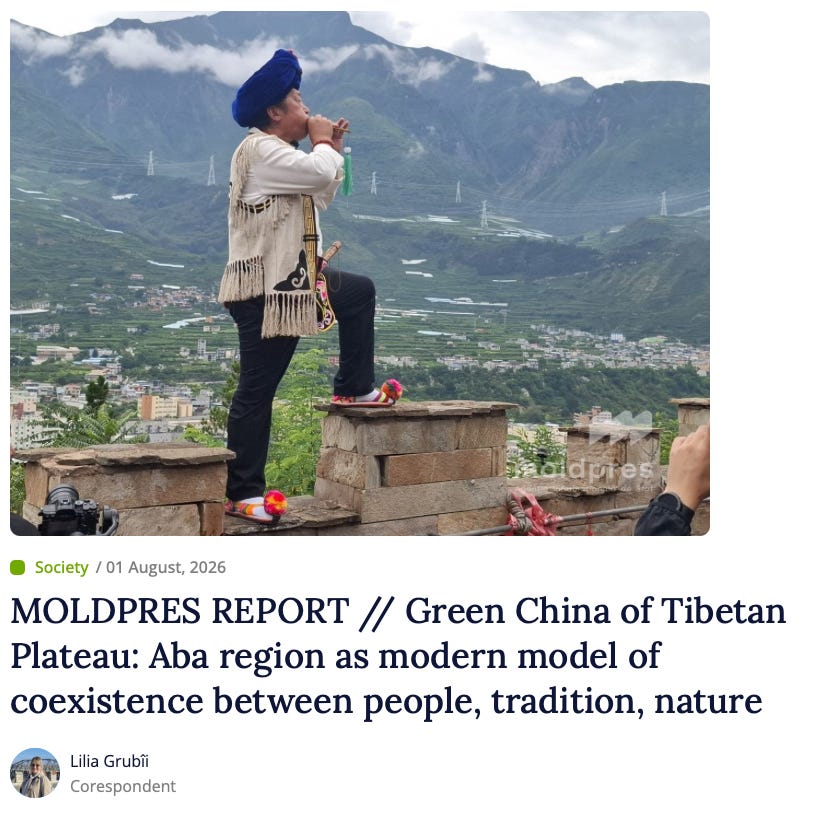
That line opened the final paragraph of an article titled “Green China of Tibetan Plateau: Aba region as modern model of coexistence between people, tradition, nature” that was published on August 1 as a special report on Moldpres.
The article is written by Moldpres journalist Lilia Grubîi about her recent trip to “Aba,” the Mandarin name for the Tibetan region of Ngawa1, presenting how China’s development of the region is an example for the world.
The article is one of 10 in a series published by Moldpres since late May. Each is described as a MOLDPRES REPORT and none discloses who funded or organized the trip. In answer to questions from Moldova Matters, Moldpres stated that Lilia Grubîi’s travel, lodging and other costs for this trip were paid by the Chinese Public Diplomacy Association, an organization closely linked to the Chinese Foreign Ministry. They also confirmed that Moldpres has no policy requiring editorial transparency about press junkets organized and financed by foreign governments.
We will look into Lilia Grubîi’s reporting on Tibet, how it contrasts with independent reporting on the region and what the implications of the Moldpres policy are below. But first…
What is Moldpres?
The State Information Agency “Moldpres” is a Public Institution under the control of Moldova’s State Chancellery. What that means in practice is a bit hard to describe, as it combines aspects of a newsroom, a wire service, and a state publisher. According to their website, their main activity is to “provide accurate, equidistant, transparent information and to ensure pluralism of opinion.”
The institution has 3 primary activity areas:
Wire Service - publishing updates and press releases from the government and state agencies. This is done in Romanian, Russian and English and their website claims that they work to ensure the “dissemination of information (news, interviews, reports, photo reports) from the first source to foreign press agencies.”
Publisher of the Official Gazette of the Republic of Moldova - this publication is the state’s official gazette where laws, presidential decrees, government decisions, major court rulings, etc. are published. Laws only take effect once they are published in the Official Gazette.
Newsroom - the institution has reporters and journalists who publish original stories, photos and interviews. These are not separated on the site but mixed into the wire service and general news feed.
Moldpres is therefore a somewhat ambiguous entity. Part state agency subject to political control, part mass media organization.
In parliament’s pending mass media reform Draft Law 123/2026, aimed at aligning with EU regulation, Moldpres is given a unique position. Article 5(2) of the bill states that:
(2) The State and the central and local public administration authorities may not have the quality of founder, owner or entity exercising control over a media service provider, with the exception of:
a) public providers of audiovisual media services regulated by the Code of Audiovisual Media Services no. 174/2018;
b) providers of media services intended for children and the promotion of national culture, founded by the Ministry of Culture;
c) the Public Institution State Information Agency “Moldpres” founded by the
State Chancellery.
The Public Broadcaster Teleradio-Moldova (TRM) referenced in Article 5(2)(a) is subject to substantial regulation in the Audiovisual Code that ensures editorial independence and transparent editorial standards. Moldpres, which is explicitly named in 5(2)(c), is not. Nowhere does Moldpres publicly disclose its editorial policies, its funding-transparency practices, or details about outside funding it receives.
When responding to questions, Moldpres representatives clearly struggled with the ambiguities of their organization. We’ll get to that below, but first let’s look at these articles and why they matter.
Tibet and “Ecological Civilization”
In her article, Lilia Grubîi presents a picture of the Ngawa (Aba) region of Tibet as an idyllic mix of traditional culture, modern development and ecological conservation. She writes:
“On this journey, the special MOLDPRES correspondent discovered that Aba is trying to find a delicate balance: economic development without destroying nature, tourism without degrading the landscape, modernization without losing traditions.”
The article describes large investments to restore wetlands, protect waterbirds, revive the local yak milk industry and encourage new tourism models - including collectivized community tourist companies.
At a high level, this is best understood as Communist Party of China (CCP) party messaging presented as travel journalism. The framing closely mirrors a key concept in “Xi Jinping Thought” called “Ecological Civilization.” As such, it is a key element of CCP ideology, formally taken up by the Party's Central Committee in 2018.
In response to questions from Moldova Matters, Moldpres stated that Lilia Grubîi’s reporting was part of a “professional internship program” and that:
“Participation in the internship did not involve editorial obligations. According to information provided by the journalist, no external entity requested the publication of any materials, and none intervened in their selection, drafting, or approval. The subjects published reflected the author’s own journalistic choices and covered fields such as technology, agriculture, ecology, and culture.”
This answer, as well as the content of the article itself, fails profoundly to grapple with exactly what is going on in Ngawa.
Ngawa (Aba) – a warning for the whole world
In her article, Lilia Grubîi praises the authorities promotion of tourism in the region, noting that:
“Tourism is allowed, but strictly controlled. Visitors travel along specially designed ecological routes, so that nature remains the priority.”
This is stunning in its failure to acknowledge that the “strict control” for which Ngawa is famous, is for the oppression of human rights. China has deployed one of the most extensive population monitoring systems in the world across Tibet, a system that Human Rights Watch has called “grid management.” This system breaks towns and villages in Tibet into segmented units which are monitored by party officials. Each individual living there is tracked - their opinions, communications and religious practices are all monitored. Checkpoints called “convenience police posts” involve regular mandatory phone searches for banned content.
Incredibly, Human Rights Watch has reported the wide scale DNA harvesting of residents against their will - including the mass collection from children while in kindergarten and villages where all boys over the age of 5 had their DNA forcibly collected.
Within Tibet, Ngawa is seen as a hotspot of resistance and an epicenter of oppression. Since 2009 more than 150 people have self-immolated in protest against Chinese imperial policies in Tibet. Of those, 40 have been in Ngawa.
According to a report by the Foreign Correspondents’ Club of China (FCCC), journalists face serious challenges trying to independently report on the Tibet Autonomous Region (TAR). The US Department of State cites this 2025 FCCC report in their own report on freedoms in TAR to Congress writing:
“Ninety-three percent of correspondents who attempted to travel to the TAR and other Tibetan areas of the PRC faced difficulty in reporting. While the government occasionally organizes press tours of the TAR, they do not provide opportunities to report independently.” …
“When U.S. journalists gained access to Tibetan areas, the Chinese government further suppressed their ability to report about Tibet by intimidating and preventing Chinese nationals from interacting with them. Group tours enabled the government to claim increased numbers and greater access to the region while maintaining strict control over the information conveyed.”
Emphasis mine.
So while the MoldPres correspondent may not have been under any official editorial obligations, the Chinese government assures that these trips are controlled in a way that shapes their outputs - especially for non-critical journalists.
As we can see in this story, they succeeded.
Is Moldpres Obliged to Report Funded Trips Transparently?
When I reached out to Moldpres to ask about this piece on Tibet, I wanted to understand a few things. Who paid for the trip? Did the sponsor exercise any editorial control? and Does Moldpres have a policy for disclosing sponsored reporting trips?
The initial response from the director of Moldpres highlighted the ambiguity of the organization itself. He stated that my questions, framed as a “request,” were sent to the relevant departments for review and that:
“We assure you that we will provide you with a response as soon as possible, in strict compliance with the deadlines and provisions of the legislation in force regarding access to information.”
This is a standard response from a state agency to a freedom of information request - but a very unusual response from a newsroom. The “legislation in force” typically allows for multiple weeks to meet information request deadlines. I pressed, noting that if Moldpres is unable to answer basic questions about its reporting and editorial policies I’ll simply note that in my piece. This caused a switch to “journalism mode” with Moldpres beginning to send answers.
On the 3 main questions:
Who paid for the trip?
Moldpres responded that “MOLDPRES journalist Lilia Grubîi participated, during the period May 11 – August 11, 2026, in an international professional internship program, with the agreement of the press agency’s administration” with the costs being covered by the “organizers from China.” After I pressed for a specific organization that paid, they responded that it was the Chinese Public Diplomacy Association (CPDA).
Officially, the CPDA is an NGO, but in reality it is a part of China’s public diplomacy apparatus with close ties to the Chinese Foreign Ministry.
Did the sponsor exercise any editorial control?
Moldpres stressed that “Participation in the program did not involve any editorial or contractual obligation to provide content” and that the “published subjects represented the author’s own decision and focused on technological, agricultural, ecological, and cultural themes.”
That answers a narrow, contractual question, but somewhat misses the bigger picture. Across numerous articles, it is very clear that all of the perspective and quotes are drawn from a carefully choreographed process. This is explained at times in quotes like this one:
“As part of a documentary program for the international press, the MOLDPRES special envoy visited several Chinese companies active in sectors considered essential for the green economy”
Each article reads as if a story was laid out clearly for the journalist to report on. No articles indicate independent followup or contradictory perspectives to those presented by the “organizers” who are never named. No example is more clear than the uncritical reporting on Tibet.
Does Moldpres have a policy for disclosing sponsored reporting trips?
Moldpres repeatedly described this program as a professional development internship - not a press junket or funded reporting trip. They wrote:
“MOLDPRES does not currently have a policy requiring journalists to specify, in each individual article, the funding of study visits or professional mobility programs.”
Noting that this policy applies equally to “programs are funded by American, European, Chinese, or other international partners.” Moldpres also stated that:
“As far as we know, no similar policies exist at other private media entities either.”
I reached out to Alina Radu, CEO of Ziarul de Gardă (ZdG) to ask about their policies in this area. She stated that in all cases ZdG discloses their sponsorship and that this applies equally to any paid travel. However, she stressed that the first question is always about whether to accept a paid trip in the first place. According to Radu, ZdG never accepts trips designed to promote someone - whether a company or a government program. She stressed that they apply journalistic ethics to these decisions and differentiate between informational trips to Brussels sponsored by the EU and trips to visit a factory sponsored by the company that owns it.
Putting aside whether or not this was an internship or a press junket, it is unambiguously true that all of the articles produced in this series are promotional in nature (see footnote for links to the articles2). They promote Chinese companies, Chinese policies and China itself.
So whether or not there was an obligation to report the trip’s sponsor as a matter of Moldpres policy or journalistic ethics, there was an editorial choice made here. This choice resulted in a series of stories that uncritically presented a curated view of various aspects of Chinese policy to readers. Most notably, an article that omits, and in that omission whitewashes, human rights abuses in Tibet.
Why does it Matter?
Ngawa’s story is not really about wetlands, yak milk or eco-tourism. It is about what happens when a system built for oppression is allowed to write its own account of itself - and what happens when that account is published, unlabeled, by a state news agency of an EU candidate country, without a single word of independent scrutiny.
Moldova’s pending media law will soon draw a sharper line around who can own a newsroom and who must disclose their funding. Moldpres, carved out of that law by name, will remain outside of the accountability mechanisms that apply even to state broadcasters. Until that changes, Aba’s “lesson for the whole world” will keep circulating in Moldova’s press exactly as Beijing packaged it - with Ngawa and the warning quietly left out.
Moldovans know well that questions of language and naming are never politically neutral. This article consistently choses Mandarin names for places referenced over their Tibetan equivalents.
All links are in English. These articles were also published in Romanian, most likely in Russian as well but the cross linking on Moldres is does not work so I didn’t confirm each one.
MOLDPRES REPORT // Solar energy, batteries and electric transport: green technologies developed in China that could be of interest to Moldova May 30
MOLDPRES REPORT // Technology that can change energy of future: how China tries to revolutionize solar market, what opportunities arise for Moldova June 7
MOLDPRES REPORT // Smart technology for old apartment blocks: Chinese solutions that might fix parking, waste problems in Moldova’s cities June 8
MOLDPRES REPORT // From farm to table: How Moldova can modernize agricultural sector inspired by Chinese giant Famsun’s technologies June 13
MOLDPRES REPORT // Chinese smart home model might become source inspiration for Moldova July 18
Good read. Thank you. Did you ask Moldpres who else was on the "international media group" that visited China?
Great post, very insightful.
What’s the justification for why MoldPress are exempt from the proposed new law?
Also, out of curiosity - to what extent / how has this been covered by other local outlets like ZdG? (“this” being MoldPress’ actions / policies rather than Tibet generally)