

On March 23rd Ukrainian President Volodymyr Zelenskyy warned his country in an address of the potential of a massive Russian attack that evening. He said:
“Please pay special attention to air raid signals today. There are intelligence reports that Russian forces may be preparing a massive attack. Appropriate instructions for our air defense forces have already been issued. Please take care of yourselves and Ukraine ,”
There was a massive attack with Russian drones overnight as well as a major daytime attack on March 24th. In total Russia launched more than 1000 drones against Ukraine including Shaheds and Gerbers1. Ukrainian air defense shot down 541 drones but 15 got through and scored hits.
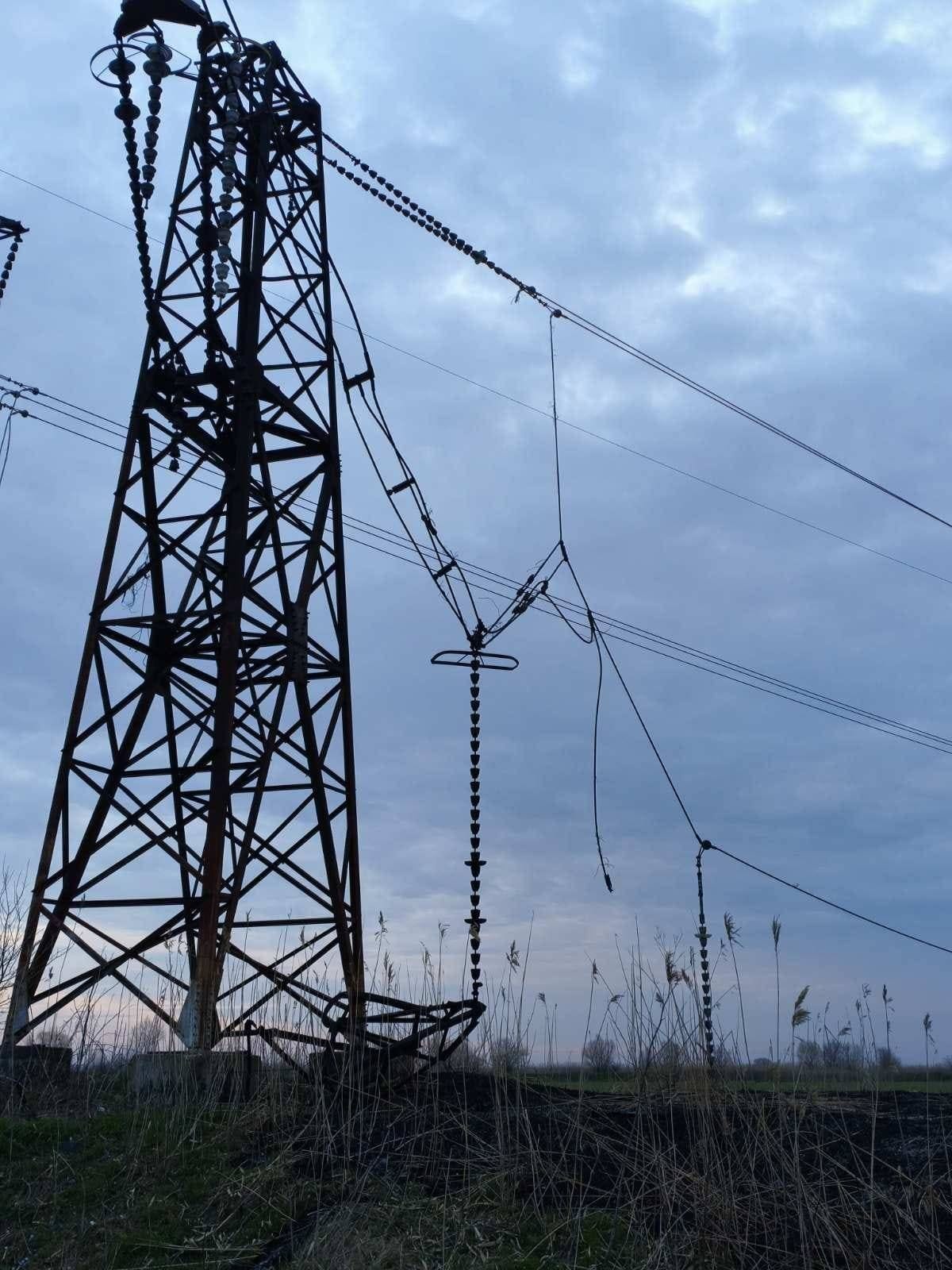
At 7:15 pm on March 23rd residents in Chisinau noticed the lights briefly go out and then flicker back on. In the morning the Ministry of Energy announced that the key high-voltage line between Isaccea (Romania) - Vulcănești (Moldova) had been hit and damaged. They wrote:
“On the evening of March 23, at around 7:15 p.m., due to Russian attacks on the territory of Ukraine, our energy infrastructure, the property of the Republic of Moldova, was affected. What happened? Several “Shahed” drones targeted our energy infrastructure. And as we see in this picture, this is the effect.“
Understanding the Infrastructure Situation
On January 31st, 2025 most of Moldova lost power due to “serious problems in the Ukrainian power grid” that caused a massive voltage drop on the Isaccea-Vulcăneşti-MGRES high voltage line - which triggered automatic disconnections. At the time I wrote a detailed overview of the key infrastructure and I recommend re-reading that article for context. In short, Moldova gets up to 60% of its power from Romania via a line that runs from Isaccea in Romania through Ukraine to Vulcăneşti in Moldova and then back and forth across the Moldovan-Ukrainian border before it meets the MGRES power plant in Transnistria. From there the power line runs to Chisinau.
The damage on March 23rd was to a particularly critical section of that power line between Isaccea and Vulcăneşti which also runs through Ukraine. You can see the whole system on the map on the left as well as an illustration of the part targeted on the map on the right below.


Moldova has been working to create its own direct connection to Romanian power via the Vulcăneşti - Chisinau high voltage line that was supposed to be completed in December but is running behind schedule. That line would allow Moldova to bypass Transnistria BUT critically not fully avoid transiting Ukrainian territory. It would still require the small segment Isaccea-Vulcăneşti which was targeted.
At the time of writing we do not know if this was intentionally targeted by Russia or if it was accidentally hit by a drone targeting the Ukrainian port of Remi (either off-course or shot down). We do know that this was the first Russian attack directly on Moldovan owned critical infrastructure in this war.
State of Emergency
On March 24th Prime Minister Munteanu convened the National Crisis Management Center and requested that parliament be called into extraordinary session to declare a state of emergency. He stated:
“Crash drones were identified in the immediate vicinity of the affected infrastructure, which imposes access restrictions for technical teams and the need to carry out demining works to fully allow the necessary intervention and in safe conditions,”
Parliament was convened on March 24th and held a debate on declaring a State of Emergency in the Energy sector for the next 60 days. Prime Minister Munteanu explained the gravity of the situation saying:
“The 4 interconnection lines with Romania have been activated, but the situation remains complicated. Starting tomorrow, the estimated deficit will reach 350-400 MW during peak hours. Chain disconnections, as you can deduce, remain very possible. We cannot rule out new attacks, we cannot wait,”
The these interconnections mean that the country is maintaining electricity through emergency “island connections” via smaller 110 kV lines. I explained island connections in the January article I referenced above.
The Minister of Energy estimated that repairs could take 5-7 days. The reason is that explosive materials remain on the site and army sappers have to make it safe before technicians can affect the repairs. There is also the risk of continued attacks on the line.
The State of Emergency was passed with 72 votes in favor, 18 abstentions and 0 against. Igor Dodon explained that the Socialists refused to vote for the bill because their suggestion that Moldova start buying power from the MGRES plant again were not taken into account (I’ll explain why this makes no sense in a footnote2).
Following the declaration of the State of Emergency, the government issued a series of orders and recommendations as follows:
Called on all users to minimize electrical consumption during peak hours (6 am - 9 am and 5 pm - 11 pm). They warn against the use of elevators in this time in case of outages.
Mandated that Thermoelectric plants in Balti and Chisinau have been instructed to produce at full capacity.
Called on public and commercial buildings to reduce light by 30% and refrain from using decorative and advertising lights.
Called on industrial activities to schedule operations outside of peak hours.
Mandated export and re-export restrictions on petroleum products until a stockpile of 5,000 tons of gasoline and 25,000 tons of diesel are stored.
Accelerated import processes for fuels.
Restricted gas station purchases in containers to 20L jerrycans.
Instructed grid operators to prioritize hospitals and critical infrastructure in case of shortages and resort to rolling blackouts as a last resort.
Chisinau Mayor Ion Ceban called on city residents to conserve power and he condemned the “the war and Russia’s attacks on Ukraine.” He announced plans to move schools to online education and suspend trolleybus routes if there are major shortages.
On March 25th the National Agency for Energy Regulation (ANRE) met to approve a decrease in electricity prices, but postponed the move for the duration of the State of Emergency.
The Other Energy Crisis
This new State of Emergency replaces last week’s State of Alert which was called to respond to America and Israel’s war against Iran. Fuel prices continue to increase in response to the global supply shock with prices for gasoline now 23.74% higher than before the war and for diesel 49.3% higher.
This has caused the Employers’ Association of Auto Transport Operators (APOTA) to announce that “an enormous number of regular district and inter-district trips [bus and mini-bus routes] will be suspended, and their number could reach 80% of the total number.” The prices of bus tickets are regulated and the association claims that the National Road Transport Agency (ANTA) is not raising prices fast enough to keep routes profitable.
On March 23rd President Sandu convened the National Security Council (NSC) and after meeting warned that prices will continue to rise. She stated:
“All of the energy shocks, despite the measures we have taken—and because we do not have oil, because we do not have natural gas—are clearly affecting us through rising prices, both at the household level and across economic sectors. We will continue to monitor the situation, and our hope is that this crisis will end sooner rather than later, but we must also prepare for the worst-case scenarios
We have a pricing formula, or a price formation mechanism, that assumes a slower transition to market prices—over a period of 14 days—and this helps us, to some extent, avoid extreme volatility. However, this does not mean that prices will not eventually reach global market levels,”
Right now prices in Moldova remain lower than those in Romania and much of the region because of this 14 day transition period. Across Europe many countries have different levels of market responsiveness to rapid price changes which has led to drivers crossing borders to fill up in other states and countries like Hungary to create differentiated prices for citizens vs foreigners.
President Sandu went on to speak about support mechanisms for farmers, but noted that the only long term options is increased adoption of renewables. Indeed, without Moldova’s hard pivot to wind and solar it is likely the country would already face substantial rolling blackouts.
President Sandu concluded saying:
“So, I repeat, we are monitoring the situation, and it is a worrying one. I will say this plainly: it is a very worrying situation if things do not stabilize, if prices do not stabilize in the coming weeks,”
Nistru Oil Spill Updates
On March 19th Prime Minister Munteanu announced that water supplies were being reconnected for Balti, Soroca, Singerei and Floresti. He stated:
“I know that these days have been difficult. Thank you for your patience. I also thank the teams in the field who worked non-stop so that people have water. The interventions at the Cosăuți station and in the localities have yielded results. The supply is being resumed in stages, with strict control at each stage. The installed filters remain in operation, and the teams remain in the field for continuous monitoring and rapid intervention, if necessary”
This outcome was achieved via a massive cleanup effort by many parts of the Moldovan state including the National Army. It was supported by Romania and donations from EU partners including Poland and Belgium. Many filters and dams were installed along the river which allowed for the water feeding these towns and regions to return to safe levels.
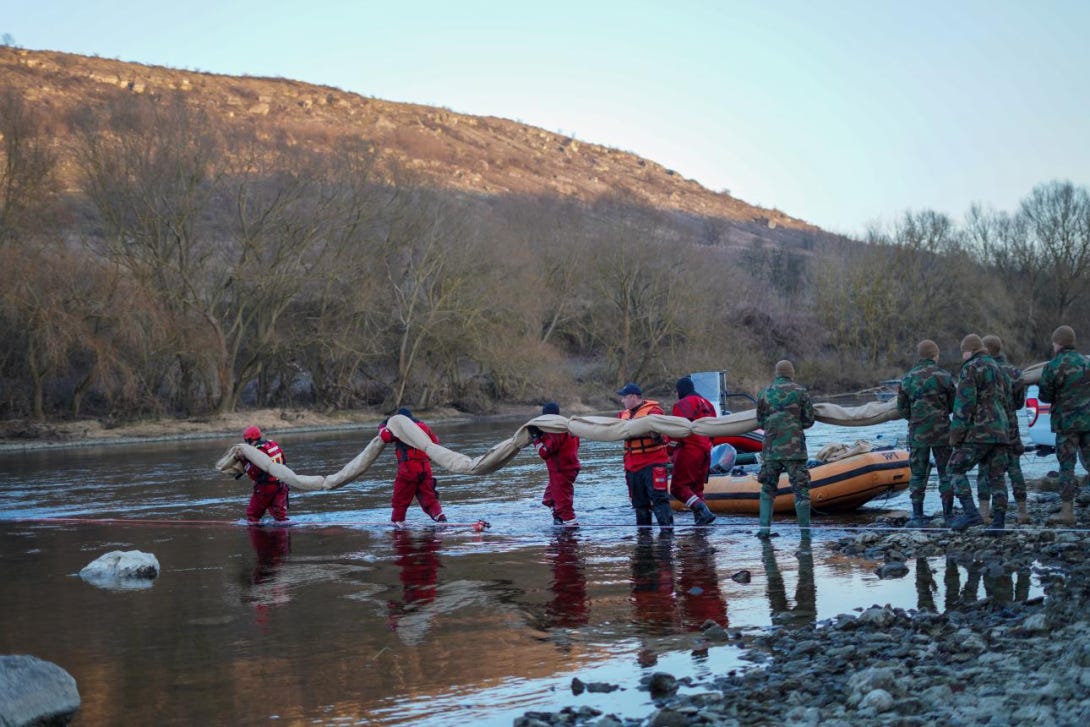
On March 25th Minister of Environment Gheorghe Hajder posted a video from Ukraine where he was checking on the origin of the spill. He explained that the origin of the leak (still unnamed) had been stopped and no more oil was entering the river. He explained that small slicks may still be seen working their way down the river but with the containment mechanisms in place and the source of the problem stopped the crisis was ending.

Politics & General News
Here’s a roundup of the other top stories of the week:
Parliament voted for the final denunciation of Moldova’s participation in the Commonwealth of Independent States (CIS). The bill passed in the first reading 58-28. Moldova joined the CIS after it was created in Minsk in January 1993 along with many former Soviet Republics. Moldova has slowly been disentangling itself from various multilateral aspects of the CIS since 2022.
Ion Ceban claims that the Nistru oil spill was not real. The mayor claimed that without official test results he did not believe what the government was saying and alleged that it was all a 2 pronged conspiracy. First, to distract from rising gasoline and diesel prices, second, to “introduce a foreign operator to provide water and sewerage services in the north of the country.”
Invest Moldova has begun a major promotion campaign on the BBC. The campaign, titled “Moldova – a Trustful3 Partner for Export,” plans to air 250 TV broadcast commercials on BBC news from February through April. They are targeting 5 million views. You can see one of the videos on youtube here.
PAS MP Nicolae Botgros has resigned from parliament. The famous conductor and artistic director of the National Folk Music Orchestra “Lăutarii” had run in 11th place on the PAS list. He has publicly struggled with a transition to politics and has been accused of incompatibly splitting his time by continuing some performances. This month RISE posted an investigation into a real estate deal that Lăutarii was involved in which began as a public project for a music school and ended as an apartment building. Nicolae Botgros denied wrongdoing, and it isn’t clear if the investigation prompted his resignation. Asked to comment on his resignation he simply said “where is art, where is politics, they are far apart.” At the beginning of this Spring 2026 parliamentary session he had previously promised to remain in parliament “until they take him with his feet to the other side.” He joins an unusually high number of MPs who ran on the PAS list only to leave parliament very early in their term.
Plahotniuc Will be Sentenced on April 22nd
This date was set by the court after hearing closing arguments from the prosecution and defense. The case involves his role in the theft of $1 billion dollars from 3 Moldovan banks. In their closing arguments the prosecution requested a 25 year jail sentence - the maximum allowed. The defense called for an acquittal and accused both the prosecutors and the judges4 of not acting neutrally in the trial. Plahotniuc himself took the stand on the final day to speak in favor of his innocence. The court will proclaim guilt or innocence and announce the sentence on April 22nd.
Gerbers are sometimes decoys, sometimes not
Absent a real solution Dodon is simply parroting simple sounding Russian talking points. The MGRES plant makes power by burning natural gas or coal. Transnistria no longer has reliable natural gas supplies and has repeatedly rejected EU offers of gas in their emergency. They also have dangerously low coal reserves and can barely power their own tiny region. Without adequate supply this is not feasible. With adequate supply from the open market, the antiquated MGRES plan would produce power that is far more expensive than can be bought on the Romanian market. Utilizing MGRES is not impossible, but it is not as simple as a commercial contract and would require a major diplomatic solution between Moldova, Transnistria, Ukraine and the EU.
I know.
Insulting judges is often not the best defense strategy