

What happened and how was it possible? Was it planned in advance? Why is it still hotly debated in Romania and Moldova? And could it happen again?
On March 27, 1918, Bessarabia, a former Tsarist province dating back to 1812, when the Principality of Moldavia was divided in two, united with the Kingdom of Romania. Bessarabia, unlike modern Moldova, had clear cut natural borders, stretching from the Prut River in the West and the Dniester River in the East, Habsburg Bukovina in the north and the Danube mouth, and Black Sea in the south.
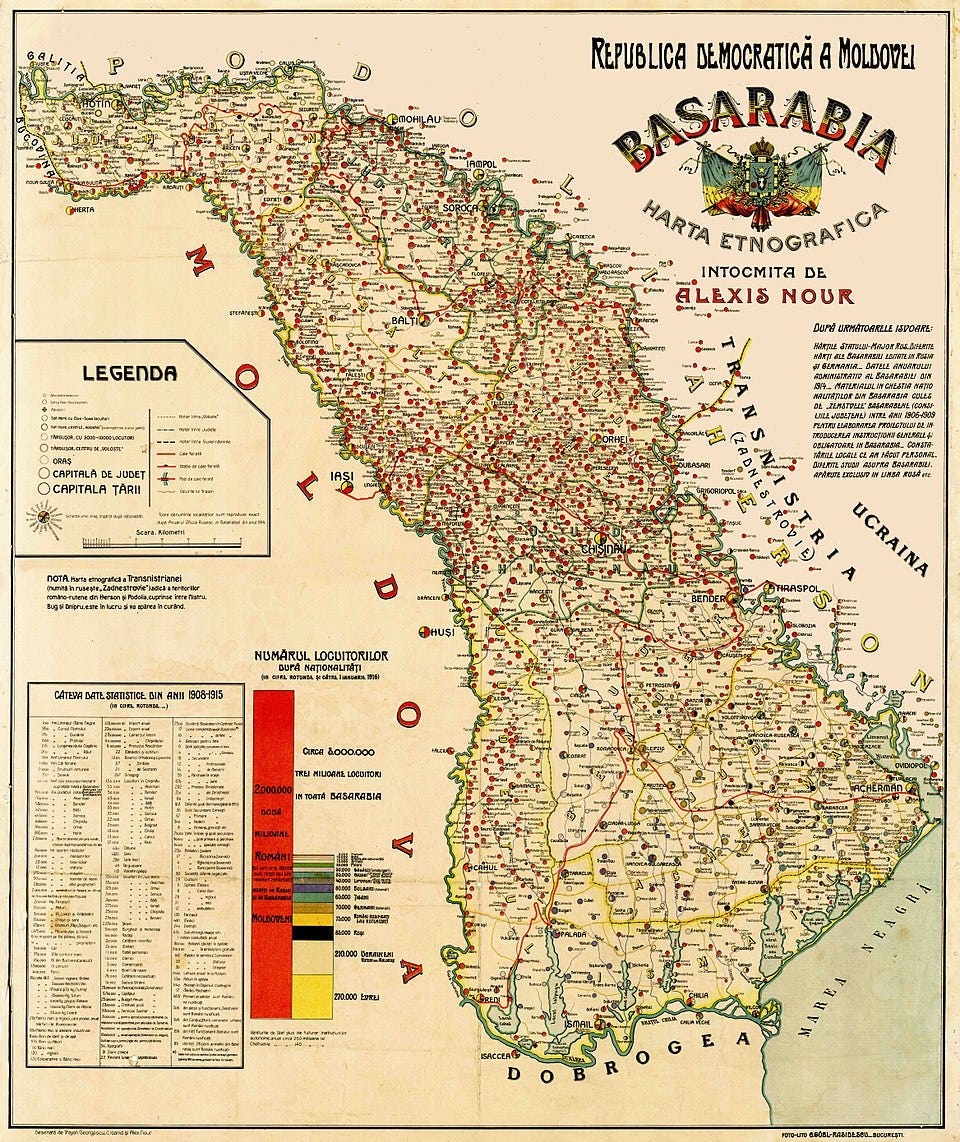
The decision was made by Sfatul Țării, the local parliament, a quasi-representative body like many others in the national peripheries of the former Tsarist Empire. In the later parts of WWI, similar indirectly representative bodies were created at a time where war prevented direct elections. Such parliaments decided the fates of other provinces and fragments of empire - creating national states (e.g. Poland and Estonia), or recreating lost independent states out of pieces of the Russian Empire (e.g. Lithuania).
This is to say Sfatul Țării was broadly representative and held democratic legitimacy according to the standards of the time. Moreover, it had legitimacy to decide the future of the province. The Bolsheviks, Mensheviks and other Russian political parties as well as the province’s main ethnic groups were represented. They all recognized the Sfatul Țării as the supreme and legitimate institution of the province.
Since then, the legitimacy of Sfatul Țării’s vote on March 27, 1918 has often been questioned or contested with the argument that the Romanian Army controlled the province since mid January 1918. At that time, the Sfatul Țării had requested Romanian support in a situation of deteriorating security and rampant violence. Much of this was driven by the disintegration of the Russian Army on the Romanian front and the transformation of these units into Bolshevik raiding parties in the chaotic context of the Russian civil war.
With this background, on the historical day of March 27, 19181, 3 members of the Sfatul Țării voted against the Union with Romania and 36 abstained. Only 86 voted for, while 12 were declared absentees.


The divided vote speaks to the fact there was some room for freedom of the ballot. In one example, Ștefan Balamez, a Ukrainian who was one of the three voting against the Union, worked in the interwar period in various capacities in the Chișinău City Hall. He was arrested by the Soviets in 1940 in the aftermath of the Red Army’s occupation of Bessarabia and sent to Siberia where he died in 1942. This demonstrates not only was there freedom of the vote, but that it did not clearly map onto what we might now call pro-Romanian or pro-Russian lines.
The vote was contested mainly by the Bolsheviks, but also by the former Tsarist political class. These forces, though irreconcilable enemies on the battlefield across all of the collapsing Russian Empire, allied in a common front during the Paris Peace Conference (1919-1920).
The Ukrainian political elites of all ideological stripes also vehemently contested the Union of Bessarabia with Romania as the province was perceived as part of ethnic Ukrainian lands2. This is in spite of all credible statistics (including Tsarist ones), showing that Ukrainians only made up around one quarter of the total population. Meanwhile, the Romanian-speaking populations3 made up around 50-60% of the province’s residents4.
The Union of Bessarabia with Romania came as a surprise to the residents of the other regions on the right bank of the Prut river that make up modern-day Romania. Bessarabia did not have a privileged place in the Romanian discourse before 1914. Transylvania was the most coveted Romanian speaking territory due to many factors, one of them being the level of national consciousness among Romanians in the region. There were also major political differences. The Bessarabian peasants were more preoccupied with the land reform than with any nation-building agenda, and Romania as a Kingdom was perceived as a harbinger of landlords’ interests. Furthermore, the King, even though he converted from Catholicism to Orthodoxy, was suspected of not being of their own faith.
The drive to unite Bessarabia with Western Moldavia (from which it was detached by the Russian Empire in 1812) and thus the Kingdom of Romania was driven by both internal and external factors. Even though Sfatul Țării was legitimate, it did not have resources and organizational capabilities to impose its authority outside the capital - and it sometimes struggled to control the capital itself. This was largely due to Bolshevik raiders and political fanatics sent from Odessa to spread propaganda and sow anarchy. This type of violent and chaotic situation was engulfing much of the collapsing Russian Empire as the Bolsheviks sought power at any cost.
Paradoxically, in this late stage of WWI, the sworn enemies in the Entente Powers and Central Powers managed to agree on this union. France, Great Britain and Germany all, for various reasons, recognized (or tolerated) the decision of Sfatul Țării of March 27, 1918. The United States neither endorsed nor opposed but chose to closely observe the process.
Within Bessarabia a sense of national identity had been growing - but with serious contradictions. Soldiers and elites serving on various fronts during the war had come to understand that they were linguistically the same as their brethren West of Prut River. At the same time, Bessarabia remained deeply Russified and even during the Sfatul Țării’s meeting of March 27th 1918 most of the discussions took place in Russian. This was because it remained the language of their education and most knew Romanian only at the vernacular level.
The Union of Bessarabia with Romania made the century long process of Russification of the Moldavians of Bessarabia reversible. In the interwar period, they enjoyed full national rights and schools in Romanian with Latin alphabet. Rights were granted to minorities as well, including to education in other languages. In the economic sphere, in the south, sometimes the minorities (Bulgarians) enjoyed privileges in detriment to the local Romanian speaking population, such as fishing rights in the Prut valley.
The interwar gave a fresh life to Romanian language and culture and made speaking Romanian more and more prestigious and respectful. In Bessarabia, it was no longer simply a tolerated language that was limited in the public space. The language was lively and loved by the Moldavians / Bessarabians across ethnic groups, including by the Gagauz. The latter were – in contrast to the Soviet period – one of the most integrated ethnic groups in the Romanian cultural and linguistic milieu. They were also one of the most loyal ethnic groups to the Romanian state as they were not attracted by Bolshevik ideology and propaganda before, during or after the Tatarbunar insurrection of 1924 - the peak of Soviet hybrid war against interwar Romania.
Being part of Romania between 1918-1940 spared tens of thousands of lives that otherwise would have become victims of Soviet state terror - as happened in other parts of the USSR. This included the Moldavian Autonomous Soviet Socialist Republic (MASSR), created on the territory of the Ukrainian SSR in 1924. This region served a similar role to modern day Transnistria, allowing the new Russia to maintain a claim on Bessarabia until they could come back in force.
In the MASSR alone, about 40,000 persons of all ages and ethnic backgrounds died during the Holodomor of 1932-1933, and about 5,000 were executed by death squads during the Great Terror of 1937-8. Tens of thousands more were deported to Siberia and Kazakhstan. Life in interwar Romania was not paradise on earth either, it was the era of extremes all over Europe, but Romania did not practice state terror on the scale seen in the Soviet Union.
Note: Romania bears responsibility for its role in the Holocaust during World War II. Under the Antonescu regime, hundreds of thousands of Jews were killed in Bessarabia and Transnistria, often in coordination with Nazi Germany. Among the victims were many Jews who were educated in, and closely connected to, Romanian language and culture.
A number of survivors later played a role in preserving elements of Romanian literary and cultural life in Soviet Moldavia after 1944. Their contributions formed part of a broader, complex process through which Romanian cultural identity persisted despite sustained pressures of Russification in the Soviet period.
Looking at 1918 Through a Modern Lens
The events of 1918 remain highly relevant in both Romania and the Republic of Moldova, particularly in the context of Russia’s war against Ukraine. For some, the parallels appear striking: a moment of regional instability, uncertainty about borders, and the question of how small states can secure their future. In this view, unification with Romania is sometimes presented as a potential safeguard against renewed Russian aggression.
At the same time, the differences between 1918 and today are profound. The Union of Bessarabia with Romania was decided in the context of collapsing empires, limited state capacity, and a very different international system. Any comparable decision today would have to follow true democratic procedures, reflect the will of the population, and take place within a complex European and international legal framework.
In this context, occasional political statements in favor of unification - such as the expressions of personal support by President Sandu for a hypothetical referendum - should not be understood as signaling an imminent or likely political project. Public discourse on Union often operates at the level of identity and historical memory rather than concrete policy. In practice, there is limited political momentum for unification in either Chișinău or Bucharest.
Moreover, the regional security environment, while unstable, does not necessarily make Union more feasible. On the contrary, a deterioration of the security situation - such as a further Russian advance in southern Ukraine - would introduce significant risks and uncertainties. In such a scenario, Romania and its allies would likely prioritize stability and deterrence over undertaking a complex and potentially destabilizing political integration.
A more immediate and tangible challenge remains the unresolved status of the Left Bank, or Transnistria. As in the early 1990s, this issue is both a domestic and a regional security problem, now with broader European implications. Any sustainable solution would require the withdrawal of Russian forces and the demilitarization of the region, followed by a cautious and gradual reintegration process that does not undermine Moldova’s internal political balance or its European trajectory.
In this sense, while the legacy of 1918 continues to shape political imagination and identity, its direct replication under current conditions appears unlikely. The questions facing Moldova today are less about territorial reconfiguration and more about security, governance, and integration within the European framework - challenges that differ fundamentally from those of 1918.
Sometimes referred to as April 9, 1918 O.S
The nationality and ethnicity we now call Ukrainians has emerged over time as a common term for the residents of modern day Ukraine who were previously called Ruthenians in the West (in former Hansburgs lands) and “Little Russians” (Malorossy) in the East and South. Russian propaganda today refers to Ukrainians as “Little Russians” (Malorossy) as part of their attempts to deny Ukraine a state, language and ethnic identity. This rejection (shared by Putin) is a legacy of Tsarist imperial classification of “triune Russian nation” (triedinaya russkaya natsiya), comprising Great Russia, Little Russia and White Russia (Belarus).
Meaning ethnic Romanians who would have identified themselves as Moldavians because they did not participate yet in the modern Romania’s nation-building process
This is an estimate - according to the Russian Imperial census of 1897 there were 47 %, but it is controversial. The Romanian census of 1930 gives 56 %. These numbers are certainly a decrease (via colonization) from a number 78% in the 1817 census.

It was good to hear Dr. Casu’s views on this topic!
It is really helpful to hear thoughtful, well-written accounts like this from Moldovans...hope Igor is heard and appreciated by his fellow citizens.