

Easter of the Dead
On the Sunday and Monday following Orthodox Easter Moldovans gather in the graveyards to commemorate a very Moldovan holiday, “Paștele Blajinilor,” often translated as Easter of the Dead. On this day Moldovans remember those who came before and gather in the graveyard for a picnic where they symbolically share food and wine with their lost relatives.
On the occasion, President Sandu put out Easter wishes writing:
“On Easter, we give ourselves the time to return to what really matters: our roots, our family, and the invisible thread that connects generations. Let us turn our thoughts these days to those who gave meaning to our path and who remain part of us, through everything they left us. And let us find in the moments spent with our loved ones, in peace and gratitude, the reconciliation we need and the strength to move forward,”
This is the last event of Moldova’s long Easter season - stretching from lent fasting through Catholic and Orthodox Easter and on to this very local commemoration. If you’d like to read more about Easter of the Dead we published a guest essay on the topic back in April 2024 which you can read here:

Politics & News
Here are the top stories of the week:
The Alternative Bloc and Faction continue to disintegrate. After Mayor Ceban confusingly announced that his MAN party would withdraw from the Alternative Bloc but remain in the Alternative parliamentary faction - while also loudly distancing itself from that faction - Mark Tkaciuk announced that his Civic Congress party was withdrawing from the parliamentary faction. He said that in a circumstance where MAN loudly distances itself from its partners the only honest move was to break away.
The Central Election Commission (CEC) submitted plans for revising the electoral code for public consultations. The amendments envision tighter control over social media advertising, including parties declaring all their paid channels and platforms being required to report spending and targeting. The plan pays specific attention to Gagauzia, where the CEC proposes to add additional eligibility criteria for those standing for Bashkan. Specifically, a candidate for Bashkan would be required to speak both Gagauz and Romanian, be at least 35 years old and have lived in the region for at least 1 year. Additionally the amendments would restructure the Central Electoral Council of Gagauzia, reducing the membership from 9 to 7. Two members each would be appointed by the People’s Assembly of Gagauzia, the Executive Committee of Gagauzia and the Comrat Court. One would be appointed by the CEC and the chair and vice chair of the CEC would be permitted to attended Central Electoral Council meetings without voting rights.
The Electronic Government Agency (AGE) announced that digital ID documents through the EVO app will be useable for interactions with banks and government agencies by June. The agency plans to eliminate the requirement to personally visit agencies by Fall through the use of electronic signatures. EVO is part of the government’s plan to digitize 100% of state services by 2030.
President Sandu commemorated the victims of the Stalinist Famines. She marked the occasion, commemorated on the 3rd Sunday in April, in the village of Mingir where 1400 people died in the famine - nearly half of the population. She stated:
“The famine of 1946–1947 affected hundreds of thousands of people and led to the loss of 200,000 lives. Figures that still terrify us today, but which cannot fully encompass the trauma that parents and children, young and old, went through,” (…)
“When the truth is told, even after decades, it brings justice. It helps us to understand, not to forget and not to repeat. And, above all, only the truth sets us free,”


Local Public Administration (LPA) reform is becoming contentious. The MAN party protested last week against the planned reform calling it “a direct attack on local public administration” and claiming that PAS would use it to eliminate mayors from other parties. Meanwhile, activists like Vasile Tofan continue to give interviews calling for more radical reform and urging the government to think bigger. The government hopes to pass LPA reform this year but we are still at the early stages of what promises to be a long process.
Energy Crisis
The energy crisis caused by the American-Israeli war against Iran continues to create uncertainty in Europe’s energy markets. The fragile ceasefire and negotiations have caused fuel prices to drop slightly in Moldova, but diesel remains 51% more expensive than before the war started while gasoline is 23% more expensive. Fuel imports continue without issue and the country continues to maintain stockpiles of around 19 days of gasoline and 11 days of diesel. With the situation slightly stabilizing, on April 15th, Prime Minister Munteanu again announced that he would ask parliament to lift the State of Emergency. At the time of writing he has not yet done this, possibly owing to the holiday schedule.
Rising prices continue to have knock-on effects with Transnistria announcing a 17% increase in ticket prices for suburban buses and intercity transit. Moldova’s Lukoil stations also continue to operate as the Trump Administration extended waivers on American sanctions until October.
In order to help farmers with the near term diesel prices, and the projected medium term problems with fertilizer, the Ministry of Agriculture announced that they were creating a new component of the Agricultural Credit Facility Program to support loans for working capital. The program is set to launch through banks within 2 weeks and provide lines of credit up to 500,000 lei at a fixed 5.1% APR for 5 years. This support is targeted at “micro and small farmers1.”
Transnistria & Security
Here’s a roundup of the top security stories of the week:
Chisinau has declared the leadership of the Russian army in Transnistria “undesirable.” Zona de Securitate has reported that the military commanders and their deputies will be blocked from entering Moldova. Transnistrian “Foreign Minister” Ignatiev called the move “unreasonable and destructive,” noting that the Russian army units and the Russian “Peacekeepers” are “a single entity” and saying that any restriction on their operations would “negatively impact the peacekeeping operation.”
Head of the Ukrainian Presidential Administration, General Kirill Budanov, says that the withdrawal of Russian troops from Transnistria is not part of peace negotiations with Russia. In an interview with Malenkaia Strana he called the troops there a “known threat” but stated that Ukraine is not putting this condition forward in order not to complicate the peace process.
Romania is becoming a “boulevard for Russian drones.” That statement was made by former Romanian President Traian Băsescu who added “we are starting to look ridiculous.” The comments come after reports of multiple drone incursions into Romanian airspace in the delta region. DW reports that for multiple political and technical reasons Romania has made a decision not to shoot down these drones and to largely let them pass through the country’s airspace to attack Ukraine.
The Russian Duma passed a bill in the first reading to allow the president to deploy military forces to “protect the rights of Russian citizens.” This bill focuses specifically on Russian citizens who are detained, arrested or prosecuted outside of Russia, and is likely being passed in the context of the EU’s proposals for setting up a “Special Tribunal for the Crime of Aggression against Ukraine.”
Alexandru Balan will be extradited to Moldova following sentencing. The former director of Moldova’s Security and Intelligence Service (SIS) pled guilty to divulging state secrets and was sentenced last week to 1.5 years in prison. He joined the court hearings via video call as he is currently under house arrest in Romania where he faces treason charges (he is also a Romanian citizen) and up to 20 years in prison. Those charges relate to his participation in a Belarusian spy ring where he was caught passing secrets to the KGB. Romania has agreed to extradite him to Moldova to begin serving his sentence.
International Affairs
Here’s a roundup of the top international affairs stories of the week:
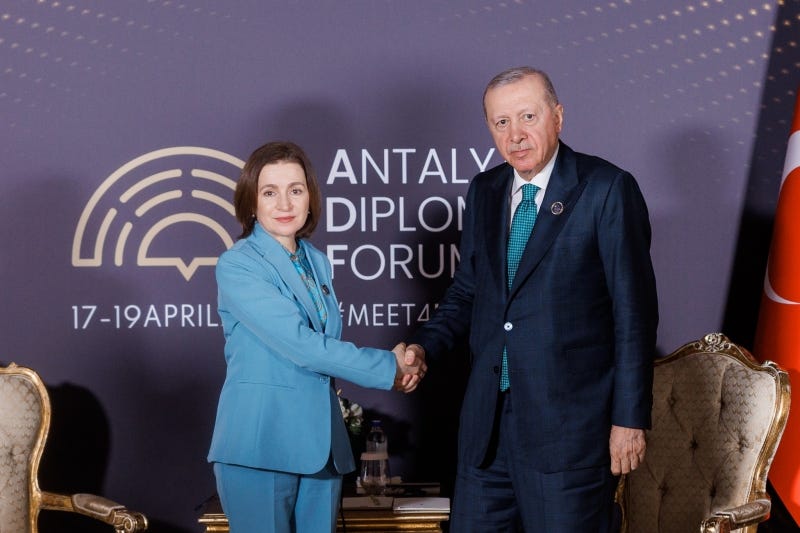
President Sandu attended the Antalya Diplomatic Forum in Turkey. There she met on the sidelines with President Erdogan and discussed economic cooperation, attracting investments and “the protection of the Gagauz language and culture and joint support for the development of the region.” Turkey is Moldova’s 2nd largest export designation and the 4th largest source of foreign investment after Romania, Germany and France.
A Moldovan Parliamentary Delegation held meetings in Washington DC. PAS MPs Radu Marian, Adrian Băluțel and Andrian Cheptonar, join Ambassador Vlad Kulminski for meetings with congressmen and Senators including Sen. Ted Budd (R-NC), Sen. Steve Daines (R-MT), Sen. Marsha Blackburn (R-TN), Rep. Keith Self (R-TX), Rep. Mike Lawler (R-NY), Rep. Pat Harrigan (R-NC), Rep. Deborah Rep. Ross (D-NC), Rep. Bill Keating (D-MA) and others. MP Radu Marian wrote of the trip:
“We are here to consolidate the partnership between our countries and strengthen the parliamentary dialogue with the US Congress. I reiterated that US support in combating Russian pressure on the Republic of Moldova has been, is and will be essential for Moldova to remain a free, democratic country and part of the free world. We share the same values with the US,” (…)
“I thanked for the recent investment of 130 million dollars for the Straseni-Gutinas power line, which is to be built by an American company2. I mentioned that the Republic of Moldova is ideally positioned for American investors who want to scale production and support the reconstruction efforts of post-war Ukraine”
Khotyn Fortress Partially Collapses
Today we’re ending on a bit of a sad note with the news that the iconic Khotyn Fortress in Ukraine had a partial collapse of its outer wall. Khotyn is one of the castles and fortresses built by Stefan Cel Mare when he was Voivode of Moldavia. It’s an iconic castle that many readers will have seen before in movies and, in my case, on the cover of my 4th grade history textbook in Virginia.
Unbelievably, the collapse was caught on camera and can be viewed online here. So unbelievable was the story that the mayor of the town was forced to put out a statement saying:
“Unfortunately, it is not artificial intelligence. Yesterday (April 17, 2026), a very unpleasant and extreme emergency situation occurred in our beautiful Hotin fortress. Yes, there was a partial collapse on the great wall. And this collapse is very significant. Everyone is alive! Most importantly, no one was injured,”


The local authorities plan on restoring the wall in the future.
Moldova’s laws defining micro and small enterprises use a combination of turnover and number of employees to sort companies. This is an issue with agriculture as most farms use large numbers of unofficial seasonal workers. The government has long chosen to ignore the problem of unofficial work and companies in agriculture and this has created problems making targeted programs like this as larger companies will likely benefit more from programs designed for smaller ones.
The fact that the line will be built by an American company was understood but had not been previously announced officially. It highlights how aid from the United States has changed to include more obvious benefits for US companies who would not previously have had any business in the country or experience operating here. Which company will be selected and how they plan to operated in Moldova is something I’ll watch going forward.
I worked in Moldova for almost three years starting in June of 2016. I was at the US Embassy working as a Senior Police Advisor. It was the most incredible experience of my life! Thank you for publishing this news letter and keeping Moldova on the mind and hearts of all who know this lovely place. Ed Cronin