

Drone Incursions Become a Near Daily Occurrence
Russian violations of Moldovan airspace have massively intensified in both quantity and potential danger to the population. Overflights - where a drone briefly enters and then exits Moldova on its way to a target in Ukraine are becoming a daily occurrence. At the same time, drones that crash and explode in Moldova, or linger for long periods in the country’s airspace, are becoming much more frequent. Here is a roundup of the main violations in the past week:
September 18 - Explosion in Colonița outside Chisinau. Multiple residents called the police after hearing the explosion at 4:20 am1. While various home security cameras captured the sound and flash (video compilation from the police here), military radars did not track or identify this drone. At 1:00 pm police search teams found debris from the turbojet-powered missile-drone scattered across a 100 m radius.


September 19 - “Several” drones violated Moldovan airspace from multiple directions. One may have crashed and exploded approximately 1.5 km across the border in Ukraine.
September 20 - Residents from 2 villages in different parts of the country called police to report drone overflights. Military radars did not record any overflights and they are unconfirmed.
September 21 - Radars detected drone incursions at 00:17, causing closure of the country’s northern airspace for 24 minutes. The drones returned to Ukraine. In the afternoon another drone overflew Moldovan airspace in the south near Planaca.
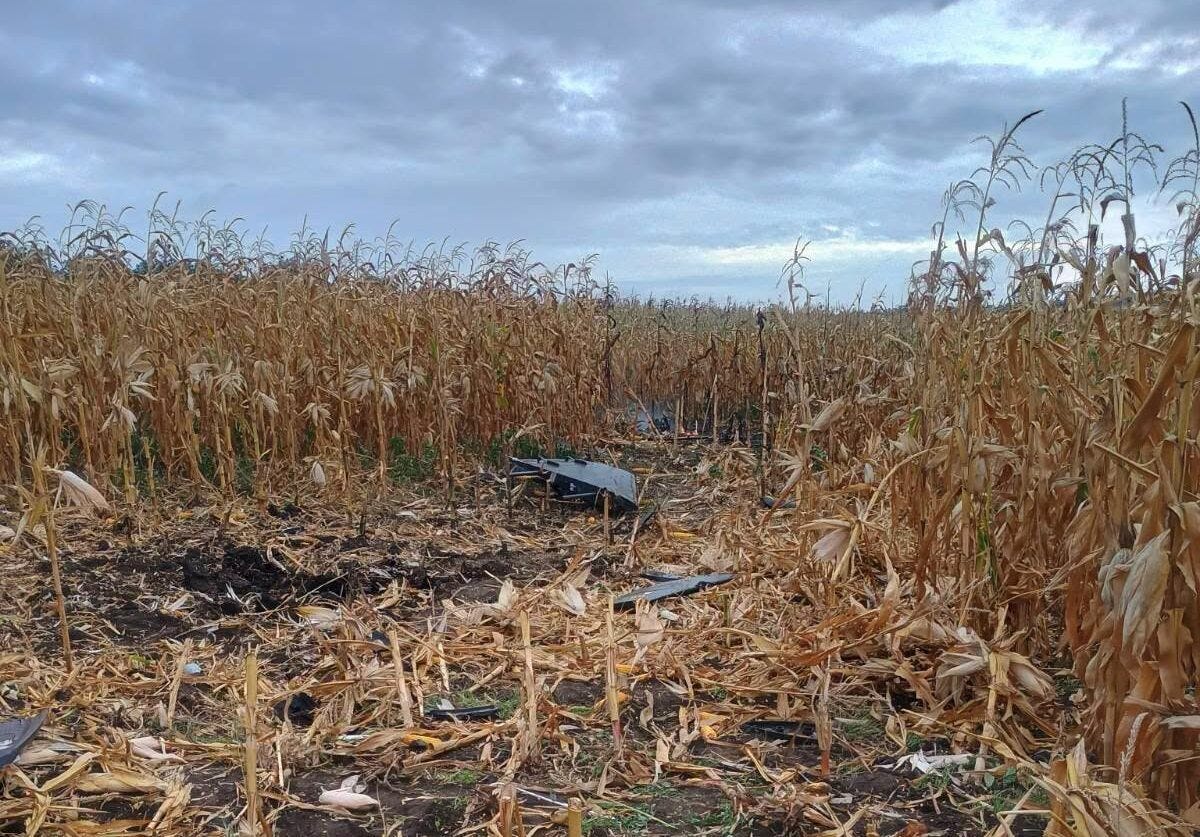
September 24 - Four drones entered Moldova in 2 hours with 2 crashing and exploding. One went down in the village of Cernița, Florești district. It hit a tree and then exploded in a cornfield. The other is believed to have crashed and exploded in Transnistria, but is unconfirmed by their “authorities.”
What’s Happening and What is Being Done About it?
State Secretary of the Ministry of Defence Ghenadie Cojocaru gave an interview to answer the public’s questions and concerns about the drones. Asked how the military did not track the drone that crashed in Colonița, very near to Chisinau, he explained that various conditions, including altitude make tracking drones difficult. He noted that the current radar situation is much better than at the start of the war2, but that there are still major gaps. Right now the system is capable of giving decision makers the general situation and allowing for enough warning to protect civilian aircraft (closing airspace, etc).
Asked whether Moldova has the capability to shoot these drones down, he said “partly,” explaining that the army has Man Portable Air Defense (MANPADS), machine guns and Electronic Warfare Systems (EWS). At the same time, numbers are limited and they are organized to protect critical infrastructure systems. Asked what is going on, Cojocaru explained that in the cases where there are long-distance incursions the government suspects that the Russians are probing Moldova’s capabilities.
The STRATCOM center put out a statement explaining that these incursions coincide with waves of disinformation being spread through Kremlin propaganda channels. They seek to foster fear and include messages linking the abandonment of European integration with safety from Russian attack.
Between February 24, 2022 and September 22, 2026, there have been 77 recorded violations of Moldovan airspace. 40 of those occurred in 2026 with 16 cases of crashes resulting in explosions or fires in August and September alone.
Quick Note: After each of these incidents the Ministry of Foreign Affairs releases a statement condemning violations of Moldovan sovereignty, etc, etc. These have become so rote that they may as well be copy / paste. From now on I will not note them unless they contain new substance, and readers should simply assume that the Moldovan government strongly disapproves of all of this.
Ilan Shor is now Everyone’s “Monster”
This week the FT released an article titled “Kremlin-backed forgery scheme moved $6.9bn through global banks.” It was shortly followed by a NYTimes piece titled “The ‘Monster’ Behind Russia’s Global Effort to Evade Western Sanctions.” This monstrous forgery scheme refers to Ilan Shor’s A7 companies and their growing centrality to Moscow’s sanctions evasion and war financing architecture.
Both investigations are worth reading in full as they shine a light on the growing A7 empire and how it relies much more heavily on shell companies and document forgeries than on crypto. Financial Analyst Zachary Tvarozna, whose articles Moldova Matters has cross-posted on multiple occasions, is cited in the FT piece. He recently dove deeper into his thesis (seemingly proven) that the A7 story is far more about money laundering through traditional banking systems than it is about crypto. Here’s a link:

I really suggest subscribing to his Substack.
Here are a few of the top line findings from the FT and NYTimes articles:
FT: A7 operates via a vast network of shell companies and correspondent bank relationships. They use OpenAI products for mass forgeries of invoices and stamps in order to mask the actual goods being paid for.
FT: Reports that A7 claims to now manage 1/5th of all Russian foreign transactions, including masked military purchases as well as civilian business.
FT: Tracked $6.9 billion in money laundering, promissory notes (veksels) worth $20 billion in face value and unspecified “billions” in USDT crypto.
NYTimes: Tracked more than 4000 transactions in the first half of 2025 totaling more than $500 million with over $130 million in military / industrial purchases.
NYTimes: Gazprom is routing some energy payments through A7 companies
NYTimes: Kyrgyzstan was the major hub for sanctions evasion via A7 with Kyrgyz bank profits soaring from $42 million in 2021 to $354 million in 2024. Chinese and European shipments to Kyrgyzstan grew from $8 billion to $23 billion in the same timeframe. Following crackdowns on sanctions evasion in Kyrgyzstan, A7 shifted operations to Bahrain, UAE, Nigeria, Mongolia and others.
NYTimes: Reported that “hundreds of millions of dollars” from these schemes were funneled through a “nonprofit” (likely Evrazia) to interfere in Moldvoan elections.
The NYTimes notes that A7 has adopted the nevalyashka toy as a mascot. This is a type of traditional Russian doll with a weight at its base that allows it to self-right when knocked over. It symbolizes A7’s resilience to sanctions.

Energy Crisis (Again)
In what is becoming a grim annual tradition, Moldova has slipped into energy crisis and parliament declared a State of Emergency on September 22 lasting 60 days. Prime Minister Tofan stated that the government is reversing course on plans to bring austerity to the energy compensation programs and is now planning to expand on last year’s subsidies to meet the new challenge.
Addressing parliament to ask for a State of Emergency, the Prime Minister stated:
“The problem is that we are entering the cold season with several major risks overlapping at the same time. We have, basically, a perfect storm”
In his speech (which is well worth reading in full simply as a piece of oratory), he identified 4 interconnected risks that the country is facing:
Natural Gas - Moldova has contracted 90% of the winter supply but these contracts rely on European TTF market prices which are now skyrocketing due to the “crisis in Hormuz,” damage to Saudi Arabia’s East-West Pipeline and attacks on the Ras Laffan LGN facilities in Qatar. Moldova has gas, but the market prices are already 50% higher than consumers’ bills and they are climbing.
Diesel - Refineries and production in the Middle East and Russia are damaged or offline. The government has been managing this crisis since August but needs more tools to assure supply.
Water - The drought affecting the Dniester and Danube has spilled over from an agricultural problem to a problem of drinking water and energy production. The hydroelectric plant at Costeşti on the Prut is showing 55% reduced output right now. These threats have reduced production in Moldova’s adjacent hydroelectric stations and threatened shutdowns at Romanian and Hungarian nuclear reactors.
Ukraine’s Coming Winter - Right now Moldova is still importing electricity from Ukraine. Tofan stated: “According to our assessment, if Ukraine, before the war, had about 70 GW of installed electrical capacity, today the capacity has reached 11-12 GW.” Ukraine supplied 100 MW in August to keep Moldova’s lights on at peak hours. During the winter, Moldova will need 400-450 MW at peak, and Romania can only supply 360 MW. If Russian attacks this winter further degrade Ukraine’s energy infrastructure, Moldova will face critical shortfalls.
Prime Minister Tofan concluded stating:
“Here’s the problem. These multiple risks don’t exist separately:
Gas influences district heating and electricity production.
Water influences hydropower.
Electricity keeps the water pumps running.
The situation in Ukraine influences how much electricity we can import.
And diesel influences transportation, agriculture, logistics, and ultimately prices throughout the economy.”
He called on parliament to vote the government emergency powers to manage this “perfect storm” and parliament voted to create the State of Emergency with 54 in support, 20 against and 22 abstentions.
In parallel, Prime Minister Tofan has accelerated the reorganization of state agencies in order to reduce budget expenditures and allocate more resources to household energy subsidies. Each ministry is reviewing its subsidiary agencies with 161 state agencies, with 52,000 total employees, under review. They have set a target of reducing staff by 10-30% by merging institutions and cutting redundancies.
International Affairs
Here’s a roundup of the top international affairs stories of the week:
This week multiple news outlets, including the Washington Post, France24 and Forbidden Stories, reported on the architecture of the American 3rd country deportation network. They investigated cases where individuals were deported to countries to which they had no connection. They found that Moldova accepted 31 deportees, all of whom were “citizens of the former Soviet region” without criminal records who already had visa-free access to Moldova. In the reporting, only 2 countries responded to requests for comment and one was Moldova. The Ministry of Foreign Affairs noted that of those, 27 have already left Moldova while 4 remain - 2 citizens of Georgia and 2 of Russia. One of these has applied for asylum. Moldova has no official agreement with the United States and was not paid in either money or other resources in this effort. Moldova Matters analyzed rumors of an agreement with the United States back in July 2025 when these transfers apparently began:

Moldova at the United Nations General Assembly (UNGA). British PM Andy Burnham spoke of the UK’s support for “Moldova in protecting its elections from Russian interference” when he announced plans to create a new “National Information Defence Centre” (similar to Moldova’s STRATCOM). He noted that Russian information attacks are an accelerating problem and cited a $1.7 billion annual budget allocated by the Kremlin to these efforts. Romanian President Nicușor Dan called Moldova the “second country most affected by this war” and promised additional support on Moldova’s path to the EU. Prime Minister Tofan will address UNGA September 26 from 5-6 pm. He has been holding meetings on the sidelines encouraging investment into Moldova and speaking with journalists including a video interview with CNN.
Security / Transnistria
Here’s a roundup of the top security / Transnistria stories of the week:
Russia opened 16 polling stations in Transnistria during its Duma “elections.” This compared to 3 total polling stations in the United States, 2 in Germany, 7 in Belarus and 7 in Kazakhstan. ZdG reporters who observed the polling places in Tiraspol undercover from a distance reported a large police and military presence along with “several men in civilian clothes, with an athletic build and dark glasses, near the stations.” Each polling station had metal detectors at the entrances and loudspeakers playing Russian patriotic songs. Moldova’s Ministry of Foreign Affairs condemned the opening of these 16 unsanctioned polling places.
Politics & Elections
Here’s a roundup of the top politics stories of the week:
The Barometer of Public Opinion (BOP) previewed its latest annual poll with sliding approval for Moldova’s direction of travel. 38.2% of respondents stated that the country was on the right track while 56.6% said it was on the wrong track. These numbers were driven in part by growing economic and cost of living anxieties. A majority of Moldovans always consider the country to be on the wrong track, but these numbers show a slide from around 43% right track / 47% wrong track a year ago.
Parliament has passed the new anti-SLAPP law in the final reading. The law aligns Moldova with EU standards and provides protection for journalists, media organizations, civic activists and others from Strategic Lawsuits Against Public Participation (SLAPP). Under this law, if a court rules a suit was filed abusively the plaintiff could risk significant fines and other penalties. A late amendment by PAS MP Artemie Cătănoi slightly watered down the law by retaining criminal liability for slander (set to be repealed) and delaying the implementation of the law to 12 months from its publication in the official Gazette (it had been planned for January 1, 2027).
A friend of mine on the other side of Chisinau woke up to it.
When it was near to non-existent