

Drone Flies Over Moldova North to South
On May 13 a drone entered Moldova near Sauca at 4 pm and flew the length of the country before exiting into Romanian airspace approximately 1 hour later. The drone was spotted and filmed by residents in Balti and in other towns as it flew over. The country’s airspace was temporarily closed while the Army tracked the drone on radar for portions of its flight.
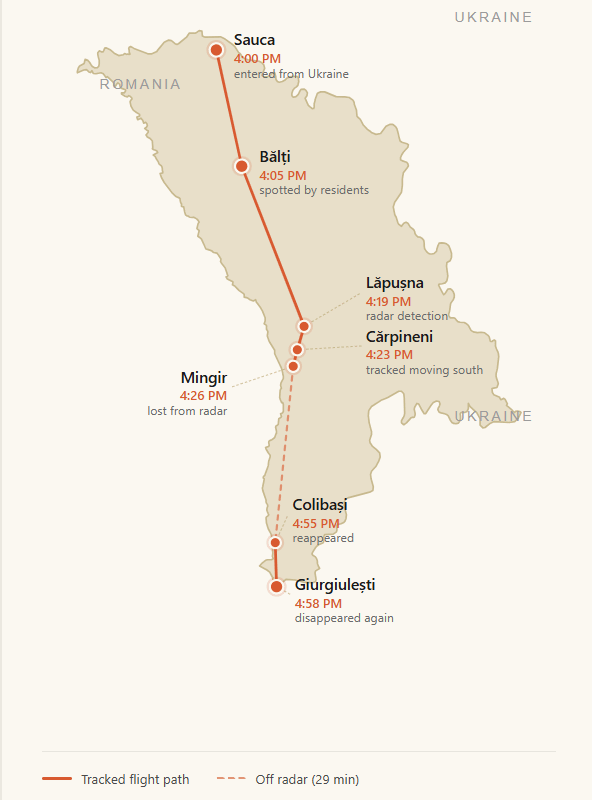
This is now the most extensively tracked and by far the longest drone flight over Moldova of the war. Video filmed from the ground appears to show a Shahed 131 / Geran-1 drone. This model is a kamikaze attack drone that is normally fitted with a warhead, not a model typically used as a decoy.
Moldova’s limited air defense constrain the country’s options for response, but we have recently seen how different countries are approaching drone incursions in very different ways. As we’ve written before, Romania has opted to observe drones and send alerts to people on the ground - but not to shoot them down. This week, a Romanian fighter jet with NATO’s Baltic Air Policing Mission shot down a Ukrainian drone that went off course over Estonia. In Lithuania, a drone entered the airspace from Belarus and headed towards Vilnius - this resulted in the evacuation of the president, prime minister and parliament to bunkers as well as widespread alerts for people to seek shelter.
This drone flight in Moldova, which passed over major population centers, has highlighted Moldova’s passive response - where the army confirms after the fact whether (or not) they detected it at all.
Putin, Russian Citizens and Transnistria
On May 14 the Russian Duma passed a bill giving Putin the right to invade foreign countries to protect Russian citizens abroad. According to the Kyiv Independent, this bill allows for military intervention “where Russian citizens face arrest, detention, trial or other perceived persecution by foreign nations and international courts.”
On May 16, Vladimir Putin signed a decree simplifying the process of obtaining Russian citizenship for residents of Transnistria. The proximity of the 2 events led to much online chatter and speculation about potential military intervention in Moldova.
Responding to the news President Sandu said that “they probably need more people to send to the war in Ukraine,” and noted that the 2022 invasion of Ukraine has led to a surge in Transnistrian residents applying for Moldovan citizenship - not Russian.
Valeriu Pasa of Watchdog wrote an excellent analysis of these events as a hybrid action utilizing reflexive control. He noted that the law in question already existed, but previously Putin would have needed approval from Russia’s Federation Council - as if they would have denied it to him. He also noted that anyone and everyone in Transnistria who wanted Russian citizenship got it long ago. The process did not need to be simplified, it was nearly universal before. Finally, Pasa noted that Putin would attack Moldova if he had the opportunity, but that…
“Moldova is protected today not because it “does not frustrate the bear”, but because the Ukrainians shed their blood so as not to let the Russians go any further.”
The purpose of these stories is therefore to create fear. Fear in Moldova of Russian attack. Fear in Armenia ahead of their elections (where this story was amplified as well), fear in Europe to dissuade countries of accepting Moldova into the EU. Russia’s “press” and troll farms amplified the story, then the Western Press spread it uncritically1. That’s reflexive control.
Other Security, Transnistria & Hybrid War News
Here’s a roundup of the other top security stories of the week:
Austria expels Russian diplomats over rooftop antennas presumed to be used for spying. Euronews reports an investigation showing a growing network of electronic installations on the roofs of Russian diplomatic posts across Europe. This mirrors a story covered by Moldova Matters in 2023 about Russia’s spies and antennas in Chisinau - proving once again that hybrid operations that are tested in Moldova, Ukraine, Armenia, Georgia and elsewhere ultimately are brought to EU countries.
Transnistria has created a “Together” Social Support Fund and is gathering donations to pay salaries and pensions and to fund social services. This was reported by Zona de Securitate who note that funds here will not only pay pensions - but also the salaries of soldiers and the security services. Sheriff Holding quickly contributed 100 million Transnistrian rubbles (around €5 million euros) to the fund. At the same time the region extended their Economic State of Emergency another month.
Mass disinformation campaign about an alleged scheme to “replace the Moldovan people” with 300,000 foreigners. The campaign alleges that Moldova plans to import these foreigners, called “uncontrolled criminals” from Asia, and give them free food and housing. It was amplified by disgraced journalist Natalia Morari as well as pro-Russian politicians like Irina Vlah and Victoria Furtuna. The “great replacement” themed campaign had a clear racial tinge as Morari and others spoke about how South Asians with large families will become the majority in only 8 years. The Russian campaign appears to have been launched opportunistically based on recent comments by Minister of Economy Eugeniu Osmochescu who stated that Moldova needs an additional 300,000 active workers in order to reach EU productivity levels. He did mention targeted immigration in these comments, but mostly focused on the need to mobilize workers from the approximately 1 million people in Moldova (largely aged 25 - 45) who are not officially employed2.
The Matryoshka network and other election interference tools tested in Moldova have been deployed against Armenia. Russian propaganda stresses that a re-election of Armenian Prime Minister Nikol Pashinyan will mean war. The campaign of interference includes operations very similar to those used in Moldova - but more of them. This campaign began 243 days before the elections and has saturated Armenia’s information space for most of the last year.
Armenia’s “fact investigation platform” fip reported details on Russia’s hybrid campaigns across Europe. fip’s reporting was based on a document dump, presumably hacked and released to them3, detailing operations within Russia’s Social Design Agency (SDA). This Orwellian sounding agency is responsible for Russia’s external propaganda and disinformation operations as well as active kinetic hybrid attacks and operates under First Deputy Chief of Staff of the Presidential Executive Office of Russia, Sergei Kiriyenko. fip’s investigation is worth reading in full as it details past and future operations against Armenia, France, Ukraine, Germany, Moldova, Finland and Norway. The report found that disinformation targeting EU countries was meant to dissuade leadership and the public at large from accepting Moldova and Ukraine into the bloc. fip wrote that “Significant efforts were made to discredit Ukrainian President Zelenskyy, Armenian Prime Minister Pashinyan, and Moldovan President Sandu.” The report also produced text messages where former Romanian MP Sebastian Ghiță negotiated with Kremlin handlers fees for information operations that his network of TV channels could conduct in order to discredit Maia Sandu and PAS. The apparent Kremlin agent is wanted in Romania on numerous corruption related charges and is currently a fugitive in Serbia.
President Sandu Awarded the “European Order of Merit”
Established in May 2025 on the 75th anniversary of the Schuman Declaration, the European Order of Merit recognizes people for their “significant contribution to European integration and the promotion of EU values.” President Sandu was picked among the first group of recipients and received the award in Strasbourg this week.
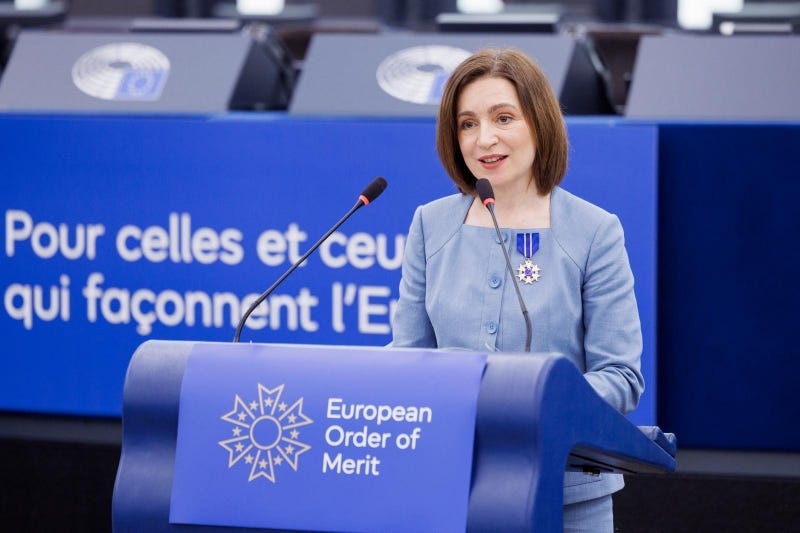
Speaking in Strasbourg, President Sandu stated:
“Thank you for the European Order of Merit. Receiving it alongside leaders who have shaped this continent, built on the idea that Europeans are stronger together, is an honor.”
But if we are to measure merit, then this distinction belongs to the people of Moldova. They are the ones who earned it. For three decades, Moldovans have built their European future, overcoming a difficult economic transition, taking to the streets when democracy was in danger, resisting when oligarchs tried to conquer the state, and voting for Europe again and again in the face of Russian threats and blackmail. This is merit.”
She went on to speak of the merit of Moldova’s civil servants, journalists, police, engineers, policymakers, entrepreneurs and judges who are leading the country’s “dramatic shift towards Europe” and fighting for the nation’s democratic resilience in the face of Russian pressure.
The European Order of Merit is given in 3 classes - Distinguished Members, Honourable Members and Members. In 2026 Volodymyr Zelenskyy and Angela Merkel were among the Distinguished Members, President Sandu was among the Honourable Members and humanitarian José Andrés among the Members.
Heckling and Standing Ovations
Cristian Rizea was removed from the hall by security after yelling “Maia Sandu is a dictator” during her speech. Except for this notable interruption, President Sandu got a standing ovation at the event.
So who is Cristian Rizea? At this event he claimed to be a Romanian journalist and apparently was accredited as such. He is not a journalist and his accreditation does not reflect well on the European Parliament. Rizea is a criminal, conspiracist and buffoonish attention seeker. He was indicted for a spectacular array of corruption offenses in Romania dating from his brief stint as an MP there. He then fled to Moldova and managed to resist extradition for some years before being expelled from the country in 2023 and placed in jail. Apparently he was let out on house arrest last summer and is back to his old games.
Back in 2021 I wrote an article explaining my editorial choices and what makes the cut for Moldova Matters and what doesn’t. I focused a whole section of that article on Rizea as an example of news that was often hilarious but not really important. The personality type that combines kleptomania with the desperate need to always be on TV is bound to create spectacle. This time he managed to actually make the cut thanks to the apparently lax security at the European Parliament.
Inconclusive Local Elections
On May 17 Taraclia and Orhei had early local elections for mayor. Both towns’ mayors were part of the Shor network and resigned in December when Ilan Shor announced that he was withdrawing his projects and candidate support in Moldova. In Orhei the Supreme Court of Justice issued a last minute ruling upholding the Central Election Commission’s (CEC)’s decision to remove PPDA candidate Victor Perțu from the ballot. The CEC had found that Perțu remained part of the Shor network and sought to camouflage this by moving to PPDA.
Neither race was conclusive and both will move to a runoff election. In Taraclia independent candidate Alexandr Borimecicov (31% first round vote) will face off against Socialist Ecaterina Iacobceac (28%). The PAS candidate came in 3rd with 15%. Leading candidate Alexandr Borimecicov has reported almost zero campaign financing - either income or expenses. At the same time he is running a number of paid facebook ad campaigns promoting his campaign promise to pay for just about every problem the city faces with unspecified external grant funding.
In Orhei, independent candidate Ramiz Ansarov (23.14% first round) will face off against Sergiu Aga (19.53%) of the League of Cities and Communes. Sergiu Aga is a Priest who is well known for blending civic and spiritual pursuits. He currently runs a “Christian Philanthropy” organization, serves as a municipal counselor and as a district counselor.
We’ll come back with updates on these elections and what the results say about how these 2 primary seats of the Shor network’s political power are (or aren’t) moving on.
Other Politics & News
Here’s a roundup of the other top political stories of the week:
Moldova hosted the 135th Ministerial Session of the Committee of Ministers of the Council of Europe. The Chisinau gathering brought together 50 delegations from member states as well as 20 foreign ministers. It marked the conclusion of Moldova’s rotating presidency of the Committee of Ministers. At the event, 34 member states, including Moldova, backed an agreement on the creation of a “Management Committee of the Special Tribunal for the Crime of Aggression against Ukraine.” President Sandu spoke at the event saying that “Russia is the most pressing and severe threat to the security of our continent today and, probably, for the coming decades.”
Scandal around a shooting at an army base in Cahul. Initial reports stated that a 20 year old contract soldier improperly handling a Glock pistol shot an 18 year old contract soldier and that a 16 year old who was visiting the 18 year old subsequently died of cardiac arrest. Later it was found that the 16 year old had also been shot with the same bullet and died of the gunshot wound. The shooter is in detention and multiple investigations have been launched. Parliament held closed door meetings on the tragedy and later announced that the soldier broke protocol by bringing the gun into a visitor area and showing it off. They also established that paramedics did not realize the 16 year old was shot because the bullet entered “through the aorta, then into the heart” in such as way as to cause minimal external bleeding. Opposition politicians have called for the Minister of Defense to resign (he won’t), though Renato Usatii has called for more concrete reforms to procedure (such as locking gun lockers when entering visitor areas). He also visited the shooter in prison and shared the story of how shattered he is.
PAS turns 10. Maia Sandu and a small team founded the PAS party on May 15 2016. On the 10th anniversary she wrote:
“10 years of resilience and action! On May 15, 2016, the PAS founding congress took place, and we had no idea then how difficult this path would be. But we were united by a strong hope that Moldova could overcome the darkness. When we founded the Action and Solidarity Party (PAS), we had a simple, yet at the time, nearly impossible, goal: to free the country from the corrupt group that had subjugated Moldova, ruled through terror, and completely isolated us from the world. We managed to do it together,”
Commander Butcher sentenced to 15 years in prison. The NYTimes reports that Neo-Nazi Michail Chkhikvishvili was sentenced to 15 years in prison for his plot to kill Jewish children in NY using poisoned candy. Recall, Michail Chkhikvishvili aka “Commander Butcher” of the Neo-Nazi terror organization the “Cult of Maniac Killers” was arrested in Chisinau in July 2024 after a joint American-Moldovan operation. The activities of his and related groups were later covered by a joint investigation of the Washington Post, Wired, Recorder (Romania) and Der Spiegel (Germany). It’s dark reading and we still have no idea why he was in Chisinau.
The IMF released updated forecasts for Moldova showing inflation and slowing growth. They now project 8.1% inflation in 2026 and economic growth slowing to 1.5% of GDP. Their final calculations for 2025 showed 7.8% inflation and 2.4% growth. The IMF notes that the downturn of indicators is completely due to the war in Iran and that the situation could become worse depending on how long the crisis carries on.
Ending on a High Note
Literally a high note since we’re talking about Eurovision! Moldova’s Satoshi placed 8th in the Grand Final and was praised for a fun and upbeat song and performance.
Unfortunately, the whole affair landed with a fairly mixed note in Moldova. While the public vote in Moldova awarded the most points to Romania, the national jury gave top points to Poland and Israel. They only gave 3 points to Romania and 0 to Ukraine.
This situation has created a HUGE scandal in Moldova. Former government spokesman Daniel Vodă explained saying that “the jury from the Republic of Moldova seemed not to understand that Eurovision is also a geopolitical contest, not just a musical one.” He went on to explain the scandal saying:
“The problem is that the jury results appear first. And the initial impression was an unfair one: that the Republic of Moldova had turned its back on Romania. That is false. The public voted for Romania. The public saved its honor ,”
Traditionally neighboring countries often support each other and both Romania and Ukraine gave high points to Moldova from their juries. The Romanian Embassy was forced to respond noting no serious damage to diplomatic relations because the “audience’s sincere support speaks louder than any assessment [jury score].”
The scandal did not stay contained online as PAS MP Dinu Plângău called for the resignation of the management of Teleradio-Moldova. The state company did not itself control the jury votes but did organize the jury. Shortly after sitting MPs joined the online calls, Vlad Ţurcanu, CEO of Teleradio-Moldova, resigned. In a statement he noted that his team did not control the jury decision but that he took responsibility as the director of the organization.
Eurovision is no stranger to political controversy, but this is an unusual level of mess. The whole thing made it into the NYTimes as an example of how politics has consumed a song contest. So Moldova looks bad here on both ends - through the “scandal” of the jury vote itself and through the fairly hysterical reaction.
Oh well, the song was fun. Congrats to Bulgaria for their first Eurovision win!!
Even more than the bad reporting, I really hate when they write that there are 470,000+ people in Transnistria. It’s just very very sloppy work.
“Officially” is doing a lot of heavy lifting here. Many of these people work seasonally in agriculture or doing construction in Europe and sending money back. Formalizing their employment would help gather more taxes, and would help these workers build credit and access the financial system more fully. But it would not necessarily change the labor market so dramatically as they are already participating. It’s also worth remembering that many are working unofficially because there is no legal way for them to work officially. I’ve written about this before - specifically how the lack of a legal basis for plumbers to work does not preclude toilets from clogging or people taking money to fix them.
We don’t know who did this, but the repeated penetrations of the Shor network likely indicate a state level intervention.
Eurovision...
I'm still not clear on the nature of the scandal - I can see the difference in votes would be controversial, but is there any suggestion of malign influence? For example, any evidence that the jury vote was nobbled by a pro-Russian operation?