

Hello and welcome back to Moldova Matters! I’m back after some vacation and travel and it’s time to get caught up. Last week I sent a short update detailing Moldova’s commemoration of 35 years of independence. This week, we’ll lead with alarming updates in Russia’s new campaign to intimidate Moldova with drones. Then we’ll do a roundup of the other important stories of the last 2 weeks. Summer’s over and while there was hardly a break from major stories in Moldova, the start of September is typically the time everyone gets back to work and the pace of news escalates again. If you aren’t already, please consider subscribing to Moldova Matters. It’s only $8 / month and goes a long way to supporting the work that goes into this newsletter.
Moldovan Border Hit with Drone Attack
Last night Russian drones attacked and struck the Tudora-Starokazache border crossing point with Ukraine. An alert at 11:35 pm triggered the evacuation of the border crossing and Moldovan border police reported hearing explosions around 5 minutes later.
**Correction: An earlier version of this article stated that the Tudora-Starokazache is jointly operated. That is incorrect and the Moldovan side is separated from the Ukrainian crossing by around 1 km. The nearby Palanca crossing is jointly operated with Moldovan and Ukrainian officials working under 1 roof.
Of 3 drones apparently targeting the checkpoint, one struck it while 2 more crashed nearby. The Ukrainian authorities report 2 Ukrainian civilians were killed and 2 more people injured, one of whom was a Moldovan bus driver. He was returning with an empty bus after transporting Hasidic pilgrims to the Ukrainian city of Uman ahead of Rosh Hashanah. His injuries were light and he returned home that evening.


Prime Minister Tofan noted at a government meeting that the 2 civilians killed at the border needed to be identified via forensic analysis because the bodies were unidentifiable. Moldova’s Ministry of Foreign Affairs condemned the incidents while also conveying “sincere condolences to the families of the deceased and a speedy recovery to the injured.”
This is now the 3rd recent incident where a drone strike was apparently directly targeting Moldovan - Ukrainian border crossing infrastructure.
7 Planes Diverted in Drone Incident
On the same day, September 8, the Moldovan Army detected a drone entering the country’s airspace at 4:20 pm. The turbojet-powered “missile drone” initially headed towards Chisinau before skirting the city to the north and then crossing into Romania after flying over a town near Ungheni. The drone then returned to Moldova from the direction of Iași and headed north before crashing and exploding in a field near the town of Mihăilenii Vechi, Rîșcani.
Observers compared it to a Shahed-type drone and police confirmed it used a turbojet engine, likely making this a newer Geran-4 or similar. During the incident, Moldovan airspace was temporarily restricted and 7 planes were diverted. 3 were held on the ground at Chisinau’s Eugen Doga International Airport, 3 were diverted to holding patterns in the air, and one diverted to Iași for an unscheduled landing, apparently by the decision of the captain.
The Institute for the Study of War (ISW) analyzed this incident in the context of Russia testing Moldova’s air defense capability and NATO’s eastern defense posture. They mapped out the drone flight with the timeline clearly showing how much more quickly the situation unfolds with jet-powered drones.
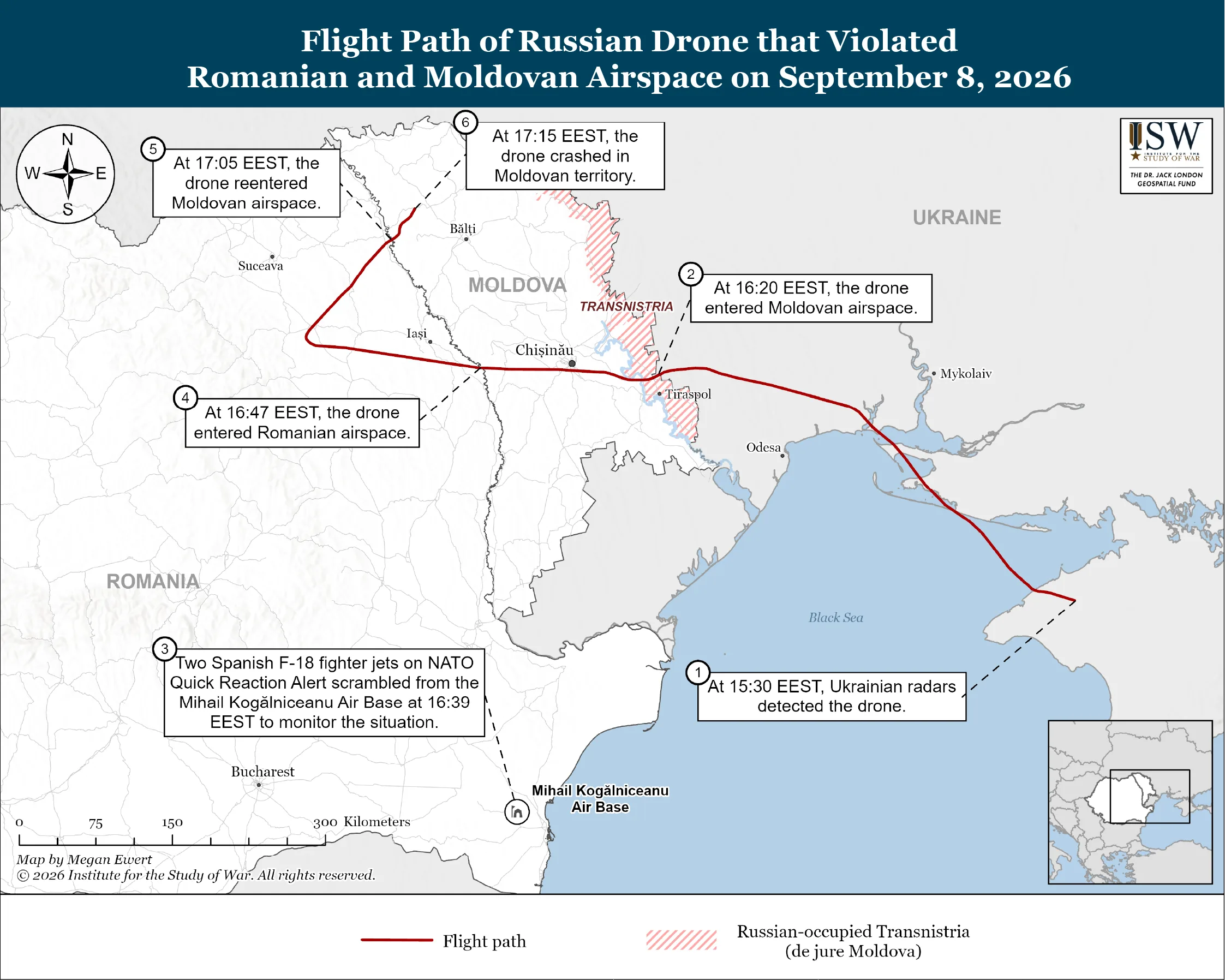
These incidents are part of a clearly escalating series of airspace incursions that show signs of being deliberate. Since the last weekly roundup, which itself led with a section called “Lots of Drones This Week,” there was a drone incursion and separate crash in Romania near the border on August 24, 5 drone incursions to mark Moldovan independence day on August 27 and a drone incursion on August 30.
Taken together, there were 17 airspace incursions in August alone, more than in the entirety of 2025.
Other Security News
Here’s a roundup of the other top security stories of the past weeks:
Moldova’s Deputy Prime Minister for Reintegration has begun what he promises will be regular direct addresses to Transnistrian residents. In a video message, Deputy PM Valeriu Chiveri spoke in Russian to the region’s residents calling reintegration “a process that can no longer be stopped.” He stated that the government feels it is essential to regularly inform them about steps being taken and to dispel false narratives being spread by their “leaders.”
Russia will illegally open 16 polling stations in Transnistria for the upcoming Duma elections. They will also open 1 polling station in Chisinau at the Russian embassy. No polling stations in Transnistria were authorized by the Moldovan government, leading to a formal diplomatic protest.
The Moldovan authorities arrested a 49 year old Azerbaijani man under charges of spying for Russia. They allege that the man was gathering photos and information about military targets in Moldova, as well as American facilities in the country, and forwarding them to his handlers in the FSB. They also allege that he was preparing for acts of sabotage against installations in Moldova and Ukraine.
Russia’s FSB announced the arrest of a Moldovan citizen who attempted to assassinate a Russian general. They showed video of 21 year old Nicolae Cociu, allegedly confessing to being recruited by the Ukrainian security services to conduct the assassination in exchange for $70,000. Separate reports indicate that the target was Major General Nikolai Varpakhovich who was shot 6 times in a village outside of Engels but survived. He was responsible for organizing and ordering the air attack on a children’s hospital in Kyiv in July 2024 that killed 2 and injured 32. Moldova’s Ministry of Foreign Affairs stated that they have heard no official communication from Russia on the incident.
International Affairs & EU Integration
Here’s a roundup of the top international affairs and European Integration stories of the week:
European Commissioner for Enlargement Marta Kos stated that Moldova and Ukraine have met the conditions to open all negotiating clusters. She noted that once again progress is being blocked by Hungary, but expressed hope that the remaining clusters could be opened by the end of the year.
American diplomat Christopher Smith is the new head of the OSCE mission to Moldova. He is a career diplomat who previously served as the Deputy Assistant Secretary of State in the Bureau of European and Eurasian Affairs, and before that as the Deputy Chief of Mission at US Embassy Kyiv from 2022-2023. On arrival, Ambassador Smith met with President Sandu and Prime Minister Tofan to discuss the security situation and Transnistria.
Moldova abstained in the recent UN vote on right-sizing the world’s maps1. The proposal would replace the Mercator projection with the Equal Earth projection, which more accurately shows the size of land masses in relation to each other. The vote was supported by 164 countries and opposed only by the United States2. Moldova was one of 6 countries that abstained, joining Lithuania, Estonia and Ukraine in protest against the reference map showing Crimea as a separate entity. Georgia also abstained without giving a reason and Serbia abstained in protest of the map showing Kosovo.

Tax Reform Moves to Parliament
On September 8 the government voted to approve a proposed tax reform bill and will send it to parliament for consideration. This bill incorporates amendments to the original bill that was presented on August 6. The new proposal marks a substantially more conservative bill than the one that made waves over the summer3, but will still substantially reshape the country’s system of taxation. It estimates 5.1 billion lei4 in new revenue, with 820 million coming from income tax, 1.6 billion from VAT and 2.7 billion from excise duties. Most provisions will come into effect on January 1, 2027 with the exception of VAT duties on parcels which will come into effect on October 1.
While the summer’s reform attempted to move most VAT categories to a standard 20%, this bill takes a far more moderate approach. Restaurants and HORECA will go from 8% to 12% and most socially necessary food products will remain at 8%. Energy will not change until April of 2027 and the current tax rates will remain for the first 100 kW of electricity and 150 cubic meters of natural gas used by a household. After that, rates will go up to 20%. Plans around dividends and reinvested profits will remain, with new provisions designed to encourage investment in the business sector.
The government backtracked on a plan to increase the VAT on feminine hygiene products from 8% to 20%, with Prime Minister Tofan saying:
“It was a wrong decision. We are correcting it, as Minister Belous announced. Hygiene products will remain at the reduced VAT rate. Thank you to everyone who drew attention to this issue. Governance also means promptly recognizing when a decision is not good and fixing things.”
The majority of the increases though are from “sin taxes,” with new excise taxes on non-alcoholic sugary drinks, energy drinks and fireworks. Excise taxes on tobacco will increase by 20% in 2027 and then 15% in both 2028 and 2029.
We’ll continue to watch this bill as it moves to parliament and is debated there.
Other Political Updates
Here’s a roundup of the other top political stories of the last 2 weeks:
Gagauzia votes on November 15. Moldova’s Central Election Commission (CEC) has determined that elections for both the People’s Assembly and Bashkan will be held on that date. Once the People’s Assembly declared the Bashkan’s seat as vacant on August 17 that triggered a legal ticking clock that required elections to be set. The People’s Assembly then failed multiple times to set a date, which triggered legislation forcing the CEC to intervene and set the date. Thus, after almost a year of impasse the autonomy has an election scheduled.
Alexandr Stoianoglo announced that he will run for Bashkan as an independent. The former Socialist-backed presidential candidate stated that he will suspend his activity as an MP during the campaign and plans to present a full program of governance at a later date. Stoianoglo got 97.4% of the votes in the autonomy during the second round of the 2024 presidential elections. This election will be the first where the Bashkan is required to speak Romanian, which is not an issue for Stoianoglo but may limit the field otherwise.
Moldova marked Romanian language day on August 31. This year marked 37 years since the Supreme Soviet of the MSSR established Romanian as the state language and returned the Latin script. It was marked by the Great National Dictation as well as speeches on the importance of language and history. President Sandu stated:
“Our parents and grandparents continued to speak it even in the most difficult times, despite prohibitions and humiliations. Thanks to them, the Romanian language has survived on this piece of land.
Today we can speak it freely, without fear. Even more so, we have a duty to take care of it. And, above all, to transmit to our children the love for the Romanian language, just as we received it from those before us. Let us leave them this precious legacy: a living language, spoken beautifully, in which to tell their stories, sing their doinas and express their longing.
Happy birthday, Romanian language!”
Prime Minister Tofan announced a government reshuffle. Eugeniu Osmochescu was moved from the office of Deputy Prime Minister of Economic Development and Digitization5 to the role of Minister of Agriculture. In his place, Claudiu Năsui became the new Minister of Economy. Minister Năsui is Romanian and had been serving as a Romanian MP with the Party USR. He was formerly Romania’s Minister of Economy from 2020-2021. He had never been to Moldova before being invited to be a minister, and was made a citizen by President Sandu on August 25. Like Vasile Tofan, Năsui is a well-known admirer of Javier Milei and is committed to liberal reforms aimed at shrinking the size of the state.
Mayor Ceban is working remotely and plans to see the city from a new perspective. He explained that while he recovers from surgery, he is attending meetings online, but that he will soon be getting out and about in a wheelchair and evaluating the city from the perspective of mobility issues. He has continued to dodge questions about how he broke both of his feet.
Parliament has extended by 30 days the Commission of Inquiry looking into the management of state-owned companies. Commission Chair Dinu Plîngău called the situation with these companies “serious” and explained that more time is needed to understand the full situation and come up with proposals. He noted that it isn’t even clear how many companies the state owns, with records for 1359 registered since independence, but mixed records now. The State Register of Legal Entities lists 515, but of those 323 have no IDNO6. Meanwhile, the Public Property Register lists 163 companies while the State Fiscal Register lists 609. Plîngău has stated that they are focusing on the risk that board seats on these companies have turned into compensation tools rather than real management bodies.
Parliament passed the Restart in Education reform in the second reading. The reform moves primary and secondary schools under the direct control of the Ministry of Education via the newly established Territorial Education Agencies. The plan is to establish national norms and standards and to centrally control funding so that rural schools don’t get left behind. The changes will come into effect on January 1, 2027.
Prime Minister Tofan swam the Bosphorus with his son. He had previously said that while he was skipping August vacation to work, he needed to keep his promise to his son and swim alongside him. Tofan explained that his 14 year old son swam faster than him and that he is returning to Chisinau "with his batteries charged and his heart full."

Quite literally
The United States claimed that the map pushed an “ideological agenda” and distracted from America’s very obvious goal of solving “genuine problems of international peace, prosperity or good relations."
And very likely helped collapse the government.
This would reduce the deficit, as calculated for 2025, by 32%.
I usually just write “Minister of Economy” here but the title is bigger.
This is the organization’s identifying number. Without it literally nothing is possible so either these companies functionally don’t exist or something much more confusing is going on.
"Moldova’s Deputy Prime Minister for Reintegration has begun what he promises will be regular direct addresses to Transnistrian residents."
"Russia will illegally open 16 polling stations in Transnistria for the upcoming Duma elections."
Other than the polling stations and the shenanigans with Russian passports, is the Russian Federation taking any concrete steps to prop up the Transnistrian regime or halt the process of convergence? Is Gazprom gas still absent from Moldova?