

Like most of the world, Moldovans this week have been focused on the unfolding war in Iran and its regional spillover. Minister of Foriegn Affairs Mihai Popșoi called for restraint and condemned Iran’s attacks against its neighbors. Many Moldovans live and work in the UAE and other parts of the region and over 100 have requested help evacuating, though none have been injured or killed to date. While the world watches Iran, we had an eventful week in Moldova so here’s our roundup.
34 Years Since the Transnistrian War
On March 2nd Moldova marks the Day of Memory and Gratitude commemorating those who died in the Transnistrian war. It’s not definitively known how many people died in the 4 months of war from March to July 1992, but estimates suggest 300 combatants and 400 civilians from the right bank1, and around 800 total from the left bank.
On the occasion President Sandu, Prime Minister Munteanu and Speaker of Parliament Grosu laid flowers at the statue of Stefan Cel Mare and then participated in the March of Remembrance through central Chisinau to the war memorial. There, they laid flowers at the statue “Mourning Mother” and President Sandu spoke to honor the sacrifice of the fallen and all veterans saying “The commemoration of the heroes of the war on the Dniester reminds us that freedom is not a given. It must be protected.”
She spoke of Moldova’s struggle for freedom and for the right of people to speak their own language and have their own traditions. Then, the President connected the events of 34 years ago with the present saying:
“We need to call things by their proper names.
In war, the aggressor is the one who attacks.
In 1992, the aggressor was Russia.
Today, in Ukraine, the aggressor is Russia.
To say that “both sides are guilty” is to falsify the truth. Moral neutrality in the face of aggression is not only cowardice, but also a lie. And solidarity between peoples who have experienced aggression is a duty.
The Republic of Moldova did not covet foreign territories. It did not start wars. It only defended its ancestral land.
And even today, the aggression against our country has not disappeared. Only the methods have changed.
If in 1992 aggression came with tanks, today it comes through propaganda, manipulation and disinformation. We are living a true cognitive war — a war that targets memory and identity. A war that tries to relativize responsibility, to confuse the aggressor with the victim.
Therefore, the defense of memory must be part of national defense.
Because the Day of Remembrance and Gratitude is not just about the past. It is also about the future. It is about the values that define us. It is about our attachment to freedom, democracy and peace. It is about our natural place in the family of European states that value human dignity and the common good.
Knowledge of history and the sacrifices of ancestors is a condition for a strong state. Without memory, there is no identity. Without identity, there is no resilience. Without resilience, there is no security.”


Moldova Increases Pressure on Transnistria
On February 25th President Sandu signed a decree withdrawing the citizenship of 9 persons in Transnistria. This was done under Article 22(1)(c) of the Moldovan Constitution and the only official reason given was a referral from the Security and Intelligence Service (SIS). President Sandu’s National Security Advisor Stanislav Secrieru explained the move saying:
"The withdrawal of citizenship of the Republic of Moldova is a form of sanction for exercising functions within unconstitutional structures on the left bank of the Nistru River, for continuous actions to undermine the sovereignty and territorial integrity of the state, as well as for serious violations of the rights of citizens of the Republic of Moldova. These acts were committed in the interests of a foreign state that violates the neutrality of our country and is waging a war of aggression against the neighboring state of Ukraine."
All 9 persons named hold, or have held, senior leadership roles in Transnistria and at least 2 fought for the separatists during the war. Some were deputies in the “Supreme Soviet,” others were responsible for falsifying their elections as members of their “Central Election Commission” and others were members of the region’s security services and have been accused of human rights abuses.
Article 22(1)(c) allows for the withdrawal of citizenship in cases where a person commits acts deemed "exceptionally grave" that cause harm to the country’s sovereignty, territorial integrity, or national security. It has been used in recent years to strip citizenship of Moldovans who voluntarily fight in the Russian army in Ukraine. Previously, it was illegal in Moldova to strip citizenship from someone if the act would result in them becoming stateless. A carveout to this condition was introduced in December 2025 amendments to the citizenship law that allows citizenship to still be withdrawn for certain very serious acts.
It is unclear if the 9 persons in question also have Russian citizenship, or if they are left only with the universally unrecognized “Transnistrian citizenship.”
Moldova is Creating a Convergence Fund
The next day, PAS MPs proposed a bill to gradually remove tax exemptions for Transnistrian companies. The bill would initially target “socially non-essential” products such as alcohol, but would gradually expand. Chairman of the Economy, Budget and Finance Committee, Radu Marian, explained that the region now largely imports products via companies registered in Moldova. He estimated that equalizing the taxes for these companies would bring the state 3.3 billion lei (~€164 million euro) in additional revenue.
Starting on August 1st, 2026 this money would be directed into a “Convergence Fund” that will be used to fund the increased expansion of public services to Moldovan residents in the Transnistria region. Due to the region’s economic crisis, 2025 saw a 40% increase in social spending by the government in support of Transnistrian residents.
This week that economic crisis deepened as the Transnistrian “authorities” announced that from March 1st through December 31st the salaries of state employees will be paid in 2 installments2. They claim that this is a temporary measure.
1+1 Talks Resume
On February 26th Deputy Prime Minister for Reintegration Valeriu Chiveri met with Transnistrian “Foreign Minister” Vitali Ignatiev for the first 1+1 meeting in 10 months. The meeting was held under the OSCE mission framework.
Zona de Securitate journalist Irina Tabaranu explained that Chisinau’s message was blunt, if diplomatic. Deputy PM Chiveri explained the creation of the Convergence Fund as a mechanism for gathering internal and external financing to support reintegration. He also spoke of plans to expand social services including pilot programs to expand emergency 1123 coverage.
Additionally, Deputy PM Chiveri delivered Chisinau’s standard demands about allowing Romanian education, access for journalists and civic activists, free movement of people and farmers, etc.
New Details in Foiled Assassination Plot
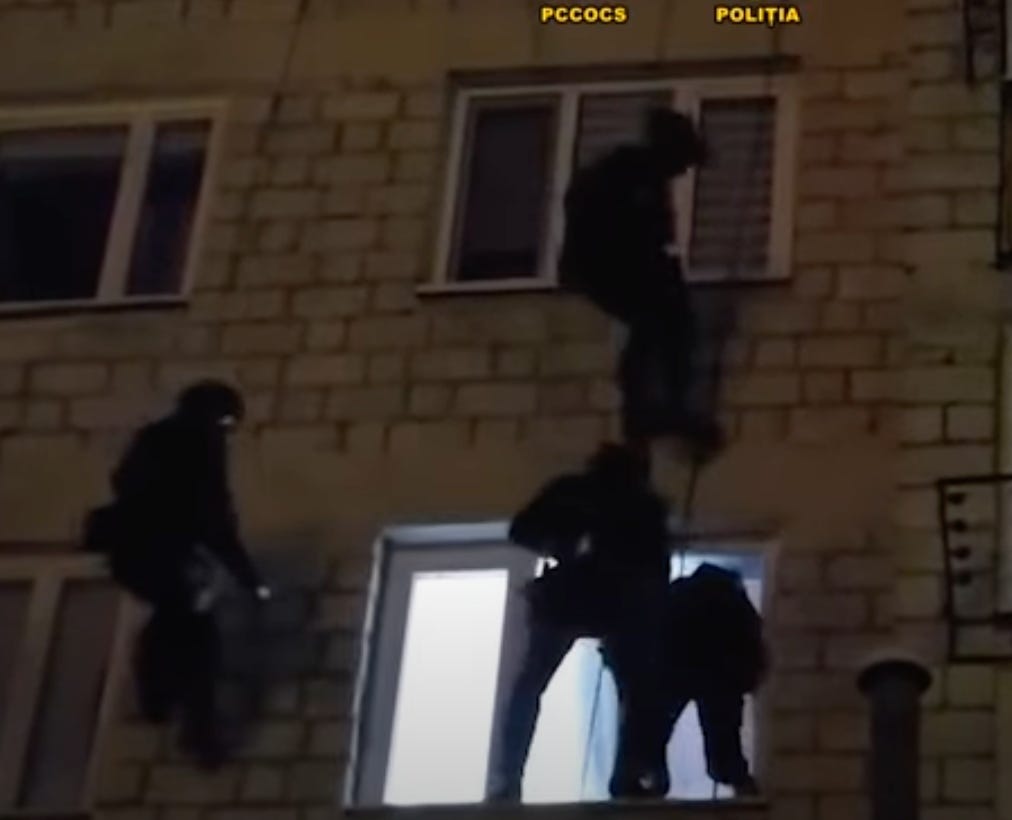
Last week we got the first details in a story about how Moldovan and Ukrainian security services foiled an assassination plot against public figures in Ukraine. We now know that the 2 countries detained 12 people in connection with this plot which was orchestrated by Russian intelligence. Searches in the case were conducted in Chisinau, Kyiv and Odesa.
The organizer of the scheme along with 2 accomplices was detained in Moldova. Police report that he is a 34 year old Moldovan citizen who was recruited by the Russian security services while serving in a Russian prison. The Ukrainian authorities stated:
“After returning to Moldova, he supported pro-Russian groups whose activities were aimed at destabilizing the country and organizing mass protests in 2022-2023,
It has been established that the group planned to kill at least five Ukrainian government officials. These murders were intended to cause significant public outcry. The aggressor state intended to use this to destabilize the situation in Ukraine,”
This network recruited contract killers to travel to Ukraine and map out the habits and movements of a set of target individuals that included high ranking military personnel, leaders of state enterprises, Russian dissidents and at least one journalist who was reported to be Dmitry Gordon. The killers were to be paid up to $100,000 per kill depending on their seniority. Ukraine’s SBU released photos showing that at least one person detained there had an ID card from PGTRK (First Transnistrian) television channel, indicating that the individual was a Transnistrian “journalist.”
Nicolae Șepeli
This is the name of one of the men detained in Moldova and based on available information likely the organizer of the plot. Șepeli was sentenced to 11 years in prison back in November 2017 in Russia for attempted drug trafficking on a large scale. He was subsequently transferred to Moldova to finish serving out his sentence in a process that started in 2018 under the government of Prime Minister Pavel Filip.
In April 2022 President Sandu released him from prison on a probationary pardon. The fact that he subsequently went on to play an active role in the Shor network (fined for electoral corruption in December 2025) and then this scheme has drawn a huge amount of scrutiny towards the pardon process. As we wrote last week President Sandu revoked his pardon the day before he was detained.
Investigative journalists including those at ZdG have done extremely detailed reporting on this pardon process and mapped out the entire multi-year cycle. The entire story is too long to include in this newsletter but interested readers should visit the above link if they want all the details. In short, the sentence transfer process from Russia was standard and following it former Prosecutor General Alexandr Stoianoglo added Nicolae Șepeli’s to a list of people to consider for a pardon. The prosecutor’s office continued this after Stoianoglo was removed from office. The rationale was that a group of people from Moldova including Șepeli had been fraudulently brought to Russia on the promise of work as couriers and did not realize that they would be forced into trafficking illegal drugs (they were told it was be supplements).
The pardon recommendation was made with the support of human rights and anti-trafficking NGOs and was contingent on the Russian court also not knowing the circumstance at the time of original conviction. Of those recommended for a pardon Nicolae Șepeli was the only one accepted because he had no prior criminal record, served the majority of his sentence4 with a good behavior record and had a family willing to support him during his probation and reintegration.
As of the time of writing, no wrongdoing has been found or alleged at any stage of this process which involved officials appointed by all Moldova’s major political parties at one stage or another.
We’ll update in future editions if there is more information about the pardon process or about the operation to dismantle the contract killer network.
Politics
Here’s a roundup of the top political stories of the week:
New IMAS poll shows dissatisfaction with the Munteanu government. Respondents were asked to rank the new government’s performance on a 1-10 scale with 10 being the best. 39% gave a grade of 1-4, 25% a grade of 5-6, 18% a grade of 7-8 and only 7% a grade of 9-10. 61% of respondents said that the Munteanu government has brought no changes, 17% said changes for the better, 14% change for the worse and 8% don’t know / no response.
Vasile Tarlev’s Future of Moldova Party loses state funding starting in February. Prior investigations by the Central Election Commission (CEC) showed major financial violations in the 2024 presidential campaign and the party owes 587,500 lei to the state budget. The party does not have this money and has requested that their state funding be diverted to pay this debt which is now happening.
Chisinau city hall has allocated 70 million lei for park & ride commuter lots. The new parking lots will be located in Ciocani, Buicani and Riscani and will allow commuters to drop their cars and proceed into the city on public transit. Explaining the move, the city noted that Chisinau is designed for 90,000 vehicles and currently has more than 400,000 vehicles registered in the city alone (not counting commuters).
Crime, Corruption & Justice Reform
Here are the week’s top stories in crime and justice:
Plahotniuc’s court hearings on the “bank fraud5” case wrapped up the judicial investigation phase on February 26th. The court will reconvene on March 20th for closing arguments and then proceed to a verdict. In the last phase of the evidentiary trial the court heard testimony from a secret (anonymous) witness from inside Plahotniuc’s alleged criminal organization. This witness explained how the oligarch hired a Romanian consultant named Bogdan-Andrei Gheorghiu to build a web of shell companies collectively called UNIASIA HOLDINGS and how between 2013 and 2015 approximately $35 million dollar was transferred into this network. In 2016 Bogdan-Andrei Gheorghiu was arrested by the Romanian authorities but Plahotniuc got him out and arranged a fake Moldovan citizenship for him under the name Andrei Munteanu. The witness described the movements of 10s of millions of euros through the UNIASIA network and how Bogdan-Andrei Gheorghiu betrayed Plahotniuc and took control of these companies himself when the oligarch fled Moldova in 2019. The witness additionally explained complex schemes by which Plahotniuc acquired and maintained a €32 million euro yacht, a €40 million euro hotel in Spain a plane and more.
Hassan Toper released and then re-arrested. Toper is alleged to be an accomplice to pre-meditated murder in the Summer 2024 “scoot by shooting” in Chisinau and was extradited from the UK to Moldova to stand trial. The court released him on house arrest over prosecutors objections creating a political scandal with MP Renato Usatii declaring “Long live reforms in the judicial system!” After 6 days of prosecutors appeals he was re-arrested.
Major searches in a case involving the embezzlement of EU funds. Anti-corruption police (CNA) conducted searches in Causeni, Singerei, Soroca, Soldanesti, Edinet, Taraclia, Straseni, Glodeni and Chisinau targeting local public authorities, the “National Office for Regional and Local Development” and a company in Chisinau. 5 people were detained. The case involves contractor(s) offering kickbacks in exchange for winning road and sewage system construction tenders. The contractors would later bribe inspectors and engineers to get their shoddy work accepted. In one phone intercept, conspirators discussed cutting the material deliveries in half and laying 6-8 cm of asphalt instead of the required 10. Works were financed through the “European Village” program supported by the National Office for Regional and Local Development with “national and foreign” infrastructure funds.
CNA searches in a second case of “embezzlement of foreign assets” targeted the Moldsilva Agency. The forestry agency was implementing a project called the “National Forest Expansion and Rehabilitation Program.” The CNA alleges fictional employee contracts totaling more than 4 million lei and the use of public funds for private purchase by Moldsilva employees. Environment Minister Gheorghe Hadjder announced the subsequent firings of the section heads of Moldsilva in Chisinau, Ghidighici, Vadul lui Voda, and Criuleni as well as many lower level employees. He said that firings will be followed by prosecutions. Explaining the origin of the case the Minister stated:
“Following inspections at the Ghidighici and Criuleni forestry units, where over 1,000 trees were illegally felled, we ordered internal audits at all forestry enterprises. As a result, inspectors recorded numerous violations. And it’s not just illegal logging; there are also unaccounted surpluses, unjustified expenses, and work that’s just on paper. We will not tolerate corruption, which is why dismissals and sanctions have followed,”
Economics and Infrastructure
Here’s a roundup of the top economics stories of the week:
The US Supreme Court decision brings Moldova’s tariff rate down to 10%6. This is a major reduction from the “Liberation Day” rate of 25%. The Moldovan government is monitoring how the US implements these changes and notes that the new legal justification for the tariffs is (theoretically) temporary and expires in 150 days. In 2025 Moldova’s trade with the US grew 8.6% to $244.9 million dollars with the vast majority of Moldova’s exports the the US being wine (62%).
PAS MPs have introduced a bill in parliament to mandate the labeling of the country of origin for products in the supermarket. The current law mandates that this information be public, but it is often hidden in the fine print. The new law would require the country to be listed on the price tag, which could include a flag, so that shoppers can easily opt for local products. Chairman of the Economy, Budget and Finance Committee, Radu Marian believes that this initiative can increase sales of local products by 5-15% and said that “It is an initiative through which we want to transform a simple act - daily shopping - into an engine supporting the national economy.”
Right bank = territory controlled by the constitutional authorities in Chisinau, Left bank = separatist controlled Transnistria
In Moldova salaries are usually paid on the first of the month, so for February the salary would be paid March 1st. Splitting salaries means that employees will get 1/2 their salary on March 1st and 1/2 on the 15th. Effectively they are giving their employers an interest free loan.
911 for Americans
It had previously been reduced by 4 years on an unrelated appeal
This case deals with his alleged role in the Theft of the Billion bank fraud
Probably… Trump later announced 15% but never implemented that. We’ll see…